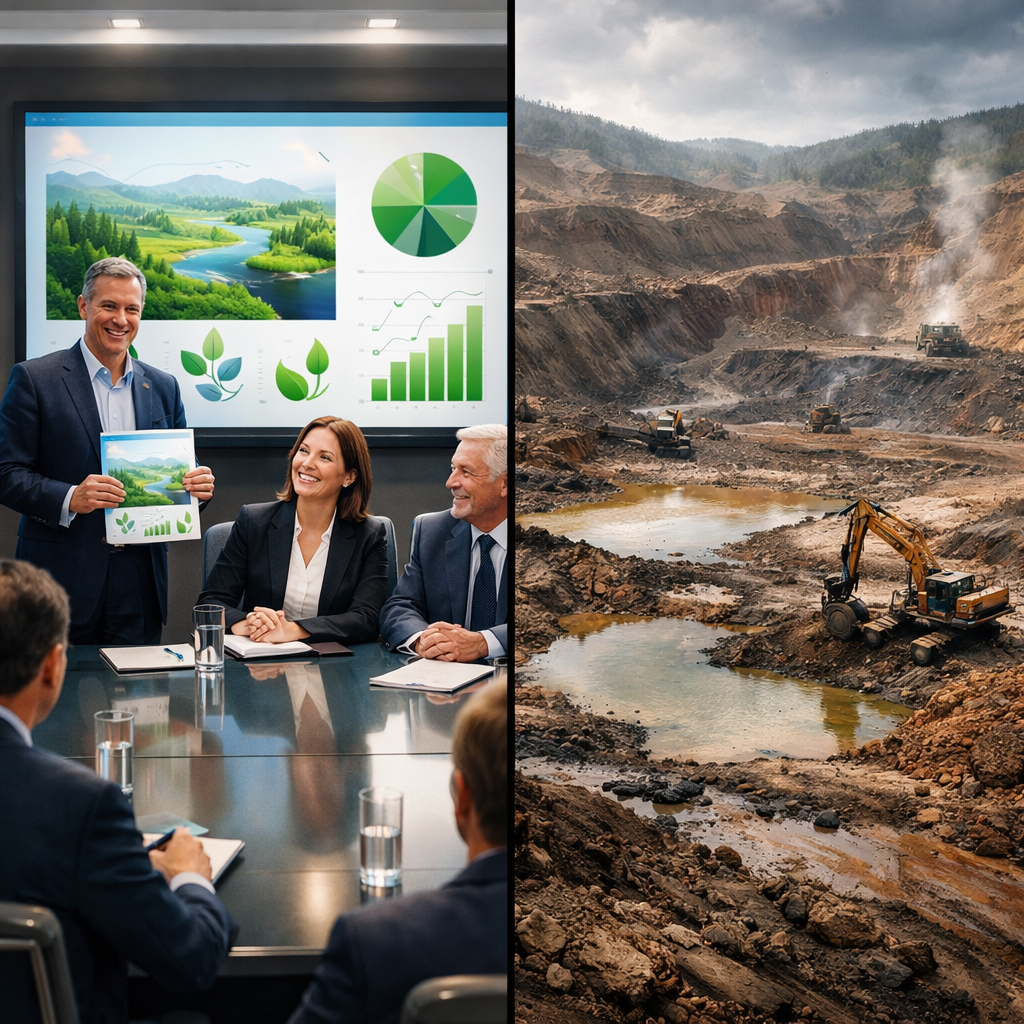
Environmental impact assessments (EIA) and their respective geological reports are already established gatekeeping tools for mining managers, professionals, and students. A large and growing body of scientific literature suggests that EIAs function more as perfunctory exercises rather than scientific evaluations. Understanding these criticisms is critical for an industry that must prove itself in terms of substantive environmental stewardship.
The pervasive problem of superficial analysis
A seminal international study by [1] analyzed EIA reports from seven nations, which included Canada, the United States, and Australia. The results were revealing: the reports uniformly stated that there would be “few to no significant environmental impacts,” although there was considerable variation in the scope of projects across nations [1].
The authors of the study also noted several methodological problems in the EIA reports. For example, there was often an inadequate consideration of scales in spatial and temporal terms, especially in relation to the long-term consequences of mining on water resources, in which precautionary scales were not employed [1]. Additionally, cumulative impacts were seldom considered in EIA reports [1].
From the perspective of practitioners, the study reveals that many EIA reports do not fully consider the dimensionality of environmental risk.
The mitigation paradox and opaque decision-making
The most worrisome aspect was in relation to mitigation measures. In their study, the source [1] found that there was a constant characterization of all mitigation measures as effective without clear justification [1]. In some cases, it was not clear if there was a plan to implement mitigation measures at all [1].
The problem is compounded by the aspect of “significance.” In all the reports sampled, it was clear that professional judgment was used to determine significance by consultants, yet there was a lack of transparency as to their reasoning and a lack of stakeholder input.
Real-world consequences: the minas conga case
The gap between claimed findings in official reports and actual conditions on the ground is exemplified in Peru’s proposed gold mining project in Minas Conga. In “How Environmental Assessment Failed in Peru’s Minas Conga Gold Mining Project,” [2] discussed how the 2010 environmental impact assessment (EIA) that claimed “no significant impacts” contradicted the complex hydrology of headwater lakes and wetlands in a region already subject to effects of climate change. The controversy that arose over this project resulted in a political crisis that indefinitely halted the project.
Toward scientific credibility
To address these deficiencies, significant changes in practice are required. The literature suggests that the implementation of more rigorous methodologies and the empowerment of regulators to require their use are essential steps.
There are signs of emerging guidance that suggest integration is the direction that is being pursued. The research suggests that integration of hydrological, geochemical, and isotopic approaches throughout the life of the mine, from planning to closure, can lead to a more robust assessment of the impacts associated with water [3]. These approaches go beyond simple checklist compliance and instead seek to obtain process understanding.
To the mining professional, the message is clear: the environmental geology report needs to move from its current state as a necessary evil to being a credible scientific tool. This requires that we move away from performativity and instead focus on substantive analysis, where results are driven by what is real, not what is convenient.
References
[1] G. G. Singh et al., “Scientific shortcomings in environmental impact statements internationally,” People and Nature, vol. 2, no. 2, pp. 369–379, Jun. 2020, doi: 10.1002/pan3.10081.
[2] T. J. Downs, A. C. Roa, K. C. Dixon, P. Duff, E. Pasay, and H. Silverfine, “The Case for Integrative Sustainable Development Practice Based on the Minas Conga Gold-Mining Experience in Peru,” Journal of Geoscience and Environment Protection, vol. 8, no. 5, pp. 17–40, May 2020, doi: 10.4236/gep.2020.85002.
[3] C. Wolkersdorfer et al., “Guidance for the Integrated Use of Hydrological, Geochemical, and Isotopic Tools in Mining Operations,” Mine Water Environ, vol. 39, no. 2, pp. 204–228, Jun. 2020, doi: 10.1007/s10230-020-00666-x.