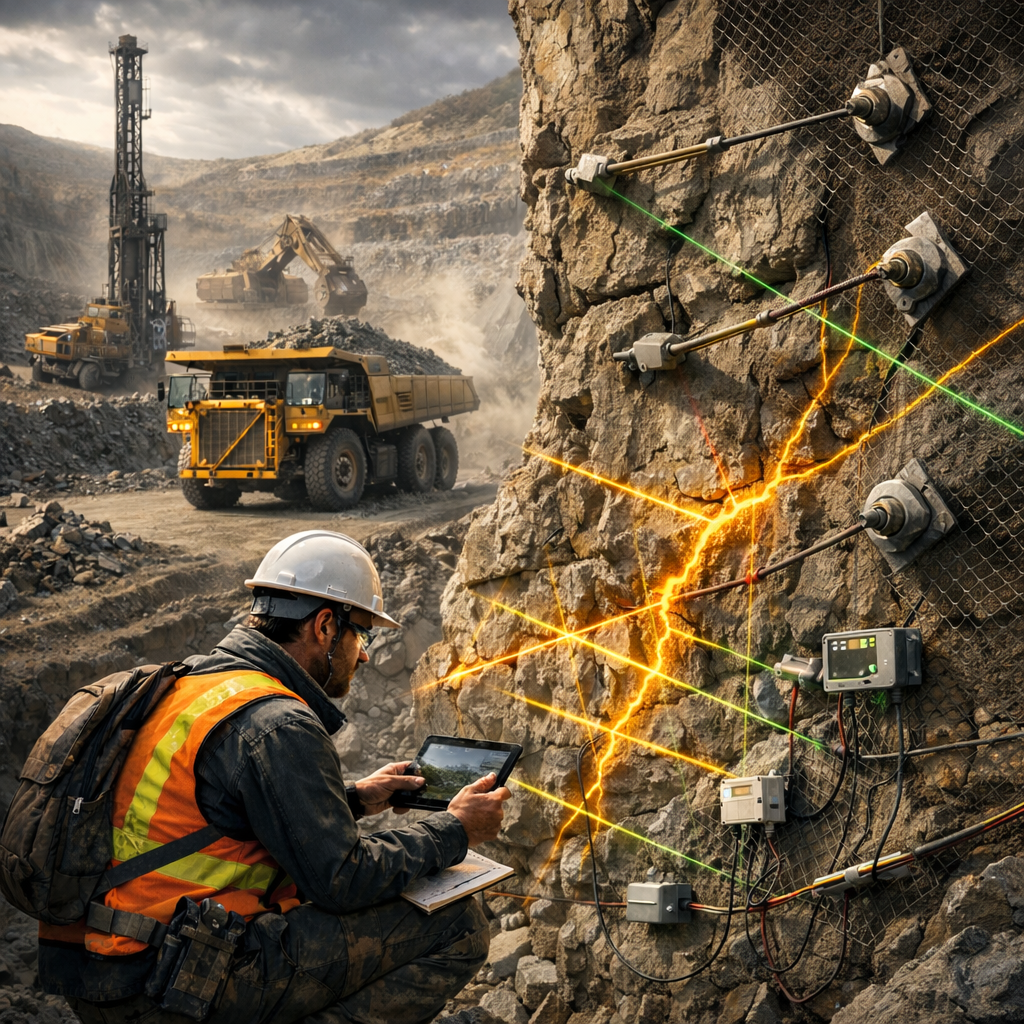
In the complex and often hazardous environment of global mining operations, geotechnical engineers serve as the essential guardians of safety and structural integrity. Often working behind the scenes, these professionals apply principles of soil and rock mechanics to ensure that both open-pit and underground mines remain stable during the extraction of critical resources. As the industry moves toward deeper deposits and more challenging geological terrains, the expertise of geotechnical engineers has become indispensable for mitigating risks and promoting sustainable practices.
Ensuring structural stability and safety
The primary responsibility of a geotechnical engineer in mining is the management of ground stability. This involves a rigorous classification of geological materials based on their physical and mechanical properties, such as particle size, water content, and plasticity index (Guo et al., 2022). By understanding these variables, engineers can predict how the ground will react to excavation. In underground mining, this expertise is critical for preventing tunnel collapses, which statistics show occur most frequently during the construction phase (Spyridis & Proske, 2021). Geotechnical engineers utilize probabilistic calculations and structural monitoring to mitigate the threat of unforeseen geological failures, ensuring the safety of workers operating hundreds of meters below the surface.
Managing environmental impact and waste
Beyond the immediate stability of mine workings, geotechnical engineers are pivotal in managing the environmental footprint of mining activities. Open-pit mining, in particular, requires the stripping of vast layers of rock and soil, which can lead to significant ecological degradation (Kuang et al., 2019). Geotechnical professionals design and oversee the construction of waste dumps and tailings storage facilities, ensuring they do not fail and cause catastrophic environmental disasters.
Furthermore, they are increasingly involved in the “circular economy” of mining. This includes the geotechnical characterization and repurposing of excavated soil and mining waste for use in civil engineering and construction (Pličanič, 2020). By identifying how mining residues can be recycled into structural materials, geotechnical engineers help transition the industry toward a zero-waste model (Guo et al., 2022).
Innovating for sustainable infrastructure
As mining infrastructure evolves, geotechnical engineers are integrating new materials to enhance durability and reduce carbon footprints. Research into the use of biochar and other industrial by-products in cementitious mortars has shown that these additives can improve compressive strength and reduce water absorption in concrete structures (Malt biochar study, 2025). Such innovations allow for the construction of denser, more resilient mining infrastructure while lowering the CO2 impact compared to conventional binders.
Conclusion
Geotechnical engineers are truly the silent heroes of the mining sector. Their ability to quantify the response of soil and rock to human intervention allows for the safe extraction of minerals essential for modern life (Isaksson et al., 2025). Through meticulous classification, risk assessment, and the implementation of sustainable waste management strategies, they protect both human lives and the environment. As the world’s demand for raw materials grows, the geotechnical engineer’s role in balancing industrial necessity with safety and sustainability will only become more vital.
References
Guo, Q., Zhan, L., Shen, Y., Wu, L., & Chen, Y. (2022). Classification and quantification of excavated soil and construction sludge: A case study in Wenzhou, China. Frontiers of Structural and Civil Engineering, 16(2), 202–213. https://doi.org/10.1007/s11709-021-0795-8
Isaksson, J., Karlsson, M., & Dijkstra, J. (2025). Quantifying the response of piled structures from displacements induced by pile installation in soft clay. Canadian Geotechnical Journal. https://doi.org/10.1139/cgj-2024-0387
Kuang, X., Cao, Y., Luo, G., & Huang, Y. (2019). Responses of Melilotus officinalis Growth to the Composition of Different Topsoil Substitute Materials in the Reclamation of Open-Pit Mining Grassland Area in Inner Mongolia. Materials, 12(23), 3888. https://doi.org/10.3390/ma12233888
Pličanič, S. (2020). Mining waste in circular economy – legislative aspect. Geologica Macedonica, 34(2), 149–156. https://doi.org/10.46763/geol20020149p
Spyridis, P., & Proske, D. (2021). Revised Comparison of Tunnel Collapse Frequencies and Tunnel Failure Probabilities. ASCE-ASME Journal of Risk and Uncertainty in Engineering Systems, Part A: Civil Engineering, 7(1). https://doi.org/10.1061/ajrua6.0001107