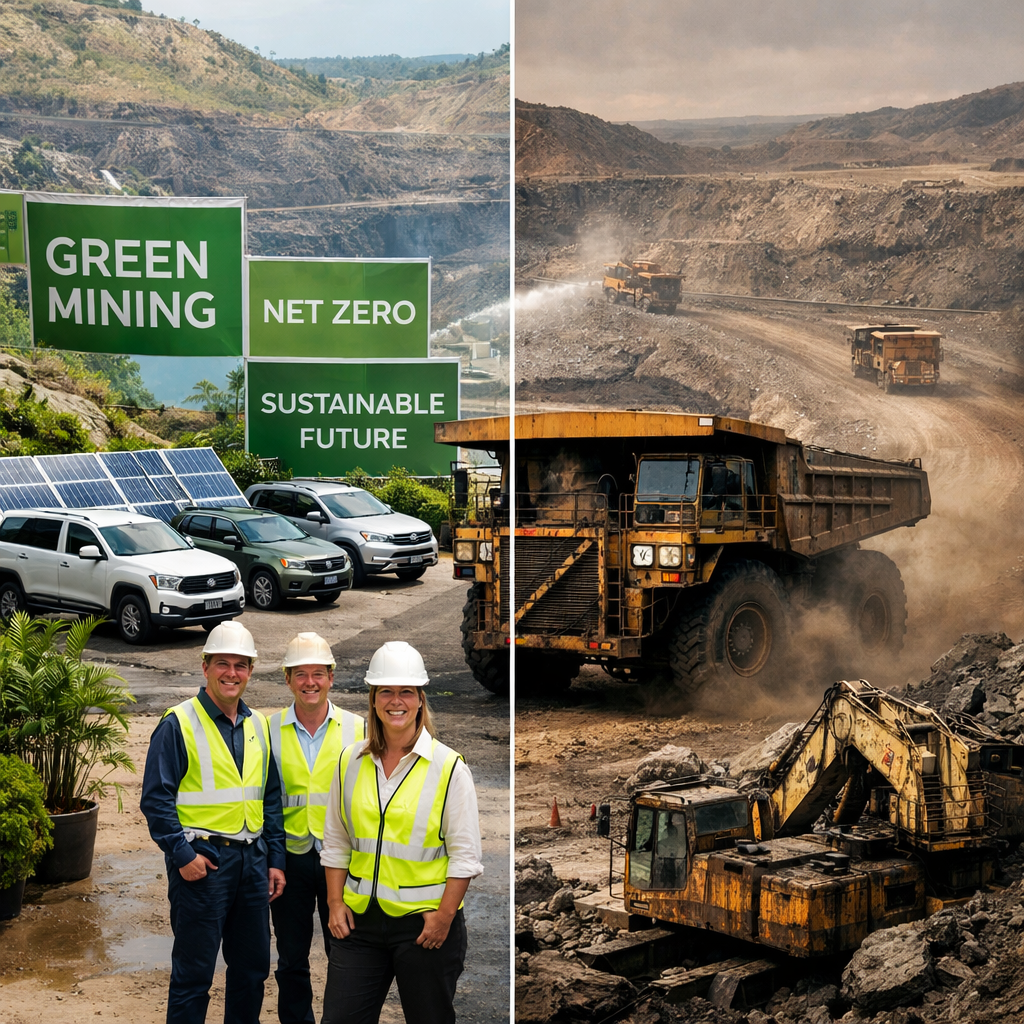
As the global transition toward renewable energy intensifies, the demand for critical minerals like lithium, cobalt, and copper has surged (Critical Minerals Boom, 2024). To mitigate the environmental stigma associated with extraction, the industry has introduced “green mining.” While framed as a sustainable evolution of the sector, a critical review of recent scientific literature suggests that green mining remains largely a marketing construct—a form of corporate “greenwashing” that masks the inherent ecological and social costs of extraction.
The paradox of sustainability in extraction
The fundamental critique of green mining lies in the inherent paradox of “sustainable” extraction. The term is often used as a promotional tool rather than a technical standard (Mancini & Sala, 2018). Mancini and sala (2018) highlight that while mining companies increasingly adopt sustainability reporting, these reports frequently emphasize incremental technological improvements while ignoring the absolute increase in environmental degradation caused by expanding operations. The “green” label, therefore, serves to justify the expansion of the frontier of extraction under the guise of climate action (Calvão et al., 2023).
Furthermore, the shift toward “green” technologies often results in “burden shifting.” While decarbonizing the energy grid requires minerals, the mining process itself remains incredibly energy-intensive and ecologically destructive (Valero et al., 2021). Valero et al. (2021) note that as ore grades decline globally, the energy required to extract the same amount of metal increases exponentially, leading to higher carbon footprints and larger volumes of toxic waste (tailings). This physical reality contradicts the marketing narrative of a low-impact industry.
Technological limits and greenwashing
Mining corporations frequently market automation, electrification of vehicles, and digitalization as the pillars of green mining (Smart, Sustainable Mining Is Reshaping the Industry – Ericsson, n.d.). However, Sovacool et al. (2020) suggest that these technological fixes often fail to address the systemic environmental impacts, such as biodiversity loss and groundwater contamination. Their study indicates that “green mining” frameworks often prioritize carbon emissions at the mine site while neglecting the broader “repaired” ecology of the surrounding landscape. By focusing on narrow metrics like “carbon neutrality,” companies can claim green credentials while their operations continue to destroy local ecosystems.
Moreover, the lack of standardized, independent verification allows companies to define “green” on their own terms. Research by Odell et al. (2018) indicates that many green mining initiatives are voluntary and lack rigorous enforcement. This allows firms to utilize “green” rhetoric to secure “social license to operate” and attract ESG (Environmental, Social, and Governance) investments without fundamentally altering their extractive logic. The study concludes that without binding international regulations, green mining remains a discursive strategy to maintain business-as-usual.
Social and ecological externalities
The marketing of green mining also tends to sanitize the social conflicts inherent in extraction. According to Bédard, (2024), the “green” transition is driving a new wave of “green coloniality,” where the Global North demands minerals for its energy transition at the expense of the Global South’s environments and indigenous rights. Marketing materials rarely mention the displacement of communities or the long-term liability of tailing dam failures, focusing instead on high-tech imagery and corporate social responsibility (CSR) slogans.
Conclusion
While technological advancements in the mining sector are necessary, labeling the industry as “green” is a misnomer that serves corporate interests more than the environment. Scientific evidence from 2020 to 2024 suggests that the industry’s focus remains on expansion and profit, with “green” initiatives serving as a veneer to mask the escalating ecological debt. For mining to move beyond marketing, there must be a shift from voluntary corporate standards to mandatory global degrowth strategies in mineral consumption and circular economy practices that prioritize recycling over new extraction.
References
Bédard, S. (2024). Arboleda, M. (2020). Planetary mine: Territories of extraction under late capitalism. Verso Books. Revue Organisations & Territoires, 33, 206–207. https://doi.org/10.1522/revueot.v33n1.1724
Calvão, F., Benya, A., & Archer, M. (2023). Global Afterlives of Extraction. International Development Policy | Revue internationale de politique de développement, (16), Article 16. https://doi.org/10.4000/poldev.6001
Critical minerals boom: Global energy shift brings opportunities and risks for developing countries | UN Trade and Development (UNCTAD). (2024, April 26). https://unctad.org/news/critical-minerals-boom-global-energy-shift-brings-opportunities-and-risks-developing-countries
Mancini, L., & Sala, S. (2018). Social impact assessment in the mining sector: Review and comparison of indicators frameworks. Resources Policy, 57, 98–111. https://doi.org/10.1016/j.resourpol.2018.02.002
Odell, S. D., Bebbington, A., & Frey, K. E. (2018). Mining and climate change: A review and framework for analysis. The Extractive Industries and Society, 5(1), 201–214. https://doi.org/10.1016/j.exis.2017.12.004
Smart, sustainable mining is reshaping the industry—Ericsson. (n.d.). Retrieved February 9, 2026, from https://www.ericsson.com/en/blog/2021/12/how-smart-sustainable-mining-is-reshaping-the-industry
Sovacool, B. K., Ali, S. H., Bazilian, M., Radley, B., Nemery, B., Okatz, J., & Mulvaney, D. (2020). Sustainable minerals and metals for a low-carbon future. Science, 367(6473), 30–33. https://doi.org/10.1126/science.aaz6003
Valero, Alicia, Valero, Antonio, & Calvo, G. (2021). Material Limits of the Energy Transition. In Alicia Valero, Antonio Valero, & G. Calvo (Eds.), The Material Limits of Energy Transition: Thanatia (pp. 147–187). Springer International Publishing. https://doi.org/10.1007/978-3-030-78533-8_6