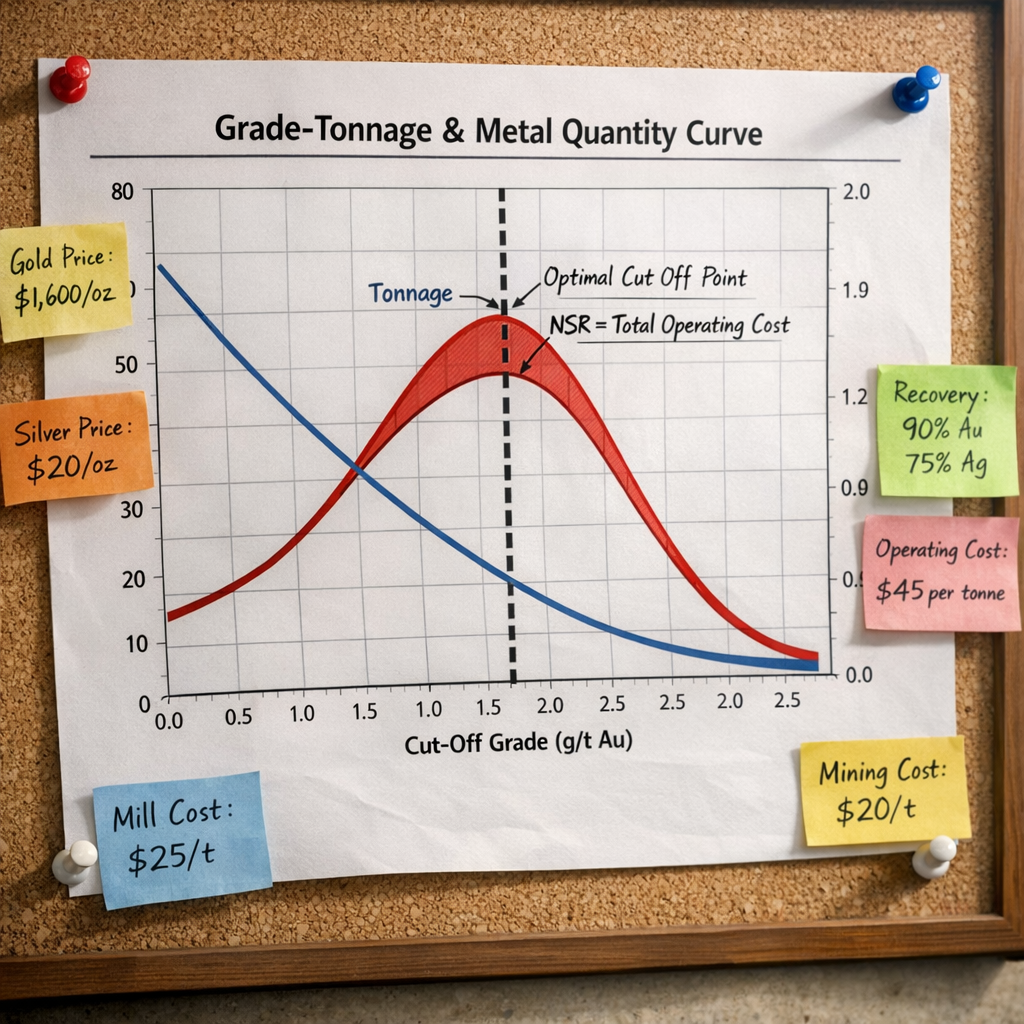
In mining operations, deciding which material is profitable to extract and which should be discarded as waste is an essential part of project valuation. This decision is dictated by the economic cut-off grade, a critical operational parameter that directly influences a mine’s life, daily cash flows, and overall profitability. Evaluating this metric is a complex process that balances extraction costs, processing constraints, and dynamic market conditions.
Traditionally, the evaluation of the cut-off grade centers on maximizing the Net Present Value (NPV) of the mining project. Early frameworks, famously pioneered by Kenneth Lane in the 1960s, defined the optimal cut-off grade by balancing the capacity constraints of the mine, the processing mill, and the final market. If a cut-off grade is set too high, valuable resources are unnecessarily sent to the waste dump. Conversely, if the cut-off is set too low, the processing facilities become choked with low-value material, heavily restricting potential revenues.
Modern evaluation methods recognize that an optimal cut-off grade cannot remain static. It is heavily influenced by dynamic variables such as commodity price uncertainty, subsequent ore grades in the extraction sequence, and bounded rates of processing (Johnson et al., 2011). Because metal prices constantly fluctuate, operators must utilize dynamic algorithms capable of adjusting the cut-off grade criterion throughout the extraction lifecycle. Utilizing these advanced mathematical models allows mining operations to dynamically respond to future market movements, thereby securing extra value that static evaluations often miss (Johnson et al., 2011).
Furthermore, the geological realities of a mine are rarely deterministic. Modern evaluations must account for geological uncertainty and the presence of complex, multi-element deposits. Recent advancements utilize stochastic mathematical programming and reinforcement learning to jointly optimize cut-off grades alongside the long-term production schedule (Cutler & Dimitrakopoulos, 2025). By accounting for both grade variations and multiple elements simultaneously, these frameworks minimize deviations from strategic forecasts, providing a highly robust operational plan (Cutler & Dimitrakopoulos, 2025).
In conclusion, evaluating the economic cut-off grade is no longer a simple calculation of current prices minus processing costs. It is an advanced, iterative process. By implementing dynamic pricing models and stochastic planning, mining engineers can continuously adapt their definitions of ore and waste, ensuring the highest possible economic return over the life of the mine.
References
Cutler, J., & Dimitrakopoulos, R. (2025). Optimising multi-element cut-off grades for a strategic production plan under geological uncertainty. International Journal of Mining, Reclamation and Environment, 1–15. https://doi.org/10.1080/17480930.2025.2455567
Johnson, P. V., Evatt, G. W., Duck, P. W., & Howell, S. D. (2011). The Determination of a Dynamic Cut-Off Grade for the Mining Industry. Lecture Notes in Electrical Engineering, 391–403. https://doi.org/10.1007/978-94-007-1192-1_32