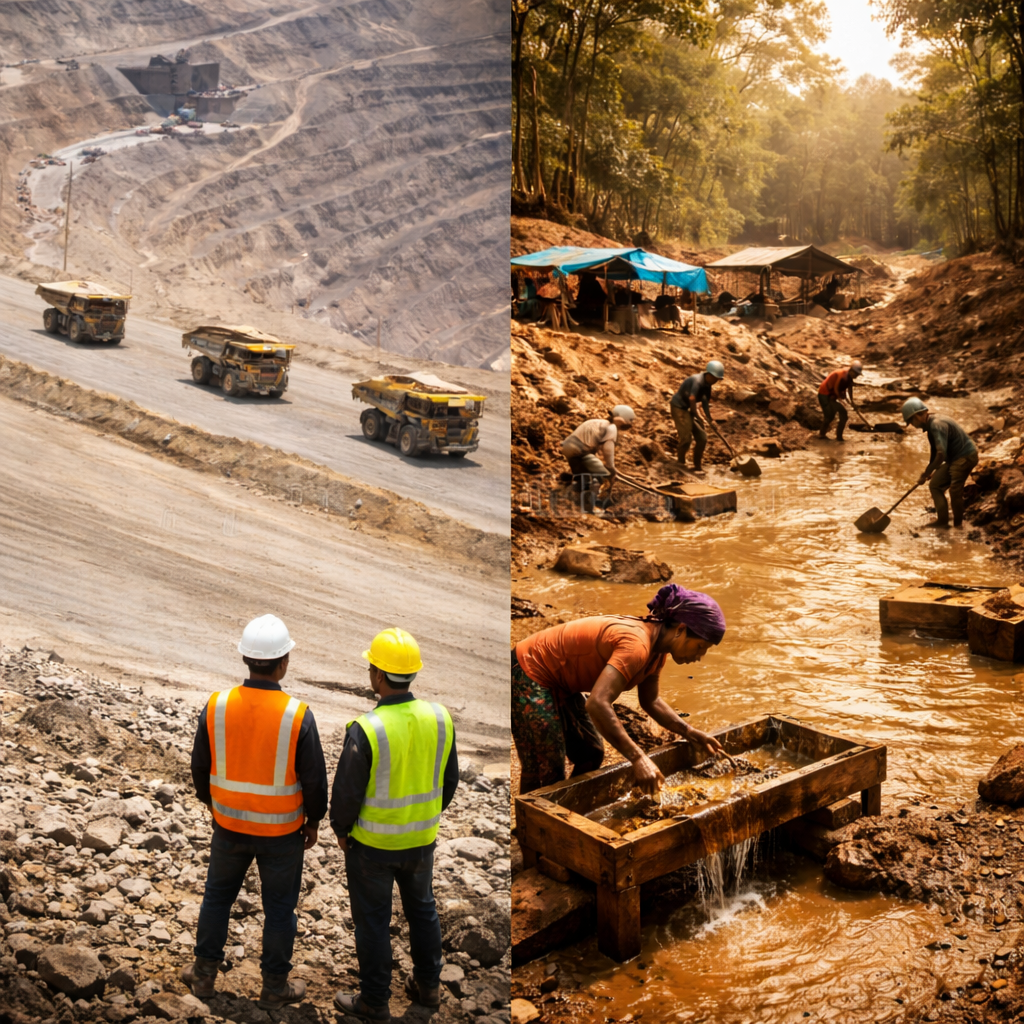
The global mining landscape is defined by two fundamentally different worlds: Artisanal and Small-scale Mining (ASM) and Large-scale Industrial Mining (LSM). While both industries pursue the same buried treasures, they diverge sharply in their operational scale, technical sophistication, legal standing, and socio-economic footprints.
The most visible distinction lies in the balance between human effort and capital investment. ASM is essentially a labour-intensive Endeavor, relying on manual strength and rudimentary tools with minimal mechanization (Rwiza et al., 2023). These operations often target “scraps”; small or marginal deposits that are geographically fragmented and financially unfeasible for massive industrial machinery (Global Report on Artisanal and Small-Scale Mining, 2002). In contrast, LSM is a high-tech, capital-heavy sector. It utilizes sophisticated geological engineering and massive equipment to move mountains of ore with clinical efficiency (Holley et al., 2022).
Navigating the legal landscape reveals another stark divide. LSM operations typically function as formal, government-sanctioned multinational corporations backed by rigorous contracts (Hilson et al., 2020). Conversely, the ASM sector exists largely in the shadows; approximately 80% of these activities are informal, operating outside the reach of official regulation (Holley et al., 2022). This lack of a paper trail creates a state of “legal precariousness,” leaving small-scale miners vulnerable to displacement and lacking the formal land tenure rights enjoyed by their industrial counterparts (FAO, 2021).
When it comes to human impact, ASM is a massive engine for local employment. It provides a livelihood for roughly ten times more people than the industrial sector, often serving as a vital safety net for rural populations facing extreme poverty (IIED, 2013). While LSM contributes more to a nation’s GDP through corporate taxes and export revenue, ASM’s wealth is felt more intimately at the grassroots level. It fuels micro-economies and local trade, even if its informal nature makes it difficult for governments to tax effectively (Global Report on Artisanal and Small-Scale Mining, 2002).
Environmental consequences are unavoidable in mining, but the risks manifest differently across the two sectors. Industrial mines undergo stringent environmental impact assessments, yet their sheer size results in permanent landscape alterations. In the ASM sector, the damage is often more immediate and toxic. Without the capital for clean technology or formal environmental training, miners frequently rely on hazardous chemicals like mercury, which leaches into local soil and water systems (Holley et al., 2022; Rwiza et al., 2023).
References
FAO. (2021). Tenure rights in large-scale and artisanal mining. FAO Knowledge Repository.
Global Report on Artisanal and Small-Scale Mining. (2002). International Institute for Environment and Development.
Hilson, G., Sauerwein, T., & Owen, J. (2020). Large and artisanal scale mine development: The case for autonomous co-existence. World Development, 130, 104919. https://doi.org/10.1016/j.worlddev.2020.104919
Holley, E. A., Rodriguez, O. F., Redwood, S. D., & Smith, N. M. (2022). Coexistence of Large-Scale Mining with Artisanal and Small-Scale Mining—A Guide for Geologists. SEG Discovery, 22–34. https://doi.org/10.5382/geo-and-mining-16
IIED. (2013). Responding to the challenge of artisanal and small-scale mining. International Institute for Environment and Development.
Rwiza, M. J., Focus, E., Bayuo, J., Kimaro, J. M., Kleinke, M., Lyasenga, T. J., Mosses, J. T., & Marwa, J. (2023). Artisanal and small-scale mining in Tanzania and health implications: A policy perspective. Heliyon, 9(e14616). https://doi.org/10.1016/j.heliyon.2023.e14616