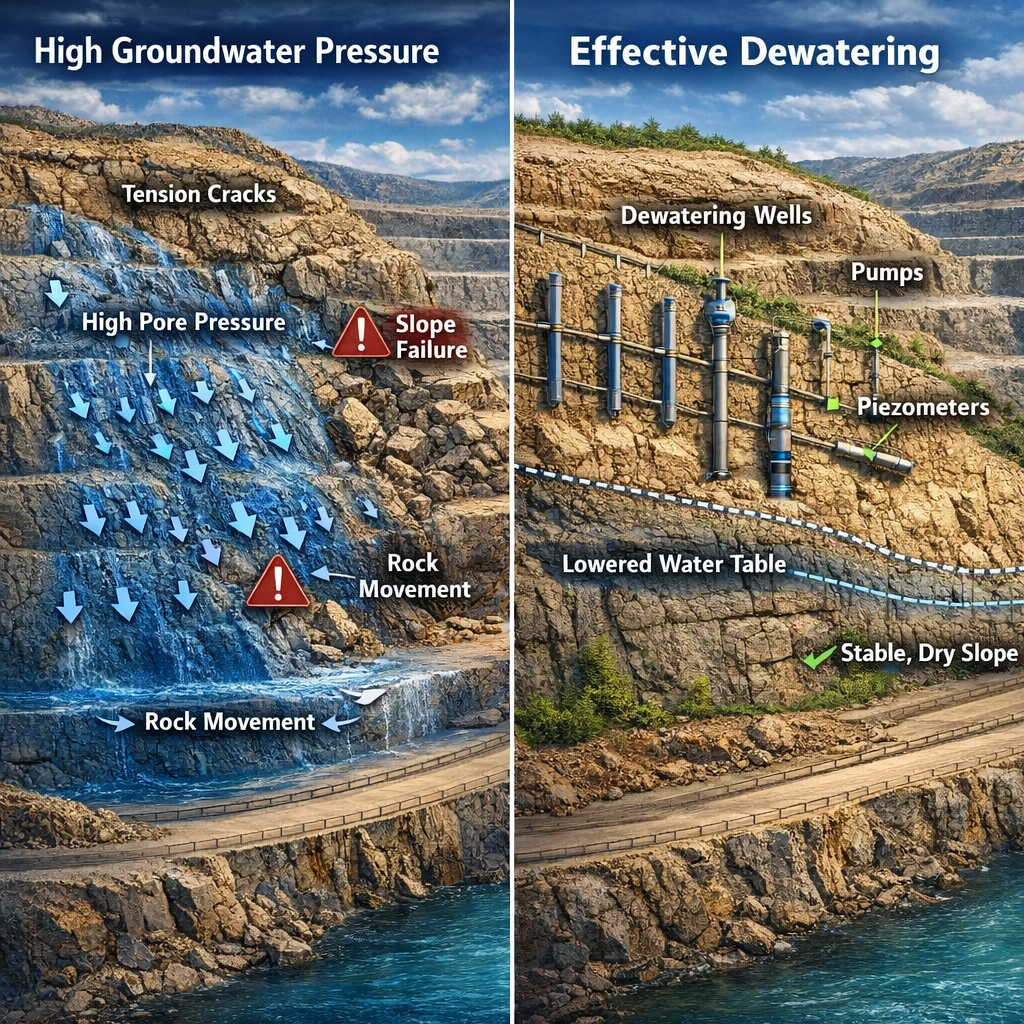
In open-pit mining, slope stability is a critical factor for operational safety and economic viability. One of the most significant variables influencing the integrity of these slopes is the presence and pressure of groundwater. Understanding the hydrogeological mechanics and implementing effective dewatering strategies are essential for preventing catastrophic failures.
The mechanics of groundwater and slope instability
Groundwater affects slope stability primarily through the increase of pore water pressure. According to the principle of effective stress established in geomechanics, the shear strength of a rock or soil mass is inversely proportional to the pore water pressure within it (Terzaghi, 1943). As water fills the discontinuities, pores, and fractures within a mine wall, it exerts an outward pressure that counters the normal stress holding the material together.
Furthermore, seepage forces, the viscous drag exerted by moving groundwater on particles of soil or rock, add a destabilizing hydrodynamic force in the direction of flow (Read & Stacey, 2009). In many open-pit environments, the presence of water also facilitates chemical weathering and lubrication of joint planes, significantly reducing the friction angle and cohesion of the rock mass (Eberhardt, 2012). These factors combined increase the driving forces of a potential slide while simultaneously decreasing the resisting forces, often leading to bench or overall slope failures.
Effective dewatering strategies
To mitigate these risks, mining engineers employ dewatering and depressurization strategies designed to lower the water table (phreatic surface) and reduce pore pressure behind the pit face.
Vertical dewatering wells
Vertical wells are a primary method for regional water table lowering. These wells are typically drilled outside or around the perimeter of the pit. By pumping water from these boreholes, a “cone of depression” is formed, effectively drawing groundwater away from the pit walls (Morton et al., 2012). This strategy is most effective in high-permeability aquifers where water can move freely toward the pump.
Horizontal drain holes
In low-permeability rock masses where vertical wells may be inefficient, horizontal (or sub-horizontal) drains are frequently utilized. These are drilled directly into the high-walls of the pit to intercept localized seepage and relieve perched water tables or high-pressure pockets within the rock mass (Wyllie & Mah, 2004). By providing a low-resistance path for water to exit the slope, horizontal drains rapidly reduce the pore pressure in the immediate vicinity of the pit face.
In-pit sumps and pumping
While sumps are primarily used for managing surface runoff and direct inflow at the bottom of the pit, they play a secondary role in dewatering by preventing the accumulation of water that could otherwise recharge the surrounding rock mass. Efficient sump management ensures that the “toe” of the slope remains dry, which is critical because the toe provides the foundational support for the entire slope (Hustrulid et al., 2013).
Conclusion
Groundwater pressure is a formidable challenge in open-pit mining, acting as a hidden catalyst for slope instability. The reduction of effective stress through pore pressure and the destabilizing effects of seepage require rigorous monitoring and management. A combination of vertical wells for regional drawdown and horizontal drains for targeted depressurization represents the most effective technical approach to ensuring the structural integrity of mine excavations.
References
Eberhardt, E. (2012). The role of advanced numerical methods and long-term monitoring in the understanding of complex rock slope failure mechanisms. Engineering Geology, 128, 58-77.
Hustrulid, W. A., Kuchta, M., & Martin, R. K. (2013). Open Pit Mine Planning and Design. CRC Press.
Morton, K. L., Muller, F., & van Niekerk, F. A. (2012). Dewatering and depressurisation of open pit mines. Journal of the Southern African Institute of Mining and Metallurgy, 112(6), 467-471.
Read, J., & Stacey, P. (Eds.). (2009). Guidelines for Open Pit Slope Design. CSIRO Publishing.
Terzaghi, K. (1943). Theoretical Soil Mechanics. John Wiley & Sons.
Wyllie, D. C., & Mah, C. (2004). Rock Slope Engineering: Civil and Mining. Spon Press.