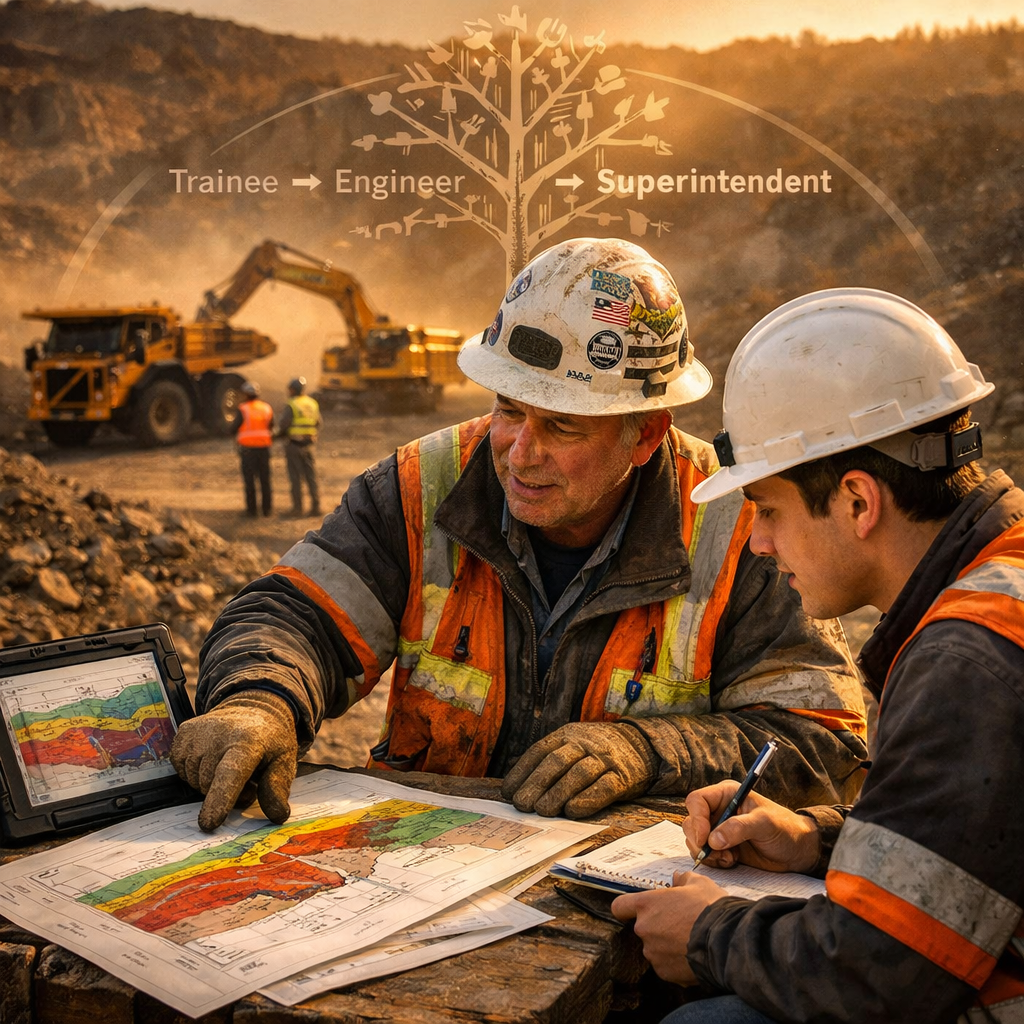
The global mining industry is facing a significant “retention paradox,” wherein the sector is generating record revenues, yet experienced employees are leaving the industry too early, not because of increased salaries, but because of a lack of perceived opportunities for professional development (Makumbe, 2025). Research suggests that the best way to address the “retention paradox” and encourage organizational loyalty among employees, which makes them immune to outside recruitment, is through mentorship programs.
The mentorship gap
The operations of the mines also have specific constraints in terms of their geographical isolation, fragmented work shifts, and the centralization of senior expertise, which creates specific barriers to the informal transfer of knowledge (The “Three Years and Gone” Phenomenon: Addressing Talent Retention in Mining • Edumine, n.d.). There is also a lack of temporal slack for developmental conversations among frontline managers, which creates a structural deficit in mentorships. In the study conducted by Caron et al. (2020) on Indigenous workers in the Canadian mining industry, where 43 workers were interviewed, it was found that positive developmental relationships were critical to retention, with workers rating the quality of mentorship as more important than wages.
Differentiated models required
Contemporary research demonstrates that effective mentorship cannot adopt a universalised approach. For Indigenous workers, mentorship must extend beyond technical skill transmission to encompass cultural safety and community relationship brokerage (Caron et al., 2020). Women in mining face distinct barriers, including lower propensity to proactively solicit career advice, rendering informal sponsorship models systematically disadvantageous (Mining Industry Mentoring: Career Development Guide, n.d.). Structured six-month cycles with defined objectives and cross-company matching demonstrate superior outcomes.
Technology-enabled delivery
Digital transformation offers unprecedented scalability for mentorship delivery. Virtual reality modules enable safe hazard simulation, while AI-driven matching systems, analysing personality, learning preferences, and career objectives, produce pairings with superior retention outcomes compared to manual assignm (Mining Industry Mentoring: Career Development Guide, n.d.). Younger professionals demonstrate greater comfort initiating developmental relationships through asynchronous digital platforms, necessitating a “digital first, human second” approach to intergenerational knowledge transfer (The “Three Years and Gone” Phenomenon: Addressing Talent Retention in Mining • Edumine, n.d.).
Measurable outcomes
Quantitative research by Makumbe (2025), which involved 380 mining participants from Southern Africa, proved that organizational commitment partially mediated the relationship between talent management and intention to stay. Mentorship, aside from skill transfer, cultivates psychological attachment, which is a basis for retaining employees. Participants who underwent mentorship programs showed faster competency development and lower turnover intentions.
Conclusion
Organizations for which mentorship is a discretionary activity likely will continue to suffer from premature turnover, even with wage premiums. Conversely, organizations with technology-enabled, demographically calibrated systems of mentorship are able to retain valuable knowledge, even as they cultivate a resilient workforce. As the mining industry can ill afford to lose either its hard-earned expertise or its young talent, mentorship has become less of a growth strategy than a necessity of operation.
References
Caron, J., Asselin, H., & Beaudoin, J.-M. (2020). Indigenous employees’ perceptions of the strategies used by mining employers to promote their recruitment, integration and retention. Resources Policy, 68, 101793. https://doi.org/10.1016/j.resourpol.2020.101793
Makumbe, W. (2025). Talent management and intention to stay in the mining industry: A moderation mediation model of workplace flexibility and organisational commitment. Rajagiri Management Journal, 19(4), 289–302. https://doi.org/10.1108/RAMJ-02-2025-0042
Mining Industry Mentoring: Career Development Guide. (n.d.). Retrieved February 12, 2026, from https://discoveryalert.com.au/mining-industry-talent-development-crisis-2026/
The “Three Years and Gone” Phenomenon: Addressing Talent Retention in Mining • Edumine. (n.d.). Retrieved February 12, 2026, from https://www.edumine.com/blog/the-three-years-and-gone-phenomenon/