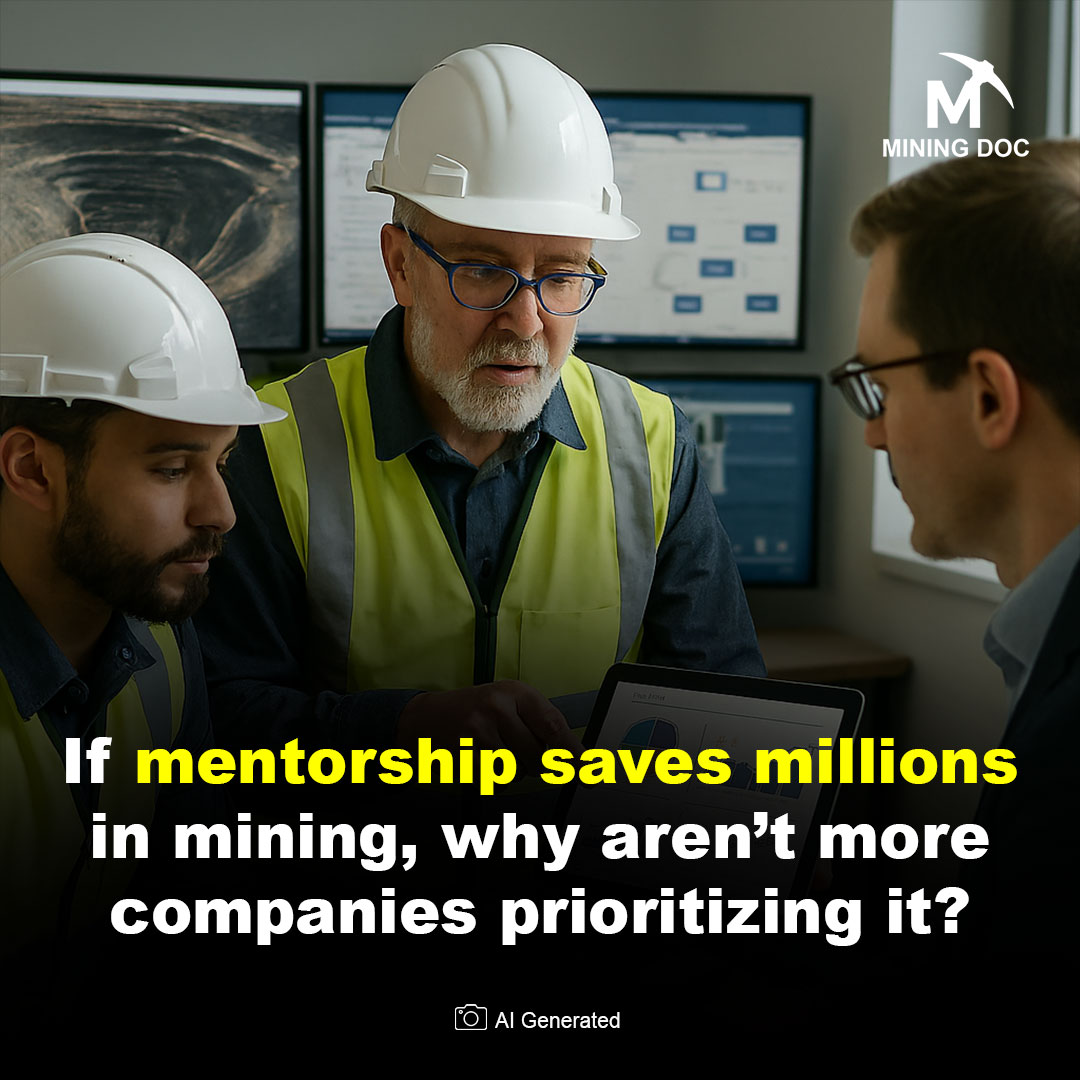
The global mining industry faces a critical knowledge transfer challenge as an ageing workforce approaches retirement, taking decades of operational expertise with them. In response, structured mentorship programs have emerged as a strategic intervention that not only preserves essential skills but delivers substantial financial returns through improved safety, productivity, and retention.
Research confirms that capturing the knowledge of experienced workers represents one of the industry’s most pressing challenges. A white paper from the US National Institute for Occupational Safety and Health emphasised that “matching the right experienced workers with new employees can have consequences for many years because today’s newly hired Millennials are tomorrow’s mine managers” [1]. However, informal apprenticeship models prove insufficient when too many inexperienced staff work with few mentors, necessitating formalised mentoring frameworks to achieve effectiveness [1].
The financial impact of structured mentorship manifests through multiple channels. A Canadian microlearning project combining digital learning with onsite coaching and mentoring, supported by a $930,000 investment from the Future Skills Centre, explicitly aims to measure how this blended approach impacts organisational bottom-line metrics and return on investment [2]. The programme integrates four minutes of daily mobile learning with mentor feedback loops, targeting improved health, safety, and communications behaviours [2].
Safety improvements driven by mentorship yield particular financial benefits. Research demonstrates that employee empowerment, a key outcome of effective mentoring relationships, positively affects safety behaviour in mining operations [3]. Given that safety incidents impose enormous costs through operational downtime, regulatory penalties, and human tragedy, mentorship programmes that enhance safety culture deliver quantifiable savings.
Furthermore, the lack of systematic mentoring contributes to underrepresentation of women in mining leadership, perpetuating skills shortages [4]. Organisations implementing formal mentorship programmes position themselves to retain diverse talent and avoid the substantial costs associated with executive turnover and prolonged leadership vacancies.
The evidence increasingly positions mentorship not as a discretionary training expense but as a strategic investment. By formalising knowledge transfer between generations, embedding coaching into operational leadership, and measuring behavioural outcomes, mining companies transform mentorship from a goodwill gesture into a mechanism delivering measurable financial returns through enhanced safety, productivity, and workforce stability.
References
[1] “(4) Coaching in Mining – Is this still a training strategy, or has it been neglected? | LinkedIn.” Accessed: Feb. 26, 2026. [Online]. Available: https://www.linkedin.com/pulse/coaching-mining-still-training-strategy-has-been-arjen-de-bruin/
[2] “Future Skills Centre • Centre des Compétences futures.” Accessed: Feb. 26, 2026. [Online]. Available: https://fsc-ccf.ca/fr/projets/le-microapprentissage-dans-lindustrie-miniere/
[3] P. Ochoa Pacheco, M. P. E. Cunha, and A. C. M. Abrantes, “The impact of empowerment and technology on safety behavior: evidence from mining companies,” International Journal of Occupational Safety and Ergonomics, vol. 28, no. 1, pp. 581–589, Jan. 2022, doi: 10.1080/10803548.2020.1808343.
[4] “An Exploratory Case Study: Mentoring Strategies Experienced by Mining Female Managers,” International Women in Mining (IWiM). Accessed: Feb. 26, 2026. [Online]. Available: https://internationalwim.org/iwim-reports/an-exploratory-case-study-mentoring-strategies-experienced-by-mining-female-managers/