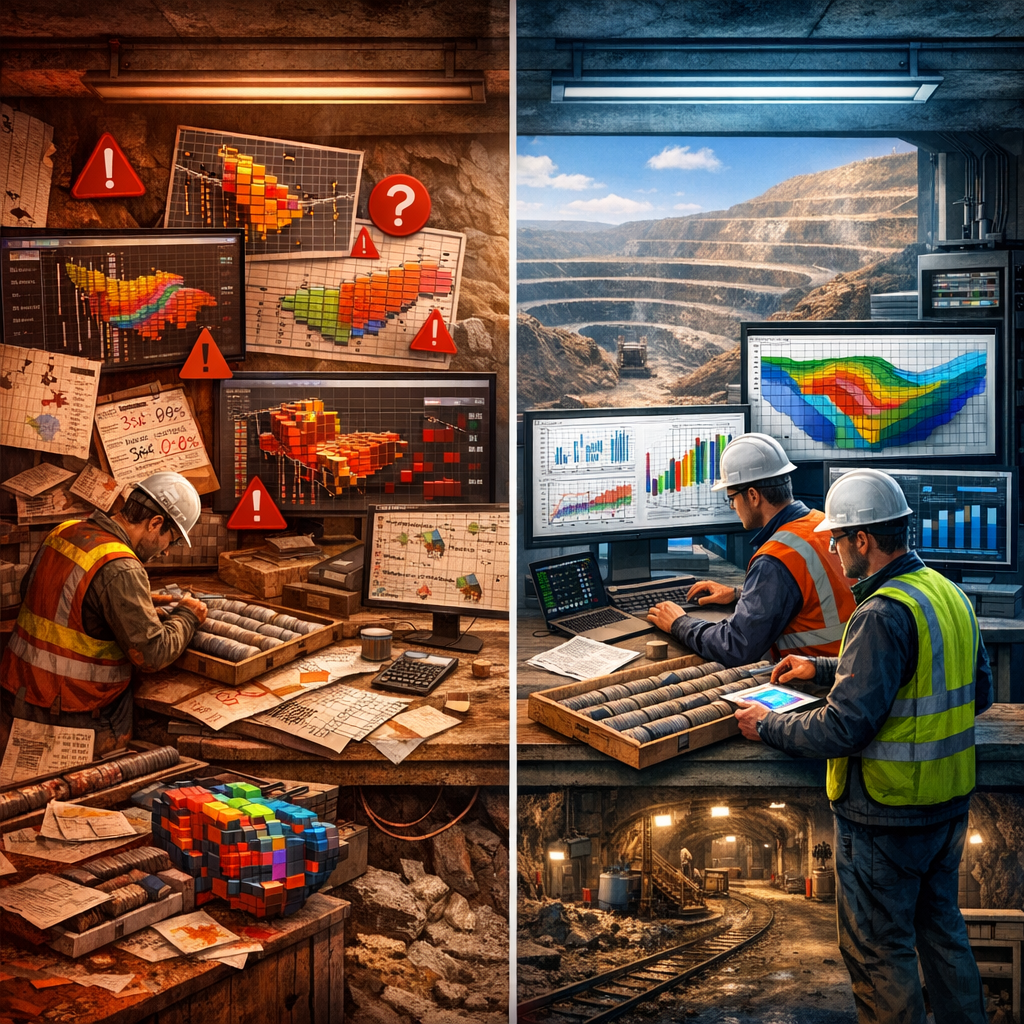
In the mining industry of 2026, the mantra “data is the new gold” has never been more accurate. As mines push into deeper, more complex ore bodies, the difference between a profitable venture and a multi-billion dollar write-down often hinges on the quality of the data informing the project’s life cycle. However, despite the surge in AI and automated sensing, human and systemic errors in data management continue to derail projects [1].
Below are the most critical data mistakes currently impacting mining projects, ranging from exploration to feasibility and production.
Sampling bias and non-representative data
One of the most persistent errors in the early stages of a mining project is sampling bias. Exploration teams often prioritize convenience or cost-efficiency over geological rigor. For instance, favoring channel samples from easily accessible outcrops rather than investing in core drilling across the entire prospect area can lead to a skewed understanding of the ore body [2]. If the samples do not represent the entire deposit, conclusions regarding ore grade and volume will be fundamentally flawed, leading to disastrous investment decisions during the feasibility stage [2].
The “perfect data” paradox
A common management mistake is delaying a project indefinitely while waiting for “perfect” data. In large-scale mining, data is inherently messy; it comes from varied sources like old hand-written logs, modern sensors, and satellite telemetry.
- Waiting too long: Organizations that refuse to release data until it is “complete and well-organized” often see project timelines balloon by years.
- Ignoring the mess: conversely, assuming data is perfect without rigorous cleaning (ETL processes) is equally dangerous. Modern mining data decays at an estimated rate of 3% per month, meaning yesterday’s drill results might not reflect today’s environmental or geological reality.
Siloed teams and data fragmentation
As mining operations become more complex, data often becomes trapped in functional “silos.” Geologists, mine planners, and processing plant engineers frequently use incompatible software tools.
- The disconnect: research in 2026 reveals that alignment between planning and execution teams can be as low as 30% in some operations [3].
- The impact: when a geological model fails to account for the processing plant’s actual throughput constraints, the resulting production schedule is a work of fiction [3].
Relying on “black box” analytics without domain expertise
With the rise of Agentic AI in 2026, there is a growing temptation to let algorithms lead the way. However, a major mistake is excluding Subject-Matter Experts (SMEs) from the data mining process.
- Correlation vs. causation: an algorithm might find a correlation between haul truck downtime and a specific weather pattern, but without a maintenance engineer’s context, it may miss the true cause—such as a specific lubricant failing at certain temperatures.
- Geological grounding: AI and ML models must be rooted in geologically sound principles. Without this “ground truth,” models can produce “leaks from the future” or overfit results that don’t hold up in a physical mine.
Inadequate geotechnical and geometallurgical integration
Failure to integrate geotechnical data (rock stability) and geometallurgical data (how the ore behaves during processing) into the primary resource model is a frequent cause of cost overruns.
- Operational complexity: projects often underestimate the “waste-to-ore” ratio because the data didn’t account for the complexity of the host rock.
- Processing failures: assuming that ore from different parts of a deposit will behave the same way in the mill, without sufficient metallurgical test work, can result in an inoperable facility once the project moves to production.
References
[1] Minetek and griffen.burgess, “Maximizing uptime with Minetek’s scaleable operational solutions,” Minetek. Accessed: Jan. 27, 2026. [Online]. Available: https://minetek.com/en-us/resource-hub/news/top-10-2026-mining-risks/
[2] “(PDF) Avoiding Pitfalls in Feasibility Studies,” ResearchGate, Aug. 2025, doi: 10.1016/j.proeng.2012.09.476.
[3] “Mining Operational Complexity 2026: Top Industry Risk.” Accessed: Jan. 27, 2026. [Online]. Available: https://discoveryalert.com.au/operational-complexity-mining-2026-importance/