
Sign In


Forgot Password?

Don't have account, Sign Up Here

Forgot Password

Lost your password? Please enter your email address. You will receive a link and will create a new password via email.


Have an account? Sign In Now

Sorry, you do not have permission to Add a Post, You must login to Add a Post.


Forgot Password?

Need An Account, Sign Up Here

Sorry, you do not have permission to add Article.


Forgot Password?

Need An Account, Sign Up Here

Please briefly explain why you feel this Post should be reported.

Please briefly explain why you feel this Comment should be reported.

Please briefly explain why you feel this user should be reported.

Mining Doc Logo Mining Doc Logo Mining Doc Logo
Sign InSign Up

Mining Doc

Mining Doc Navigation

  • Home
    • About
    • Contact us
  • Mining articles
  • Online Courses
Search
Sign up

Mobile menu

Close
join for free
  • Home
  • Online courses
  • Case study
  • Mining Community
  • Solutions listing
    • Lase Solutions
    • O-PitBlast Solutions
    • Continuous Mining
    • Longwall mining
    • Geosight Scanners
    • LoopX AI
    • Terafil solutions
    • Blasting solutions
    • Geotechnical
    • Submersible Pumps
    • Mine rescue system
    • Ore sorting
    • Whittle Consulting Solutions
  • Add Blog
  • Feed
  • User Profile
  • Posts
    • New Posts
    • Trending Posts
    • Must read Posts
    • Hot Posts
  • Polls
  • Badges
  • Home
    • About
    • Contact us
  • Mining articles
  • Online Courses

Mining Doc Latest Posts

Mining Doc
  • 0
  • 0
Mining DocProfessional
Added: January 21, 20262026-01-21T06:24:11-05:00 2026-01-21T06:24:11-05:00In: Mining Engineering

What are the advantages and limitations of electronic detonators compared to non-electric systems in modern blasting?

  • 0
  • 0

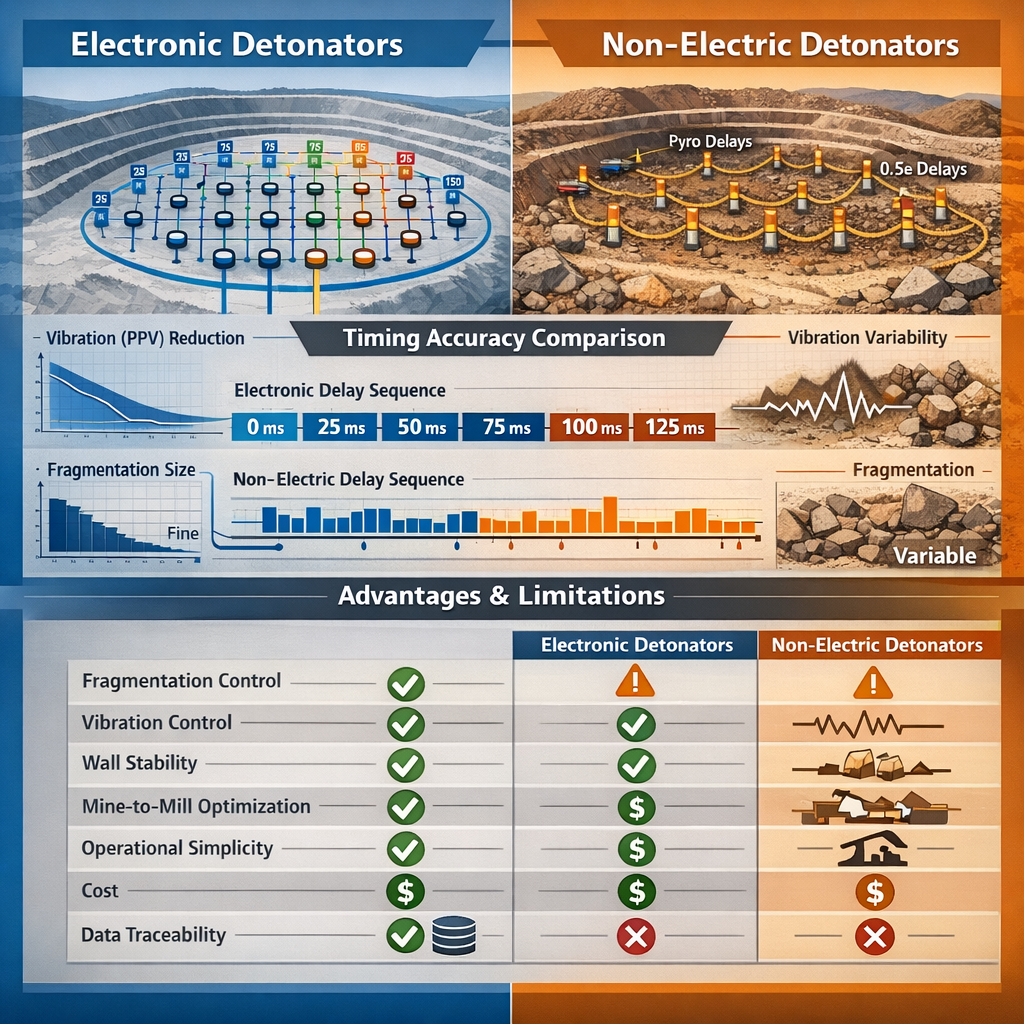
In modern blasting, the transition from traditional non-electric systems (such as shock tubes or detonating cords) to electronic detonators marks a significant technological leap. While non-electric systems remain the “workhorse” of the industry due to their simplicity and lower unit cost, electronic systems offer a level of precision and safety that is reshaping mining, quarrying, and civil construction. Let’s explore the advantages and limitations of electronic detonators compared to NONEL.

Precision and timing accuracy

The most fundamental difference lies in how delays are achieved. Non-electric detonators rely on a pyrotechnic delay element, a chemical powder train that burns at a specific rate [1]. Because of inherent variances in chemical composition and manufacturing, these have a “scatter” or error margin of roughly 3% to 5%.

In contrast, electronic detonators use a microchip and a ceramic clock to control timing. This allows for:

  • Near-zero scatter: accuracy is typically within ± 0.1 ms, compared to tens or hundreds of milliseconds in pyrotechnic systems [2].
  • Programmability: engineers can program delays in 1 ms increments on-site, allowing for customized firing sequences that are impossible with “fixed-delay” non-electric tubes [3].
  • Optimized fragmentation: Precise timing ensures that each borehole “relieves” the burden for the next, resulting in more uniform rock sizes. Studies have shown a 20-25% reduction in mean block size when switching to electronic systems [4].
Safety and security advantages

Safety protocols have been fundamentally enhanced by digital integration.

  • Immunity to extraneous energy: electronic detonators are designed to be “inherently safe” against stray currents, static electricity, and radio frequency interference. They cannot be fired by a standard battery or even a lightning strike in the same way traditional electric or some non-electric systems might be vulnerable.
  • Two-way communication: before a blast is initiated, the blasting machine “talks” to every detonator. It can identify a broken wire or a faulty unit in the circuit, allowing technicians to fix issues before the shot is fired. This has reduced misfire rates from roughly 1% in non-electric systems to below 0.1%.
  • Security: electronic systems require a specific “key” or digital code to fire. This makes stolen detonators virtually useless to unauthorized individuals.
Limitations and Challenges

Despite their technical superiority, electronic detonators face hurdles that prevent them from completely replacing non-electric systems.

Higher unit cost

The primary deterrent is the price. An electronic detonator can cost five to ten times more than a non-electric shock tube. While this cost is often offset by “downstream” savings, such as reduced fuel consumption in crushers due to better rock fragmentation, the initial capital expenditure remains a barrier for smaller operations.

Complexity and training

Non-electric systems are valued for their “plug-and-play” simplicity. Electronic systems require:

  • Specialized hardware: loggers and blasters specific to the manufacturer.
  • Intensive training: blasters must be tech-literate, capable of using software to design blast patterns and troubleshoot digital error codes.
Environmental fragility

While robust, the delicate micro-circuitry within an electronic detonator can be damaged by extreme dynamic shock from adjacent boreholes if the timing is not perfectly managed. Furthermore, the connectors can be sensitive to heavy moisture or mud, requiring meticulous handling during the “tie-in” process.

Modern blasting is increasingly moving toward a “total cost” model. While electronic detonators are more expensive upfront, their ability to protect nearby infrastructure through vibration control and reduce secondary breaking costs makes them the preferred choice for sophisticated 21st-century projects.

References

[1]      pcm_admin, “Benefits of Electronic Delay Detonators,” Quarry. Accessed: Jan. 21, 2026. [Online]. Available: https://www.quarrymagazine.com/benefits-of-electronic-delay-detonators/

[2]      M. Cardu, A. Giraudi, and P. Oreste, “A review of the benefits of electronic detonators,” Rem: Rev. Esc. Minas, vol. 66, pp. 375–382, 2013, doi: https://doi.org/10.1590/S0370-44672013000300016.
[3]      B. L. Wedding Joshua Hoffman, William Chad, “Electronic Detonator and Modern Non-Electric Shocktube Detonator Accuracy,” OneMine. Accessed: Jan. 21, 2026. [Online]. Available: https://www.onemine.org/documents/electronic-detonator-and-modern-non-electric-shocktube-detonator-accuracy

[4]      M. Cardu, A. Giraudi, and P. Oreste, “A review of the benefits of electronic detonators,” Rem: Rev. Esc. Minas, vol. 66, pp. 375–382, 2013, doi: https://doi.org/10.1590/S0370-44672013000300016.

What are the advantages and limitations of electronic detonators compared to non-electric systems in modern blasting?
0
  • 0 0 Comments
  • 165 Views
  • 165 Reactions
  • 0 Followers
  • 0
    • Report
  • Share
    Share
    • Share on Facebook
    • Share on Twitter
    • Share on LinkedIn
    • Share on WhatsApp

Related Posts

  • How is your site currently classifying technology-related downtime?
  • What geotechnical investigations are essential before constructing a pit ramp?
  • What maximum longitudinal gradients are acceptable for different classes of haul trucks?

You must login to add an Comment.


Forgot Password?

Need An Account, Sign Up Here
aalanaalanaalan

Sidebar

Ads – Mining Solutions

aalanaalan
  • Recent
  • Beyond the stope edge: how fully autonomous mapping is redefining safety, accuracy, and decision-making in underground mines
    • On: February 2, 2026

    Beyond the stope edge: how fully autonomous mapping is redefining ...

  • Rio Tinto boosts solar energy capacity at Kennecott copper mine
    • On: January 30, 2026

    Rio Tinto boosts solar energy capacity at Kennecott copper mine

  • Rio Tinto strengthens its global low-carbon aluminium footprint through joint acquisition with Chalco of Votorantim's interest in CBA
    • On: January 30, 2026

    Rio Tinto strengthens its global low-carbon aluminium footprint through joint ...

  • Enhancing economic robustness in mining: the power of sensitivity and scenario analysis
    • On: January 30, 2026

    Enhancing economic robustness in mining: the power of sensitivity and ...

  • Scalability and Expansion: Stationary Concrete Batching Plant for Growing Mining Businesses
    • On: January 30, 2026

    Scalability and Expansion: Stationary Concrete Batching Plant for Growing Mining ...

  • London Metal Exchange resumes trade after one-hour delay.
    • On: January 30, 2026

    London Metal Exchange resumes trade after one-hour delay.

  • Cultivating the future: strategies for sustainable local talent development in mining
    • On: January 29, 2026

    Cultivating the future: strategies for sustainable local talent development in ...

Go to Home page to view more

Top Members

Olena Skyba

Olena Skyba

  • 150 Posts
  • 2 Comments
Pundit
Marcial

Marcial

  • 91 Posts
  • 0 Comments
Enlightened
Jean Marais (Sanodea Group)

Jean Marais (Sanodea Group)

  • 25 Posts
  • 0 Comments
Beginner
Trending on Mining Doc

Trending Communities

Fixed Plant General Information Geology Mining Case Studies Mining Documentary Mining Engineering Mining Events Mining Finance and Economy Mining Human Resources Mining Industry Research Mining Operations Mining Software Solutions Mining Sustainability Mining Technology Solutions Mobile Plant Equipment

Explore

  • Home
  • Online courses
  • Case study
  • Mining Community
  • Solutions listing
    • Lase Solutions
    • O-PitBlast Solutions
    • Continuous Mining
    • Longwall mining
    • Geosight Scanners
    • LoopX AI
    • Terafil solutions
    • Blasting solutions
    • Geotechnical
    • Submersible Pumps
    • Mine rescue system
    • Ore sorting
    • Whittle Consulting Solutions
  • Add Blog
  • Feed
  • User Profile
  • Posts
    • New Posts
    • Trending Posts
    • Must read Posts
    • Hot Posts
  • Polls
  • Badges

Footer

Mining Doc

Join our community and connect with other people in the Mining industry for knowledge sharing.

Legal Stuff

  • Privacy Policy
  • Terms of Service

Help

  • Support
  • FAQs
  • How to add new content and how to promote a content
  • Compliance and guidelines
  • Subscribe to Mining Doc

Follow

© 2026 Mining Doc. All Rights Reserved