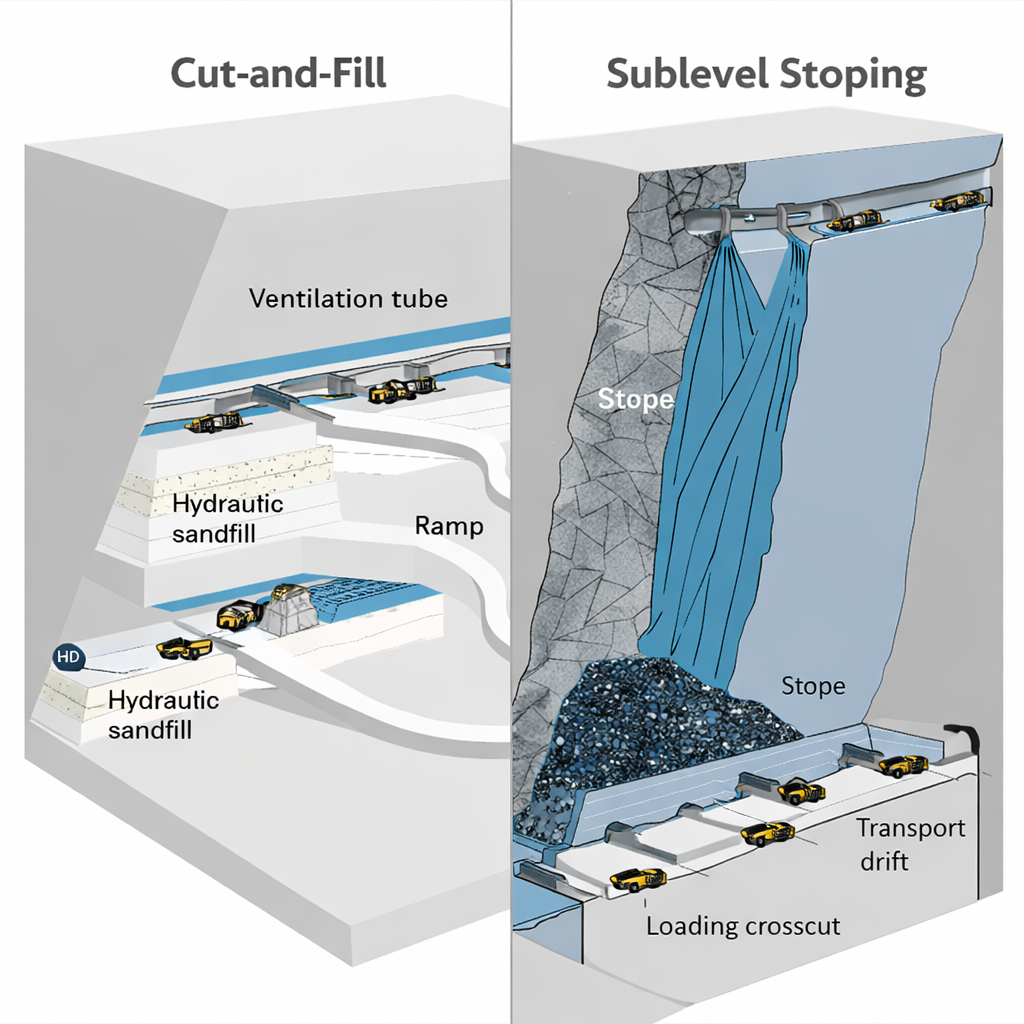
The act of designing an underground mine is an intricate puzzle where safety and profitability hang in the balance. When engineers decide between sublevel stoping (SLS) and cut-and-fill (C&F) stoping, they are essentially weighing bulk efficiency against precise control. According to established selection frameworks, most notably the Nicholas (1981) and University of British Columbia methodologies (Miller, Pakalnis, & Poulin, 1995), this critical decision boils down to three interconnected variables.
The physical competency of the surrounding rock mass usually dictates the starting point. Sublevel stoping is an aggressive, highly productive method that leaves massive, unsupported voids underground. To pull this off safely, both the orebody and its surrounding host rock must possess exceptional geomechanical strength to prevent premature collapse.
C&F, on the other hand, was engineered specifically for fragile environments. By systematically backfilling excavated spaces with waste material or cemented paste, miners provide immediate, active structural support to weak ground. This continuous reinforcement curbs instability and prevents loose waste rock from diluting the extracted ore (Bogdanovic, Nikolic, & Ilic, 2012).
Beyond sheer strength, the physical footprint of the deposit plays a massive role. SLS thrives on consistency; it is the go-to strategy for massive, uniform orebodies that dip steeply at 50 degrees or more (Nicholas, 1981). However, it is fundamentally inflexible.
If a deposit is narrow, winding, or features erratic pockets of high-grade ore, C&F takes the lead. Because the method progresses in smaller, controlled cycles, miners can continuously adjust the excavation boundaries to chase valuable veins. This adaptability maximizes ore recovery while leaving barren rock in the ground (Miller et al., 1995).
Eventually, the geological data must make financial sense. SLS operates on economies of scale. While it requires a hefty upfront investment to develop the necessary access tunnels, the sheer volume of ore extracted keeps the daily operating cost per tonne incredibly low.
C&F paints a vastly different economic picture. The ongoing, labor-intensive cycle of creating, transporting, and packing backfill material drives up operating expenses. Consequently, C&F is generally reserved for high-grade, lucrative ores whose market value can comfortably absorb those premium extraction costs.
There is no universal solution in underground mining. Engineers must look past the raw mechanics of excavation and closely align the geotechnical reality of the rock with the financial reward of the ore, ensuring the chosen method maximizes value without ever compromising the stability of the mine.
References
Bogdanovic, D., Nikolic, V., & Ilic, I. (2012). Mining method selection by integrated AHP and PROMETHEE method. Anais da Academia Brasileira de Ciências, 84(1), 219-233.
Miller, F., Pakalnis, V., & Poulin, R. (1995). UBC mining method selection. Mine Planning and Equipment Selection, 163-168.
Nicholas, D. E. (1981). Method selection: a numerical approach. Design and Operation of Caving and Sublevel Stoping Mines, 39-53.