Sign In


Forgot Password?

Don't have account, Sign Up Here

Forgot Password

Lost your password? Please enter your email address. You will receive a link and will create a new password via email.


Have an account? Sign In Now

Sorry, you do not have permission to Add a Post, You must login to Add a Post.


Forgot Password?

Need An Account, Sign Up Here

Sorry, you do not have permission to add Article.


Forgot Password?

Need An Account, Sign Up Here

Please briefly explain why you feel this Post should be reported.

Please briefly explain why you feel this Comment should be reported.

Please briefly explain why you feel this user should be reported.

Mining Doc Logo Mining Doc Logo Mining Doc Logo
Sign InSign Up

Mining Doc

Mining Doc Navigation

  • Home
    • About
    • Contact us
  • Mining articles
  • Online Courses
Search
Sign up

Mobile menu

Close
join for free
  • Home
  • Online courses
  • Case study
  • Mining Community
  • Solutions listing
    • Lase Solutions
    • O-PitBlast Solutions
    • Continuous Mining
    • Longwall mining
    • Geosight Scanners
    • LoopX AI
    • Terafil solutions
    • Blasting solutions
    • Geotechnical
    • Submersible Pumps
    • Mine rescue system
    • Ore sorting
    • Whittle Consulting Solutions
  • Add Blog
  • Feed
  • User Profile
  • Posts
    • New Posts
    • Trending Posts
    • Must read Posts
    • Hot Posts
  • Polls
  • Badges
  • Home
    • About
    • Contact us
  • Mining articles
  • Online Courses

Mining Doc Latest Posts

Mining Doc
  • 0
  • 0
Mining DocPundit
Added: March 18, 20262026-03-18T07:04:39-04:00 2026-03-18T07:04:39-04:00In: Geology

What are the types of geological faults?

  • 0
  • 0

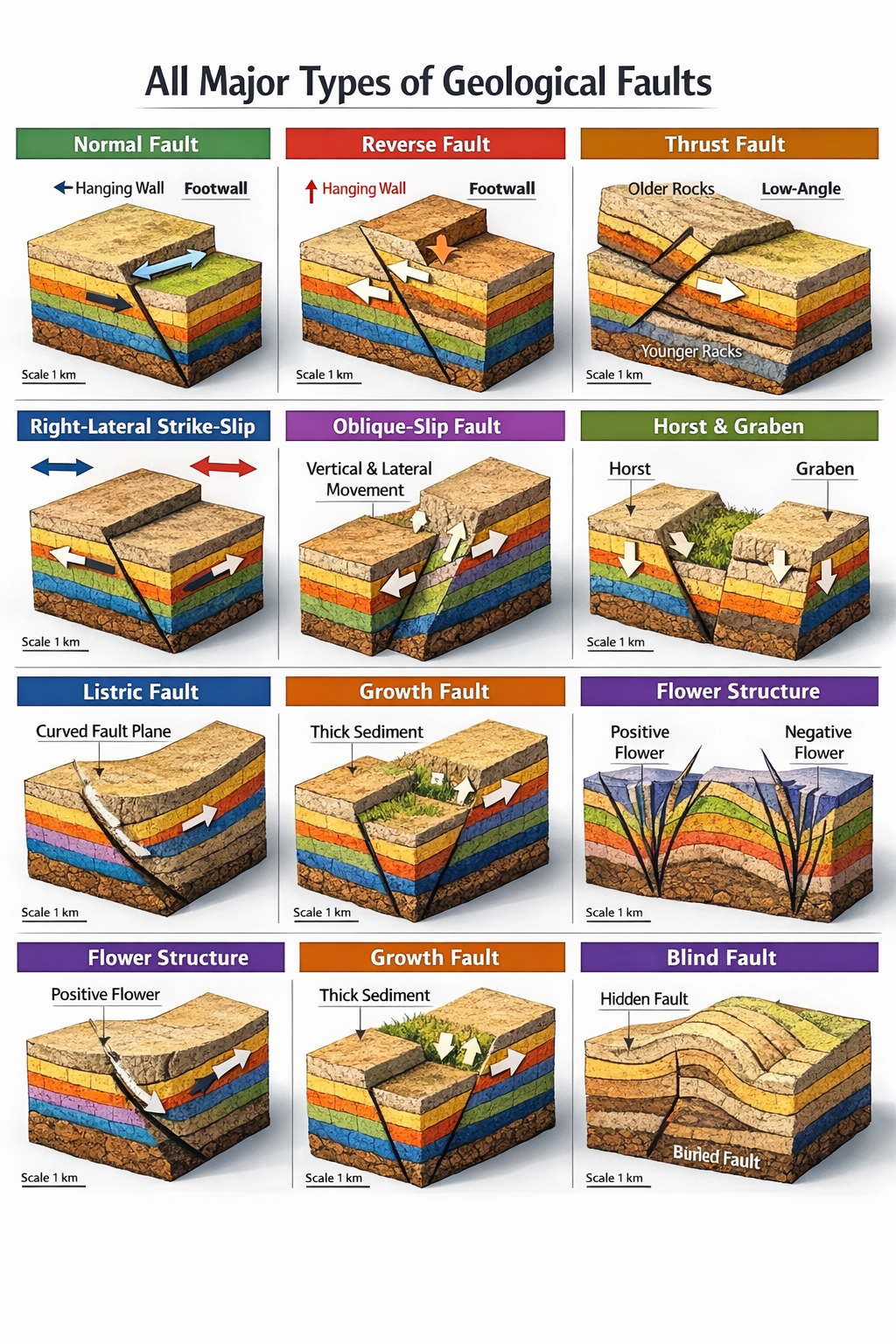
A geological fault is a planar fracture or discontinuity in rock where significant displacement has occurred. Faults form due to tectonic stresses within the Earth’s crust and are classified by the direction of movement along the fault plane. Let’s describe the different types of geological faults.

Normal fault

Normally, normal faults are caused by tensional stress. They are faults where the hanging wall is pushed downwards in relation to the footwall. Normal faults are normally observed in areas where the earth’s crust is being pulled apart. An example is the Rift Valley in East Africa.

Reverse fault

Caused by compressional stress, reverse faults are faults where the hanging wall is pushed up relative to the footwall. Reverse faults are located at convergent plate boundaries and are responsible for the creation of mountain ranges such as the Himalayas and the Rockies.

Thrust fault

A variant of the reverse fault with a low angle, less than 45°, thrust faults enable older rocks to move over younger rocks over long horizontal distances. These are characteristic of orogenic belts, which are regions of intense mountain-building activity.

Strike-slip fault

In this type of fault, movement is largely horizontal. The blocks involved tend to slide past each other. The famous fault of this kind is the San Andreas Fault, California. Strike-slip faults are further of two types: right-lateral (dextral) and left-lateral (sinistral).

Oblique slip fault

An oblique slip fault has both dip slip and strike slip movements at the same time. It is neither a pure dip slip nor a pure strike slip fault, as the net result of the movements is a raking motion along the fault plane. Such faults occur in environments characterized by a non-horizontal stress field, in which the stress axes are tilted in relation to the fault surface, or in faults that are reactivated in a non-horizontal stress field. Oblique slip faults are very common in nature, and pure strike slip or dip slip faults are relatively rare.

Horst & Graben

A horst is a block that has been raised up by faults on both sides, while a graben is the block that has been lowered by faults on both sides. These two features always go together in conjugate pairs. It is not possible to have one without the other. The most spectacular example of this feature is found in the Basin and Range Province of western North America, where the entire crust has been stretched out and thinned so that there are mountain ranges (horsts) alternating with desert valleys (grabens) in Nevada, Arizona, and Mexico.

Listric fault

A listric fault is a type of normal fault with a unique geometry, described as concave upwards. This fault type dips steeply close to the surface but becomes less steep with depth, eventually becoming sub-horizontal as it joins a décollement plane. The geometry of the listric fault has significant implications. The hanging wall does not simply translate down and out along the curved fault plane as the fault moves, as it would if the fault were planar. It rotates and deforms internally as it moves down and out along the curved fault plane, resulting in a rollover anticline in the hanging wall.

Growth fault

A growth fault is also known as a synsedimentary fault or syn-depositional fault and is defined as a normal fault that was still actively moving at the same time as the deposition of the rock units in the hanging wall basin. The key identification factor of this type of fault is the thicker strata found in the hanging wall than in the footwall because the hanging wall is still subsiding and therefore always fills up with rock units.

Flower structure (positive & negative)

Flower structures are developed in strike-slip fault systems, which are also known as transcurrent fault systems, where a vertical fault at depth branches into several faults at shallower depths, forming a fan-like structure, hence the name flower structure.

A positive flower structure is developed in a transgressional environment, i.e., an environment with strike-slip motion accompanied by compression. In this case, the fault strands splay outwards and upwards, forming a core that is pushed upwards, forming a ridge.

On the other hand, the negative flower structure, which is also known as the tulip structure, is developed in an environment with transtension, i.e., an environment with strike-slip motion accompanied by extension. In this case, the fault strands splay outwards and downwards, forming a core that has been pulled down, forming a basin.

Blind fault 

A blind fault is one which never actually breaks the Earth’s surface but instead dies out at depth with its tip buried beneath un-faulted layers of sedimentary rock. Rather than having the surface expression of a fault or scarp, the blind fault is characterized by the surface expression of folding of the overlying rock as this rock must accommodate the slip by bending or buckling. This is known as a fault propagation fold or fault bend fold.

What are the types of geological faults?
0
  • 0 0 Comments
  • 38 Views
  • 38 Reactions
  • 0 Followers
  • 0
    • Report
  • Share
    Share
    • Share on Facebook
    • Share on Twitter
    • Share on LinkedIn
    • Share on WhatsApp

Related Posts

  • What are the differences between greenfield and brownfield exploration?
  • Can predictive geology ever replace actual drilling and sampling?
  • Should mineral exploration focus more on technology than traditional fieldwork?

You must login to add an Comment.


Forgot Password?

Need An Account, Sign Up Here
aalanaalan

Sidebar

  • Recent
  • India's Jindal Stainless flags operations disruption due to fuel shortage
    • On: March 13, 2026

    India's Jindal Stainless flags operations disruption due to fuel shortage

  • Chile, US eye collaboration on rare earths and other critical minerals
    • On: March 13, 2026

    Chile, US eye collaboration on rare earths and other critical ...

  • Sinomine in talks with Zimbabwe to resume lithium exports
    • On: March 13, 2026

    Sinomine in talks with Zimbabwe to resume lithium exports

  • Safety Innovations in Construction and Mining Workplaces
    • On: March 13, 2026

    Safety Innovations in Construction and Mining Workplaces

  • How to Choose the Right Mobile Stone Crusher for Granite Crushing?
    • On: March 13, 2026

    How to Choose the Right Mobile Stone Crusher for Granite ...

  • Operational Advantages of Mobile Crushing and Screening Plant in Remote Mining Locations
    • On: March 6, 2026

    Operational Advantages of Mobile Crushing and Screening Plant in Remote ...

  • South America’s strategic minerals: the new epicenter of the global resource rush
    • On: March 6, 2026

    South America’s strategic minerals: the new epicenter of the global ...

Go to Home page to view more

Top Members

Olena Skyba

Olena Skyba

  • 150 Posts
  • 2 Comments
Pundit
Marcial

Marcial

  • 91 Posts
  • 0 Comments
Enlightened
Jean Marais (Sanodea Group)

Jean Marais (Sanodea Group)

  • 25 Posts
  • 0 Comments
Beginner
Trending on Mining Doc

Trending Communities

Fixed Plant General Information Geology Mining Case Studies Mining Doc Documentary Mining Engineering Mining Events Mining Finance and Economy Mining Human Resources Mining Industry Research Mining Operations Mining Software Solutions Mining Sustainability Mining Technology Solutions Mobile Plant Equipment

Explore

  • Home
  • Online courses
  • Case study
  • Mining Community
  • Solutions listing
    • Lase Solutions
    • O-PitBlast Solutions
    • Continuous Mining
    • Longwall mining
    • Geosight Scanners
    • LoopX AI
    • Terafil solutions
    • Blasting solutions
    • Geotechnical
    • Submersible Pumps
    • Mine rescue system
    • Ore sorting
    • Whittle Consulting Solutions
  • Add Blog
  • Feed
  • User Profile
  • Posts
    • New Posts
    • Trending Posts
    • Must read Posts
    • Hot Posts
  • Polls
  • Badges

Footer

Mining Doc

Join our community and connect with other people in the Mining industry for knowledge sharing.

Legal Stuff

  • Privacy Policy
  • Terms of Service

Help

  • Support
  • FAQs
  • How to add new content and how to promote a content
  • Compliance and guidelines
  • Subscribe to Mining Doc

Follow

© 2026 Mining Doc. All Rights Reserved