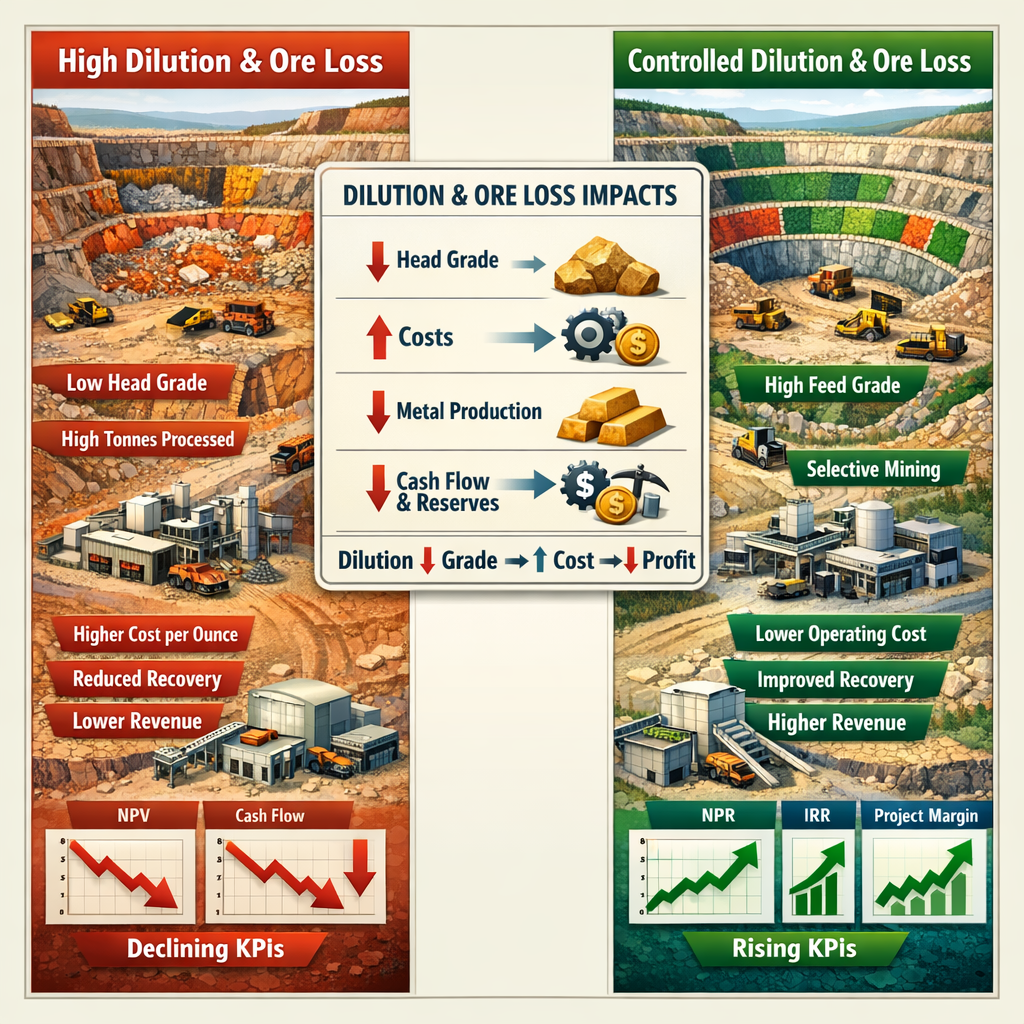
In the global mining industry, the difference between a high-performing asset and a financial failure often lies in two critical operational metrics: dilution and ore loss. While geological models provide the initial blueprint for a mine’s value, the physical reality of extraction often involves the unintentional mixing of waste rock with ore or the failure to recover valuable mineralized material. As of 2026, with declining ore grades and rising energy costs, the economic impact of these factors is more pronounced than ever.
Understanding the economic mechanisms
Dilution and ore loss represent two sides of the same operational coin, but they impact the balance sheet through different mechanisms.
Dilution: the cost of handling waste
Dilution occurs when waste material—rock with zero or sub-economic mineral content—is blasted or loaded along with the ore. According to Scoble and Moss (2016), dilution’s primary economic impact is the escalation of operating expenditures (OPEX).
- Processing inefficiency: every tonne of waste rock sent to the mill consumes power, water, and expensive chemical reagents without contributing to the final product.
- Logistics strain: dilution inflates the volume of material that must be hauled, crushed, and hoisted. For deep underground mines, this significantly increases the cost per metal unit.
- Lower metallurgical recovery: excess waste can disrupt the chemistry of the processing plant, leading to higher “tailings” losses.
Research suggests that even a small increase in rock dilution can cut a project’s Net Present Value (NPV) by nearly half due to the cumulative weight of these hidden costs (Tatman, 2021).
Ore Loss: the theft of revenue
Ore loss occurs when valuable material is left in the ground—due to pillar requirements, poor blasting, or structural complexity—or is misclassified as waste and sent to the dump. Unlike dilution, which increases costs, ore loss represents a direct loss of revenue.
- Stranded assets: when ore is lost, the “mineral base” of the project shrinks. This shortens the Mine Life and reduces the total ounces or tonnes of metal available for sale.
- Fixed cost pressure: since the mine’s fixed costs (infrastructure, labor, and administration) remain constant, losing ore volume increases the “all-in sustaining cost” (AISC) per ounce produced (Chanda, 2024).
Ore losses exceeding 20% can increase production costs per metal unit by over 75%, effectively erasing the profit margins of many mid-tier operations (Scribd Mining Analysis, 2024).
The technical trade-off and cut-off grade
Mining engineers often face a technical trade-off: to ensure high recovery of the ore (minimizing ore loss), they may have to mine more waste at the edges (increasing dilution). Conversely, being too “selective” to keep dilution low often results in leaving valuable ore behind.
The economic fulcrum for this decision is the cut-off grade. As dilution increases, the average grade of the material sent to the mill drops. To maintain profitability, the mine must often raise its cut-off grade, which inadvertently reclassifies previously “profitable” ore as waste—further compounding the economic loss (Ebrahimi, 2013).
Summary table: economic consequences
|
Factor |
Primary Impact |
Financial Metric Affected |
Long-term Consequence |
|
Dilution |
Higher tonnage, lower grade |
Increased OPEX |
Reduced margins; processing bottlenecks |
|
Ore Loss |
Lower metal output |
Decreased Revenue |
Shortened Mine Life; stranded reserves |
Conclusion
In 2026, a “fixed factor” approach to dilution is no longer sufficient for sustainable mining. Modern projects are increasingly utilizing 3D geological modeling and real-time sensor-based sorting to manage these risks. By minimizing dilution and ensuring ore recovery is maximized, companies can protect their NPV and ensure the long-term viability of their mineral reserves.
References
Chanda, E. K. (2024). Impact of mining dilution and ore loss on the economics of underground mining operations. Mining Press.
Ebrahimi, A. (2013). The importance of dilution control in maximizing the value of mining projects. SRK Consulting.
Scoble, M. J., & Moss, A. (2016). Dilution in underground bulk mining: Implications for production and profitability. Journal of Mining Science.
Scribd Mining Analysis. (2024). Operational efficiency in the modern era: A review of waste and loss.
Tatman, C. R. (2021). The economic impact of dilution on a gold mining project. Society for Mining, Metallurgy & Exploration.