Sign In


Forgot Password?

Don't have account, Sign Up Here

Forgot Password

Lost your password? Please enter your email address. You will receive a link and will create a new password via email.


Have an account? Sign In Now

Sorry, you do not have permission to Add a Post, You must login to Add a Post.


Forgot Password?

Need An Account, Sign Up Here

Sorry, you do not have permission to add Article.


Forgot Password?

Need An Account, Sign Up Here

Please briefly explain why you feel this Post should be reported.

Please briefly explain why you feel this Comment should be reported.

Please briefly explain why you feel this user should be reported.

Mining Doc Logo Mining Doc Logo Mining Doc Logo
Sign InSign Up

Mining Doc

Mining Doc Navigation

  • Home
    • About
    • Contact us
  • Mining articles
  • Online Courses
Search
Sign up

Mobile menu

Close
join for free
  • Home
  • Online courses
  • Case study
  • Mining Community
  • Solutions listing
    • Lase Solutions
    • O-PitBlast Solutions
    • Continuous Mining
    • Longwall mining
    • Geosight Scanners
    • LoopX AI
    • Terafil solutions
    • Blasting solutions
    • Geotechnical
    • Submersible Pumps
    • Mine rescue system
    • Ore sorting
    • Whittle Consulting Solutions
  • Add Blog
  • Feed
  • User Profile
  • Posts
    • New Posts
    • Trending Posts
    • Must read Posts
    • Hot Posts
  • Polls
  • Badges
  • Home
    • About
    • Contact us
  • Mining articles
  • Online Courses

Mining Doc Latest Posts

Mining Doc
  • 0
  • 0
Mining DocProfessional
Added: January 21, 20262026-01-21T06:32:12-05:00 2026-01-21T06:32:12-05:00In: Mining Engineering

What role does bench configuration (height, width, and face angle) play in controlling slope failure mechanisms?

  • 0
  • 0

In open-pit mining and civil engineering, the configuration of benches, comprising their height, width, and face angle, is the primary tool for mitigating slope failure. These three parameters do not act in isolation; they create a geometric framework that dictates whether a slope remains stable or becomes susceptible to mechanisms like planar, wedge, or toppling failure.

The role of bench face angle (BFA)

The bench face angle is the inclination of the individual bench wall relative to the horizontal. It is the most critical factor in controlling kinematic failures, particularly in rock masses where discontinuities (joints, bedding planes, or faults) are present.

  • Planar failure: this occurs when a single discontinuity “daylights” or intersects the bench face. If the BFA is steeper than the dip of the discontinuity, the block of rock above that plane is unsupported and can slide.
  • Wedge failure: when two discontinuities intersect and their line of intersection dips out of the face, a wedge-shaped block can fail. A steeper BFA increases the likelihood of undercutting these intersections, triggering a collapse.
  • Toppling: in cases where vertical or near-vertical joints dip into the slope, a very steep BFA can create a lack of horizontal confinement, causing slabs of rock to rotate or “topple” outward.
The impact of bench height

Bench height (H) significantly influences the Factor of Safety (FoS) and the scale of potential failures. While the BFA controls the type of failure, height often controls the magnitude.

  • Stress distribution: increasing bench height increases the gravitational load and shear stress at the toe of the bench. Research indicates that as height increases, the FoS typically decreases at a parabolic rate.
  • Failure volume: higher benches create larger potential “backbreak” distances. If a failure occurs on a 20-meter bench, the volume of debris is significantly greater than a failure on a 10-meter bench, potentially overwhelming safety systems below.
  • Structural interaction: higher benches are more likely to intersect a greater number of persistent joints or geological anomalies, increasing the statistical probability of a kinematic instability.
The function of bench width (Berm Width)

The bench width, often referred to as the catch berm, acts as the last line of defense. Its primary role is not to prevent the initial failure but to arrest and contain it.

  • Rockfall containment: ss rocks or debris fall from upper benches, the width must be sufficient to stop them from bouncing or rolling onto the active haul roads or work areas below.3 A common rule of thumb is that the width should be at least 4.5m + 0.2H.
  • Spill capacity: when a bench face fails, the material occupies a volume larger than its original state (the “swell factor”). The width must be designed to accommodate this “spill pile” without allowing it to crest over to the next level.
  • Inter-ramp stability: collectively, the width of multiple benches determines the inter-ramp angle. Wider benches create a shallower overall slope, which improves global stability by reducing the overall driving force behind deep-seated circular failures.

Ultimately, bench design is a balance between safety and economics. While shallower angles and wider benches are safer, they increase the “stripping ratio” (the amount of waste rock removed to access ore), making the project more expensive. Engineers use limit equilibrium and kinematic analysis to find the “optimum” configuration where these risks are managed within acceptable limits.
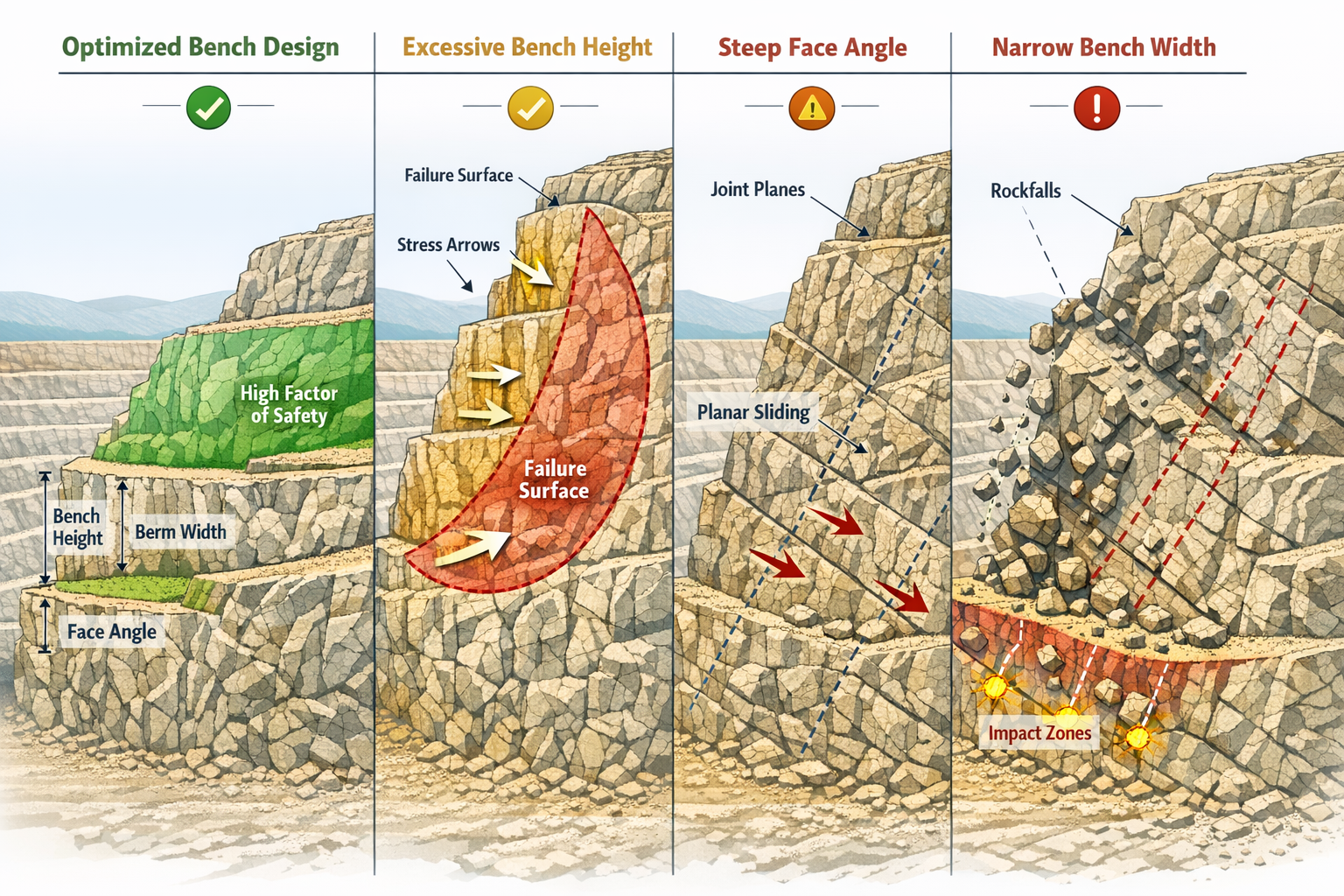

What role does bench configuration (height, width, and face angle) play in controlling slope failure mechanisms?
0
  • 0 0 Comments
  • 274 Views
  • 274 Reactions
  • 0 Followers
  • 0
    • Report
  • Share
    Share
    • Share on Facebook
    • Share on Twitter
    • Share on LinkedIn
    • Share on WhatsApp

Related Posts

  • How is your site currently classifying technology-related downtime?
  • What geotechnical investigations are essential before constructing a pit ramp?
  • What maximum longitudinal gradients are acceptable for different classes of haul trucks?

You must login to add an Comment.


Forgot Password?

Need An Account, Sign Up Here
aalanaalanaalan

Sidebar

Ads – Mining Solutions

aalanaalan
  • Recent
  • Beyond the stope edge: how fully autonomous mapping is redefining safety, accuracy, and decision-making in underground mines
    • On: February 2, 2026

    Beyond the stope edge: how fully autonomous mapping is redefining ...

  • Rio Tinto boosts solar energy capacity at Kennecott copper mine
    • On: January 30, 2026

    Rio Tinto boosts solar energy capacity at Kennecott copper mine

  • Rio Tinto strengthens its global low-carbon aluminium footprint through joint acquisition with Chalco of Votorantim's interest in CBA
    • On: January 30, 2026

    Rio Tinto strengthens its global low-carbon aluminium footprint through joint ...

  • Enhancing economic robustness in mining: the power of sensitivity and scenario analysis
    • On: January 30, 2026

    Enhancing economic robustness in mining: the power of sensitivity and ...

  • Scalability and Expansion: Stationary Concrete Batching Plant for Growing Mining Businesses
    • On: January 30, 2026

    Scalability and Expansion: Stationary Concrete Batching Plant for Growing Mining ...

  • London Metal Exchange resumes trade after one-hour delay.
    • On: January 30, 2026

    London Metal Exchange resumes trade after one-hour delay.

  • Cultivating the future: strategies for sustainable local talent development in mining
    • On: January 29, 2026

    Cultivating the future: strategies for sustainable local talent development in ...

Go to Home page to view more

Top Members

Olena Skyba

Olena Skyba

  • 150 Posts
  • 2 Comments
Pundit
Marcial

Marcial

  • 91 Posts
  • 0 Comments
Enlightened
Jean Marais (Sanodea Group)

Jean Marais (Sanodea Group)

  • 25 Posts
  • 0 Comments
Beginner
Trending on Mining Doc

Trending Communities

Fixed Plant General Information Geology Mining Case Studies Mining Documentary Mining Engineering Mining Events Mining Finance and Economy Mining Human Resources Mining Industry Research Mining Operations Mining Software Solutions Mining Sustainability Mining Technology Solutions Mobile Plant Equipment

Explore

  • Home
  • Online courses
  • Case study
  • Mining Community
  • Solutions listing
    • Lase Solutions
    • O-PitBlast Solutions
    • Continuous Mining
    • Longwall mining
    • Geosight Scanners
    • LoopX AI
    • Terafil solutions
    • Blasting solutions
    • Geotechnical
    • Submersible Pumps
    • Mine rescue system
    • Ore sorting
    • Whittle Consulting Solutions
  • Add Blog
  • Feed
  • User Profile
  • Posts
    • New Posts
    • Trending Posts
    • Must read Posts
    • Hot Posts
  • Polls
  • Badges

Footer

Mining Doc

Join our community and connect with other people in the Mining industry for knowledge sharing.

Legal Stuff

  • Privacy Policy
  • Terms of Service

Help

  • Support
  • FAQs
  • How to add new content and how to promote a content
  • Compliance and guidelines
  • Subscribe to Mining Doc

Follow

© 2026 Mining Doc. All Rights Reserved