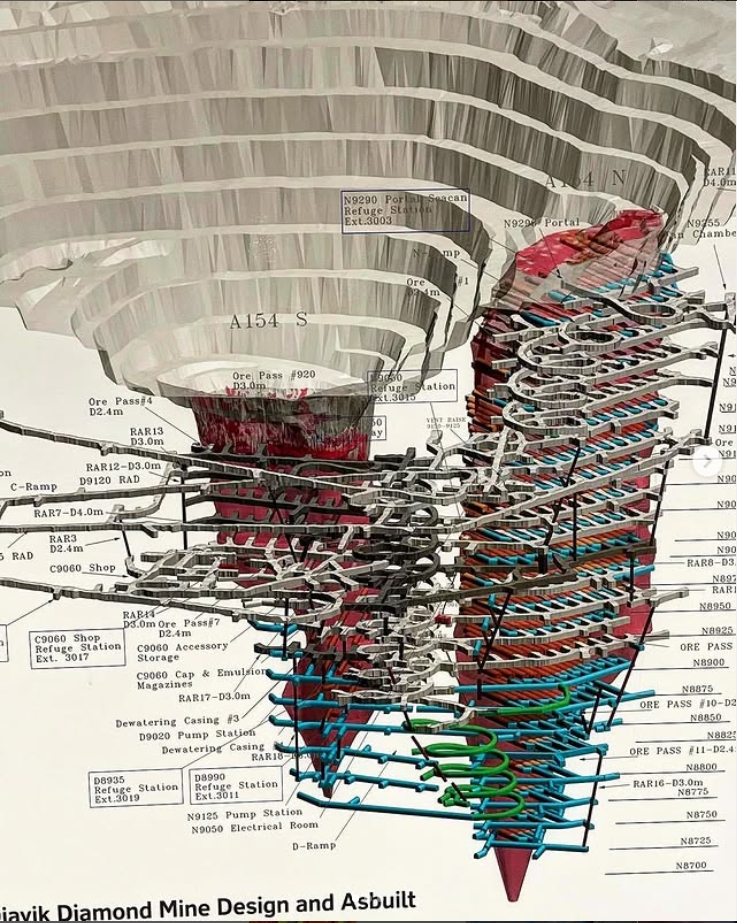
The transition for Open Pit to Underground mining hinges on balancing economic benefits with engineering limits.
The optimal depth is reached when the cost of deepening the pit by another meter matches or exceeds the cost of underground extraction for the same ore volume.
So, you can start planning it from 5 to 15 years before the pit reaches its limit. If you identify the transition point earlier, you can ensure things like proper infrastructure, stable slopes, and maximum reserves recovery.
Ultimately, choosing the right transition depth keeps the mine running smoothly and maximizes the deposit value throughout its life cycle.
One of the biggest factors shaping the choice of underground mining method once the open pit phase is complete is geomechanical conditions.
Key factors include:
- rock strength;
- fracturing instead of stress;
- pit slope stability;
- host rock properties;
Rock quality is evaluated using systems like RMR, Q, GSI or strength criteria such as Hoek-Brown criterion which helps create limit state diagrams for various scenarios.
For example, the Hoek-Brown criterion uses rock strength and structural data to define ultimate rock pressure aiding in assessing pit slope stability and predicting roof collapse.
In strong uniforms rocks like intrusive types with UCS above 150 to 200 MPa, pit slopes can be steeper around 45 to 60⁰ allowing deeper pits.
In weaker rocks with UCS below 50 MPa, slopes must be gentler under 40% restricting pit depth.
Most economically design pits have slope angles already maximized within geomechanical limits. So deepening further risks instability or requires impractical pit expansion.
Different underground mining systems place different demand on the strength of the rock mass. In strong rocks, with a low fracturing and high UCS like over 100 MPa, large stable chambers work well, making a room and pillar or large volume blast method such as sublevel stoping ideal.
For moderately strong or mixed rock masses prone to collapse, the backfilled methods like cut and fill or control caving such as sublevel caving are better where the hanging wall collapses after extraction.
For example, sublevel caving is used in Sweden and Ukraine’s iron deposits because the magnetite is so strong with UCS around 200 MPa. The surrounding weaker host rock naturally fills the void after blasting.
Block caving was once thought suitable only for weaker rocks with UCS from 6 to 60 MPa that naturally break under their own weight. However, advancements over the passed 20 years like hydraulic fracturing or preconditioning blasting have expanded block caving to strong rocks.
For example, in project like Palabora in South Africa and El Teniente in Chile, block caving has successfully been implemented in rock masses with UCS value of 140, 170 MPa even up to around 300 MPa in Palabora.
Author: K-MINE
Image rights: Mining Engineering Education⚒ (Instagram)