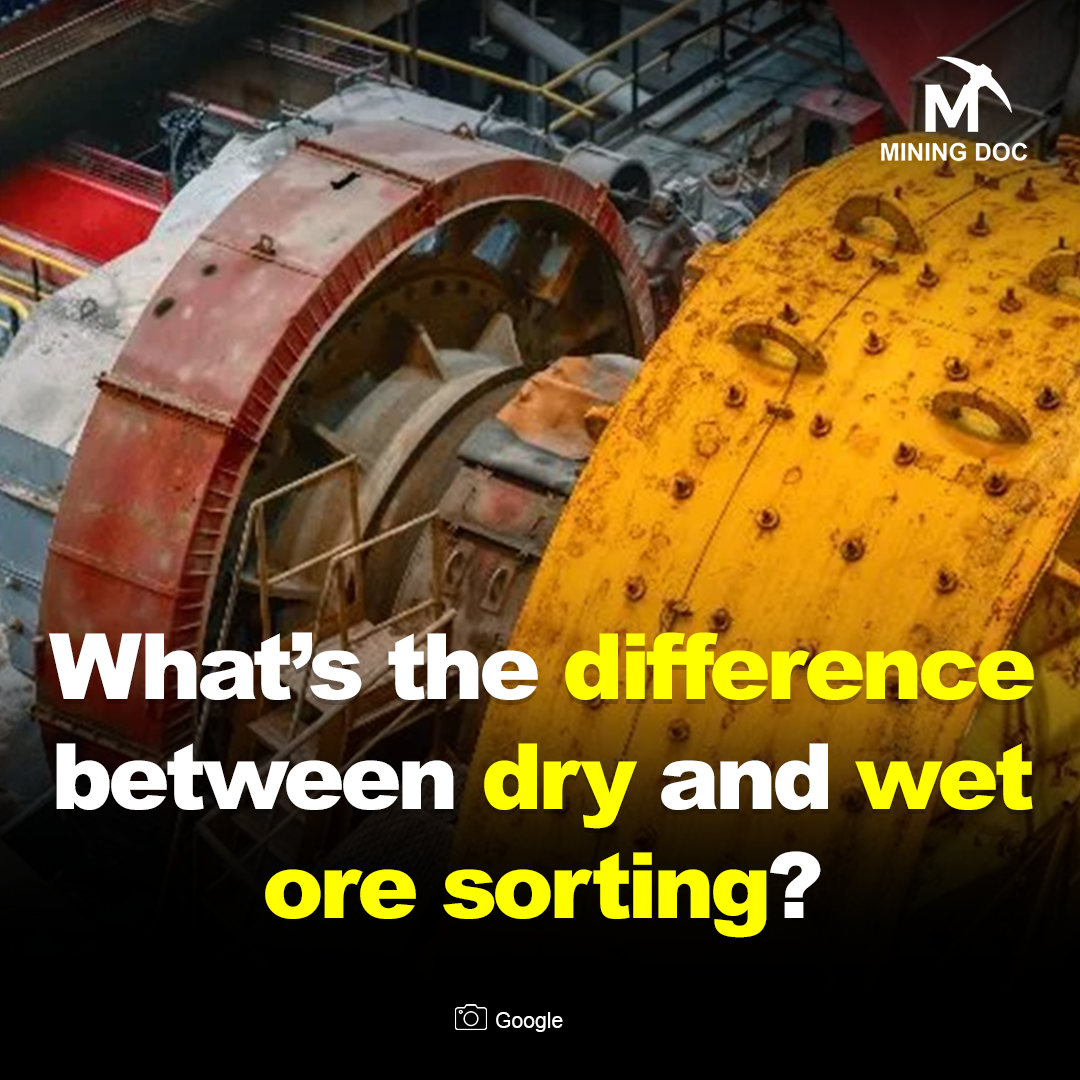
Dry ore sorting involves processing material in a dry state using mechanical screening, sensors, and air-based methods to separate ore from waste.
It is typically more cost-effective since it eliminates the need for water, pumping, and dewatering.
Dry sorting works best with coarse, dry material but can face challenges like dust generation and reduced efficiency when fine particles or clays are present(Machinery, 2023).
Wet ore sorting uses water or slurry to process the material, helping to remove clays, dirt, and fines for improved sensor accuracy and eliminating dust issues.
The slurry environment allows for finer separation using methods like centrifugal or spiral concentration.
However, it requires extra infrastructure such as pumps, piping, spray systems, and dewatering equipment to manage water before further processing or disposal.
Wet sorting is better suited for ores with fine or clay-rich content that limit the effectiveness of dry sorting(What Are the Differences between Dry Magnetic Separator and Wet Magnetic Separator?, n.d.).
The shift toward minimizing water consumption is making dry sorting increasingly attractive. What are the key mechanical or technical differences between dry and wet ore sorting systems, and how does each impact the downstream crushing and grinding circuit?
Reference:
-
Machinery, J. M. (2023, August 15). Kaolin Dry And Wet Beneficiation Method. JXSC Machinery. https://mineraldressing.com/blog/kaolin-dry-and-wet-beneficiation-method/
-
What are the differences between dry magnetic separator and wet magnetic separator? (n.d.). Retrieved October 16, 2025, from https://www.xkjgroup.com/news/product-knowledge/what-are-the-differences-between-dry-magnetic-separator-and-wet-magnetic-separator.html