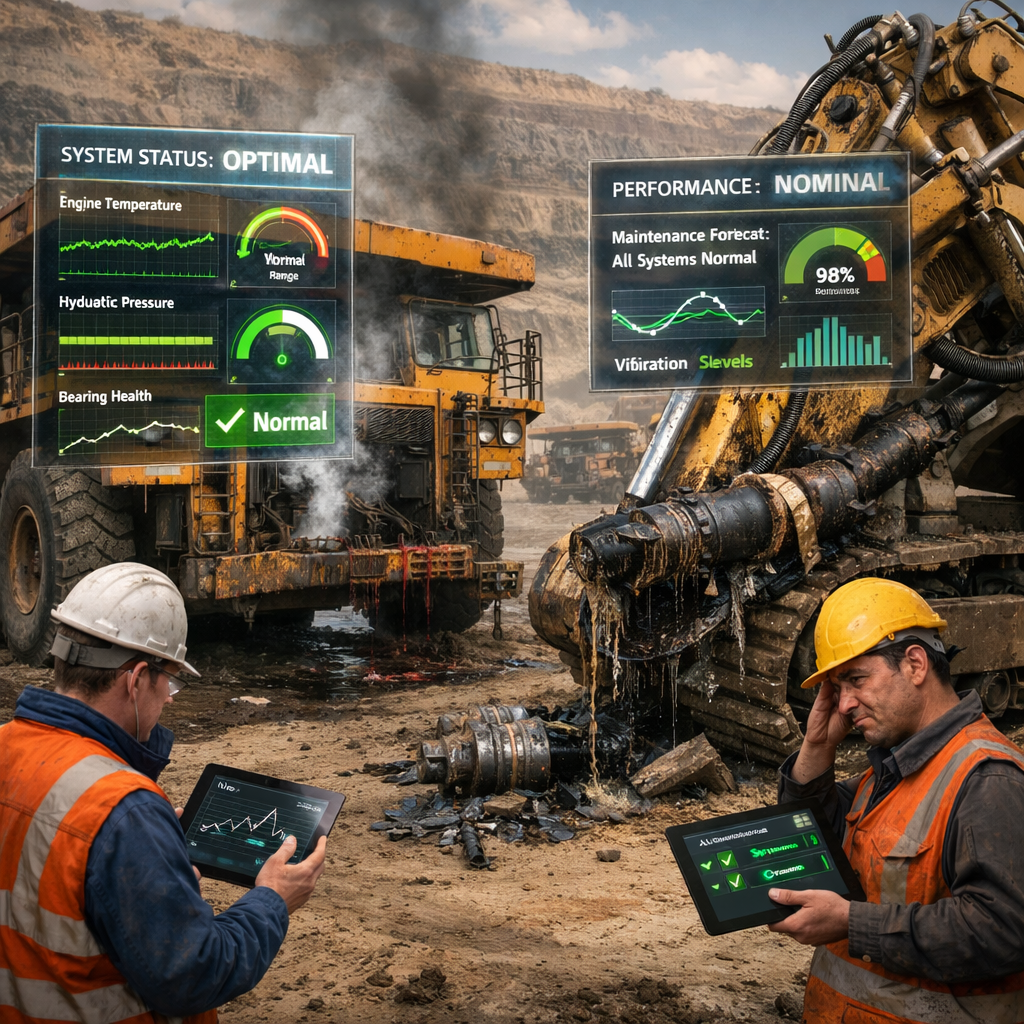
For decades, the mining industry has chased the “holy grail” of asset management: Predictive Maintenance (PdM). The promise is seductive—using artificial intelligence (AI) and real-time data to foresee equipment failure before it occurs, thereby eliminating unplanned downtime. However, despite the surge in Industry 4.0 marketing, recent scientific discourse suggests that for many operations, true PdM remains more of a theoretical aspiration than a functional reality. While the technology exists, the gap between controlled simulations and the chaotic environment of a working mine often renders these systems ineffective (Costa et al., 2025).
The harsh reality of the mining environment
One of the primary reasons PdM is often dismissed as a “myth” in mining is the extreme divergence between laboratory models and field conditions. Mining assets like crushers, conveyor belts, and underground haul trucks operate under severe environmental stress, including abrasive dust, high humidity, and fluctuating mechanical loads (Werbinska-Wojciechowska & Rogowski, 2025).
Research indicates that these non-stationary operations cause unpredictable stress patterns that traditional predictive models struggle to interpret. For example, the rapid deterioration of mine haul roads introduces external variables that can cause premature component wear, often bypassing the internal “signals” that sensors are designed to catch (Costa et al., 2025). When the physical environment changes faster than the model can adapt, the “prediction” becomes little more than a guess.
The data paradox: volume without value
A common misconception is that more data leads to better predictions. In reality, the mining sector suffers from a lack of robust, standardized datasets. Many AI-driven models remain confined to simulation-based studies and fail when faced with the “dirty” data of a real-world mine (Sayyad et al., 2021).
Several critical data-related barriers prevent PdM from becoming a reality:
- Interoperability issues: mining sites often use heterogeneous sensor technologies and incompatible data formats, making it nearly impossible to create a unified predictive framework (Costa et al., 2025).
- The “Black Box” problem: many AI models lack interpretability. If a system signals a failure but cannot explain why, maintenance teams—who prioritize safety and immediate production—are unlikely to trust or act on the recommendation.
- Latency and connectivity: in remote or underground locations, the delay in transmitting high-volume sensor data to the cloud can degrade the effectiveness of real-time monitoring, leading to “predictions” that arrive after the failure has already occurred.
Why preventive maintenance still dominates
Because PdM often fails to deliver on its high-accuracy promises, many mining operations fall back on traditional preventive maintenance. While preventive strategies can lead to “over-maintenance” and the premature replacement of healthy parts, they offer a level of scheduled certainty that current predictive models lack (Werbinska-Wojciechowska & Rogowski, 2025).
Furthermore, the implementation of PdM is incredibly resource-intensive. Maintenance costs already account for 35% to 50% of a mine’s total operating budget (Costa et al., 2025). Adding the cost of specialized sensors, data scientists, and edge computing infrastructure often results in a poor Return on Investment (ROI) if the system only achieves marginal gains in reliability.
Moving beyond the myth
Is predictive maintenance truly a myth? Not entirely, but its current implementation is often “unrealistic” due to a failure to integrate human expertise with digital twins (Sayyad et al., 2021). For PdM to move from myth to reality, the industry must transition toward “Explainable AI” and hybrid models that combine physics-based engineering with data-driven analytics (MDPI, 2026). Until then, the “predictive” part of maintenance will remain a goal rather than a guaranteed outcome.
References
Costa, A., Miranda, J., Dias, D., Dinis, N., Romero, L., & Faria, P. M. (2025). Smart maintenance solutions: AR- and VR-enhanced digital twin powered by FIWARE. Sensors, 25(3), 845. https://doi.org/10.3390/s25030845
Sayyad, S., Kumar, S., Bongale, A., Kamat, P., Patil, S., & Kotecha, K. (2021). Data-driven remaining useful life estimation for milling process: Sensors, algorithms, datasets, and future directions. IEEE Access, 9, 110255–110286. https://doi.org/10.1109/access.2021.3101284
Werbinska-Wojciechowska, S., & Rogowski, R. (2025). Proactive maintenance of pump systems operating in the mining industry – A systematic review. MDPI Preprints. https://doi.org/10.20944/preprints202502.1128.v1