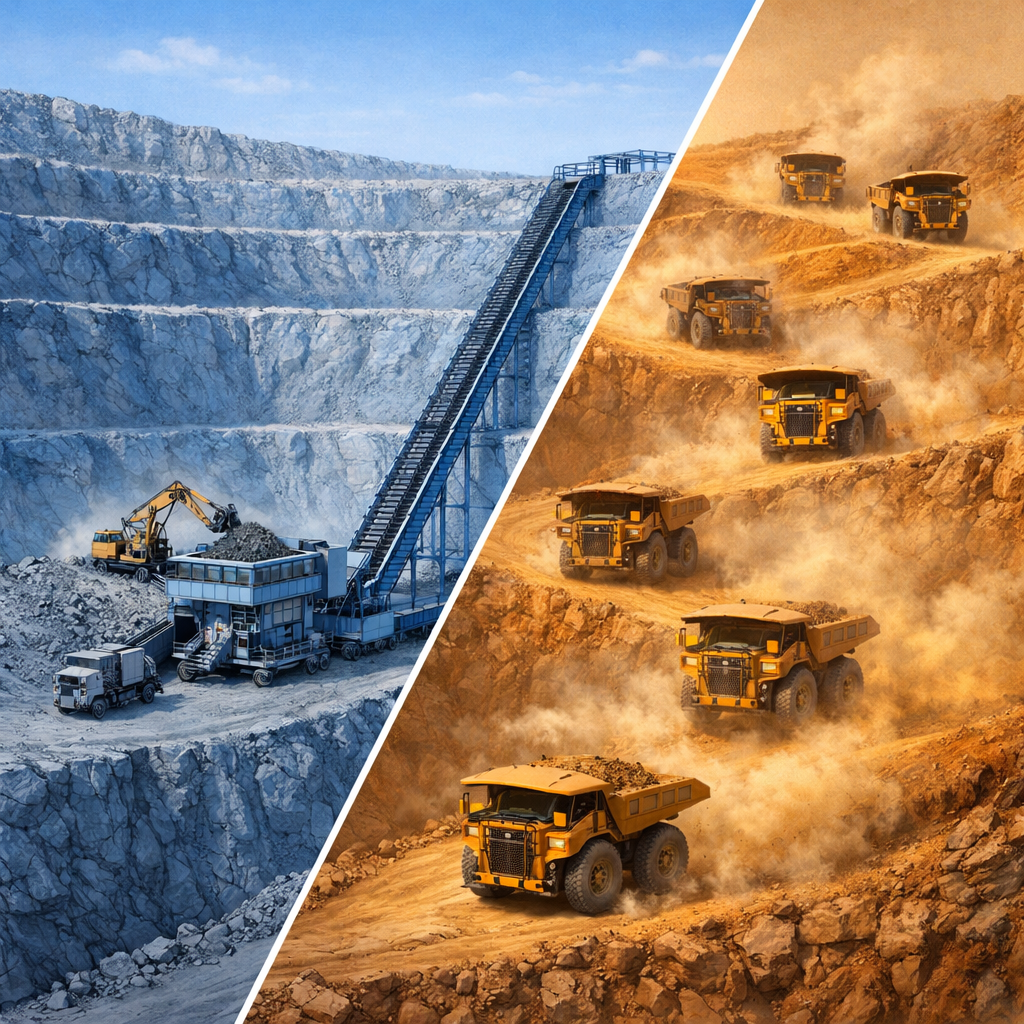
Haulage is one of the most significant; and expensive; elements of open-pit mining, often representing as much as 50–60% of total operating costs. As pits deepen and environmental expectations intensify, mining companies are looking beyond conventional truck haulage and increasingly turning their attention to alternatives such as In-Pit Crushing and Conveying (IPCC).
IPCC systems crush material directly within the pit and move it via conveyors, eliminating the need for large haul truck fleets. By comparison, traditional trucking relies on a load–haul–dump cycle, valued for its simplicity and operational flexibility.
A key strength of IPCC lies in its potential to reduce operating costs over the long term. Conveyors are far more energy-efficient than diesel-powered trucks, resulting in lower fuel consumption and reduced maintenance requirements. This efficiency also brings environmental benefits, including a smaller carbon footprint; an important consideration for companies working toward ESG commitments. Fewer trucks on site further enhance safety by minimizing traffic and the risks associated with vehicle interactions. These advantages become especially pronounced in deep, large-scale operations, where long haul distances can significantly erode truck productivity.
Despite these benefits, IPCC systems are not without challenges. They demand substantial upfront capital investment, as they require the installation of crushers, conveyor networks, and supporting infrastructure. Their fixed nature also limits flexibility, making it harder to respond quickly to changes in mine design or orebody conditions. In addition, a failure within the conveyor system can disrupt the entire production chain, potentially leading to costly downtime. Successful implementation therefore depends on careful, long-term planning and can be difficult to retrofit into existing operations.
Conventional trucking, meanwhile, remains widely used for good reason. Its adaptability allows operators to respond easily to evolving mine layouts and production needs, making it particularly well-suited to smaller deposits or shorter mine lives. However, this flexibility comes at a cost; higher operating expenses, greater environmental impact, and declining efficiency as haul distances increase in deeper pits.
Ultimately, choosing between IPCC and conventional trucking is a matter of context. Factors such as mine scale, depth, life of mine, and production consistency all play a role. In many situations, a hybrid approach that combines both systems offers the most practical solution, balancing flexibility with efficiency. The future of mine haulage will depend on selecting, and integrating, the right approach for each operation’s specific conditions.