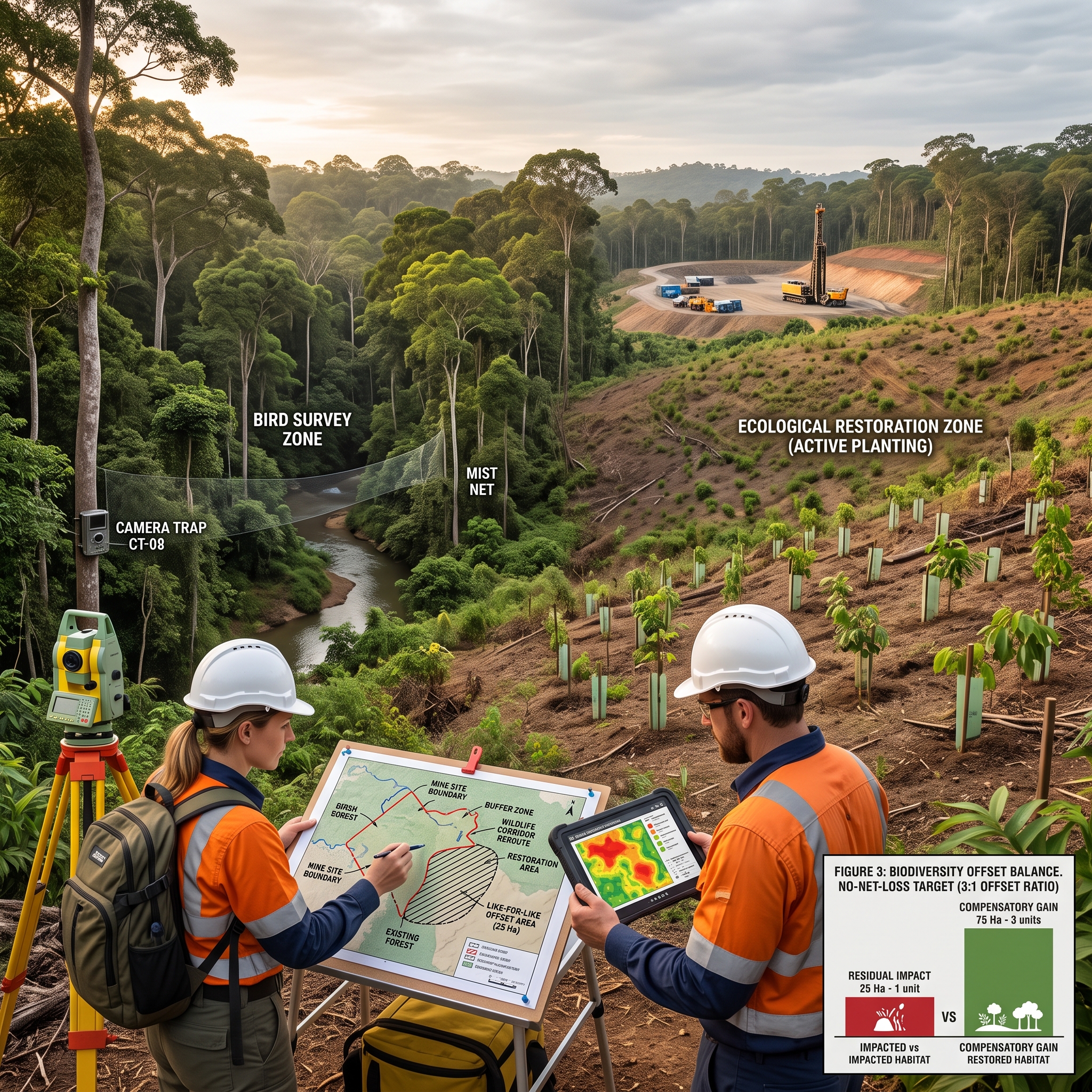
Greenfield projects involve infrastructure construction in areas that have been left untouched. In cases where such development takes place in a sensitive habitat, an area which is characterized by high ecological significance and fragility, then the risk involved in the environment becomes high. These risks are mitigated through biodiversity offsetting, which involves conservation outcomes to compensate for major residual biodiversity loss following development (Abdo et al., 2019).
The right strategy for compensating is decided before any offset plans have been formulated and is fully regulated by the hierarchy of mitigation. This internationally accepted principle demands that developers consider avoiding impacts by moving the development away from areas of important natural habitat (Phalan et al., 2017). If total avoidance cannot be achieved, then the project should minimize the impact and then restore the site that has been damaged (Arlidge et al., 2018). Offsetting is an option only if all other steps fail.
After the confirmation of the residual effects, sound ecological accounting is the cornerstone for implementing an effective offsetting strategy. Achieving the goal of no-net-loss depends on the proper baseline assessment of biodiversity of the greenfield site using accurate measures to assess the species diversity and the habitat structure (Arlidge et al., 2018). The planners are expected to follow the stringent “like-for-like” criterion by making sure that the specific habitats being destroyed are the same habitats that are created in the designated offset area.
The selection of the location of the offset is just as important, as one must take into account connectivity within the landscape as well as the well-being of people. According to modern approaches, the use of ecosystem services in the process of planning biodiversity offset is considered optimal in order to prevent the dislocation of ecological services that local people depend on (Barnes et al., 2023).
The translation of theoretical offsetting into an effective ecosystem requires the existence of sustainable governance and financing structures. Without proper monitoring and compliance measures, biodiversity offsets do not accomplish their goals for conservation and hence add to the growing gap in the world’s ecology (Brownlie et al., 2013). The right way forward is through the implementation of legal contracts that will ensure that the offset site is protected forever, along with proper financing tools to manage and monitor the site for decades to come.
In summary, the implementation of a biodiversity offset in relation to a greenfield development in an environmentally sensitive area is an extremely complicated process. It should never be seen as a replacement for avoiding damage to the environment, but rather as the final stage of a rigorous mitigation hierarchy. By using scientific baseline data, emphasizing the value of ecosystem services at the landscape level, and creating lasting governance, developers can successfully balance infrastructure and environmental protection.
References
Abdo, L. J., Kemp, A., Coupland, G., & Griffin, S. (2019). Biodiversity Offsets Can Be a Valuable Tool in Achieving Sustainable Development Developing a Holistic Model for Biodiversity Offsets That Incorporates Environmental, Social and Economic Aspects of Sustainable Development. Journal of Sustainable Development, 12(5), 65. https://doi.org/10.5539/jsd.v12n5p65
Arlidge, W. N. S., Bull, J. W., Addison, P. F. E., et al. (2018). A Global Mitigation Hierarchy for Nature Conservation. BioScience, 68, 336-347. https://doi.org/10.1093/biosci/biy029
Barnes, A., Ickowicz, A., Cesaro, J.-D., et al. (2023). Improving Biodiversity Offset Schemes through the Identification of Ecosystem Services at a Landscape Level. Land, 12(1), 202. https://doi.org/10.3390/land12010202
Brownlie, S., King, N., & Treweek, J. (2013). Biodiversity tradeoffs and offsets in impact assessment and decision making: can we stop the loss?. Impact Assessment and Project Appraisal, 31(1), 24-33. https://doi.org/10.1080/14615517.2012.736763
Phalan, B., Hayes, G., Brooks, S., et al. (2017). Avoiding impacts on biodiversity through strengthening the first stage of the mitigation hierarchy. Oryx, 52, 316-324. https://doi.org/10.1017/s0030605316001034