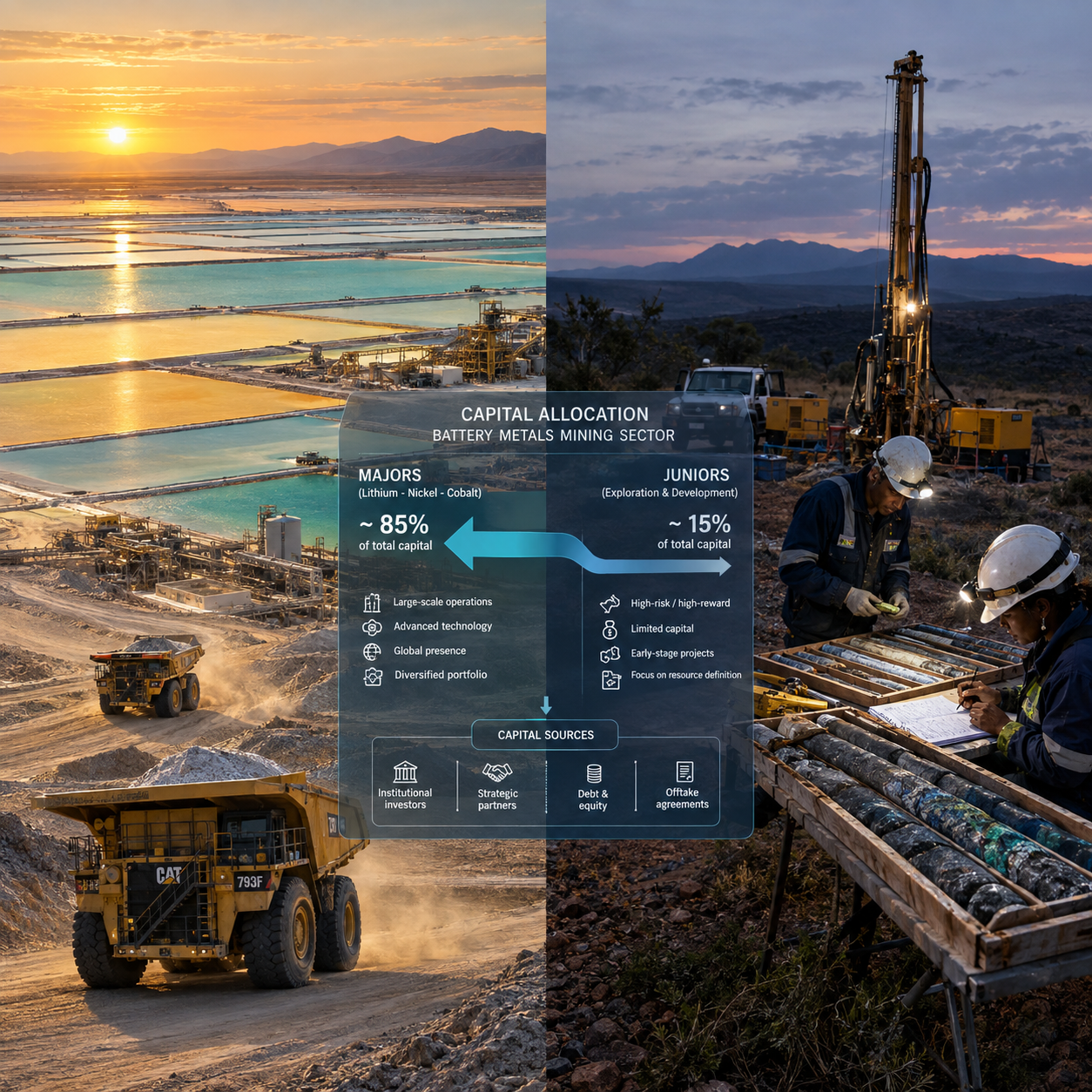
A shift towards clean energy production and consumption is enabled by “battery metals” – an array of critical minerals such as lithium, cobalt, and nickel needed for energy storage. It is important to define the two main parties involved in the industry to understand how this shift affects the allocation of capital. These include majors and juniors where majors are technologically sophisticated firms with diversified international presence and stable cash flow while juniors are smaller firms in the exploratory stage dependent on capital markets. Increasing demand for clean energy means that the capital allocation practices of both become fundamentally transformed.
The growth in use of electric vehicles and renewables is driving a demand for raw materials that breaks traditional commodity cycles. Traditionally capital used to be directed towards fossil fuels or bulk commodities is now increasingly being reallocated to critical minerals (Anzolin & Pietrobelli, 2021). This increases the dynamic connectedness across non-ferrous commodity markets which necessitates constant portfolio rebalancing as a reaction to the volatile price changes (Mishra & Ghate, 2022). Hence, capital increasingly focuses on battery metals and thus miners have to redefine their investment framework and approach to risk management.
For majors, capital allocation becomes more focused on making strategic acquisitions and brownfield development rather than high-risk exploration from scratch. Given the necessity to satisfy the demands of shareholders who want their dividends while switching to green energy, majors use their strong financials to buy out the risked-out assets. Capital allocation strategy includes integrating into global value chains through downstream processing and securing long-term deals with automotive companies (Pietrobelli et al., 2021). Such an approach mitigates geological risk while increasing the market exposure of miners.
Junior miners continue to be the risk-takers of the industry allocating capital for greenfield exploration. Increased demand for battery metals is giving junior miners a second life and making possible capital inflows through specialized private and venture capital. Given the high amount of capital needed to explore the mines, junior miners often position themselves as potential takeover targets. Junior miners’ capital allocation is focused on drilling and feasibility studies to prove resource viability and act as the discovery channel for major mining companies.
Apart from market conditions, capital allocation in mining is becoming highly limited by geopolitical factors. Governments of countries rich in natural resources become aware of the strategic importance of critical minerals and implement corresponding regulations to retain local value. Companies have to allocate significant capital in order to adapt to local content policies and become integrated into the local economy (Anzolin & Pietrobelli, 2021). Countries with coherent and clear policies see an increased share of mining investments while politically turbulent ones face capital shortfall.
Overall, this shift towards battery metals resulted in the formation of symbiotic capital allocation system among majors and juniors. Juniors allocate high-risk capital to discover new minerals while majors allocate institutional capital to scale discoveries to production. With the move towards net-zero emission in the world, it will become crucial for these firms to effectively allocate capital to ensure the supply of raw materials for the sustainable energy future.
References
Anzolin, G., & Pietrobelli, C. (2021). Local content policies: Why mining need consistent policy packages to support capabilities development. The Extractive Industries and Society, 8, 395-399. https://doi.org/10.1016/j.exis.2020.11.013
Mishra, A. K., & Ghate, K. (2022). Dynamic connectedness in non-ferrous commodity markets: Evidence from India using TVP-VAR and DCC-GARCH approaches. Resources Policy, 76, 102572. https://doi.org/10.1016/j.resourpol.2022.102572
Pietrobelli, C., Rabellotti, R., & Van Assche, A. (2021). Making sense of global value chain-oriented policies: The trifecta of tasks, linkages, and firms. Journal of International Business Policy, 4, 327-346. https://doi.org/10.1057/s42214-021-00117-6