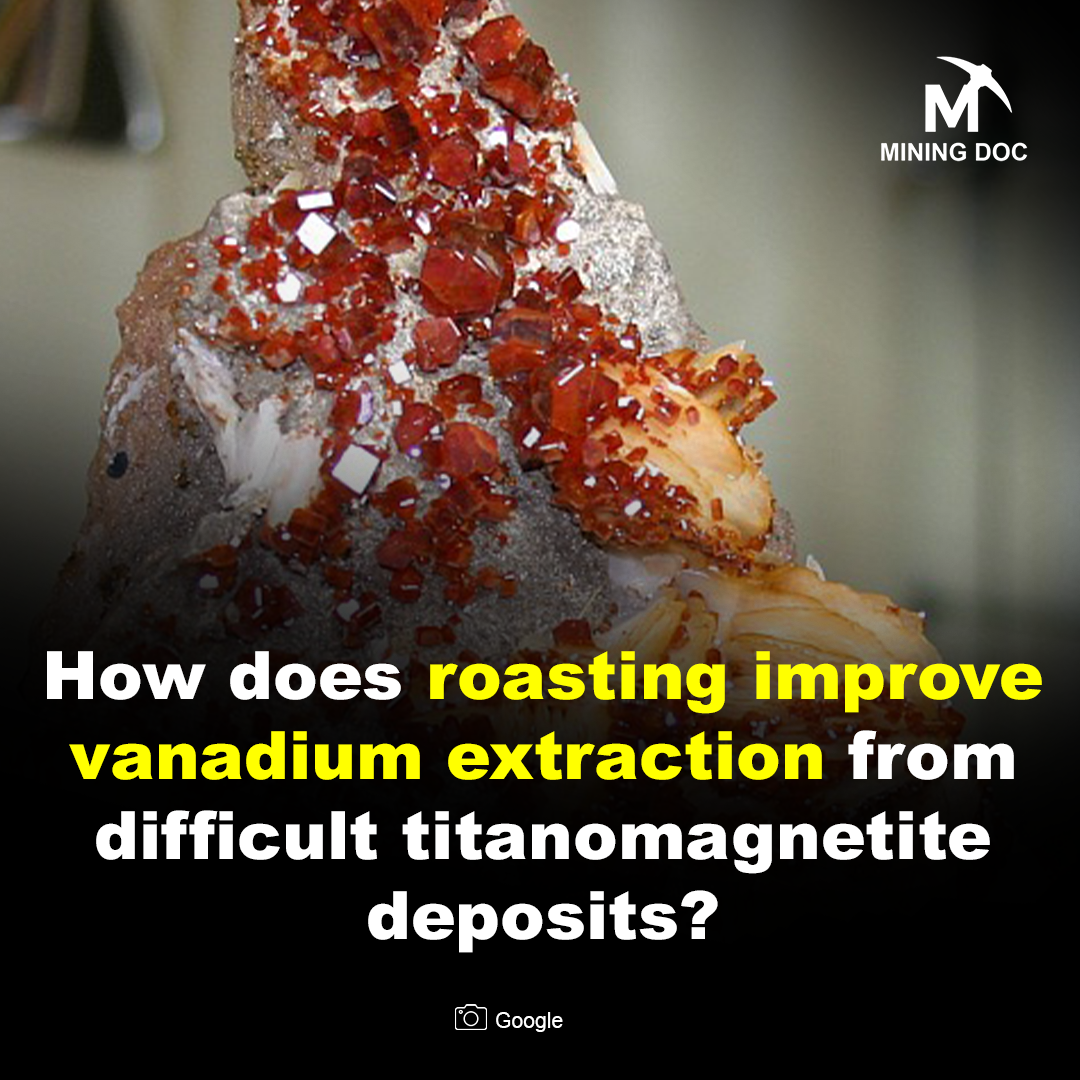
Vanadium is a critical enabler of vanadium redox flow batteries (VRFBs) for grid-scale energy storage, and a hardener in high-strength steel that’s reshaping construction and defense. As a result, demand curves are climbing. Some of the world’s largest vanadium resources sit inside titanomagnetite (V-Ti-Fe) deposits and getting that vanadium out is one of extractive metallurgy’s toughest puzzles.
In titanomagnetite ore, vanadium doesn’t sit conveniently on grain boundaries waiting to be dissolved. It’s substituted directly into the spinel crystal lattice of magnetite (Fe₃O₄) and ilmenite (FeTiO₃) locked in as trivalent vanadium (V³⁺), which makes leaching difficult.
Roasting positions itself then as an accurate solution to easily extract vanadium.
Below are the steps involved in roasting:
- Oxidation State Change
At high temperature, insoluble V³⁺ is oxidized to soluble pentavalent vanadium (V⁵⁺). This single change in oxidation state is the difference between vanadium being “trapped” and vanadium being “available.” - Salt Addition — Na₂CO₃ / NaCl / Na₂SO₄
Sodium salts are blended with the ore and roasted (commonly in the ~800–900°C range, with some processes extending toward 1200°C depending on the salt system and ore mineralogy). The sodium reacts with the newly oxidized vanadium to form sodium metavanadate (NaVO₃) a compound that is water-soluble. - Phase Separation
Roasting also cracks open the spinel matrix itself breaking down the magnetite-ilmenite structure so the newly formed NaVO₃ can migrate to the surface. Iron and titanium remain largely unreacted and stay in the solid residue, while vanadium is selectively leached out with water in the downstream circuit.
As such, a resource that was chemically “unreachable” becomes a clean, sellable vanadium stream while iron and titanium by-products can potentially still be recovered.
To mitigate the chlorine emissions and corrosive off-gas of traditional salt roasting, the industry is adopting sodium-free calcification routes, direct acid leaching hybrids, and advanced scrubbing systems to meet modern environmental standards.
As direct acid leaching and sodium-free alternatives mature, will salt roasting remain the industry workhorse for V-Ti-Fe ores?
References:
-
Li, X., Wang, Z., Zhang, Y., & Liu, Y. (2017). Extraction of vanadium from titanomagnetite ores: A review. Hydrometallurgy, 174, 79–89.
-
Moskalyk, R. R., & Alfantazi, A. M. (2003). Processing of vanadium: A review. Minerals Engineering, 16(9), 793–805.
-
Society for Mining, Metallurgy & Exploration (SME). (2019). SME mineral processing and extractive metallurgy handbook (3rd ed.). SME.