The exhaustion of high-quality ore reserves creates a clear operational challenge for the worldwide mining industry. Traditional pyrometallurgical smelting of high-grade ores produces significant emissions, while low-grade ores, primarily of primary copper sulfides and refractory gold deposits, require environmentally safe and cost-effective hydrometallurgy.
The biological extraction of metal represents up to twenty percent of copper production globally, where copper makes up over forty-seven percent of the total revenue of the bioleaching market. Organisms use iron and sulfur present in sulfide minerals to extract copper or precious metals contained in them. This article provides an overview of current advances in bioleaching technology, catalysts usage, biooxidation of refractory gold and application in low-grade ores.
Primary sulfide minerals like chalcopyrite and enargite have low solubility due to their inability to dissolve fast at ambient or moderately high temperatures. Thermophilic bioleaching at high temperature is characterized by high recovery of copper but requires extensive energy expenses. Recent research show that catalysts usage is a breakthrough for both ambient and moderately thermophilic processes.
Addition of silver sulfide results in decrease of solution’s redox potential and formation of intermediate chalcocite mineral; ninety-six percent recovery is achieved without unnecessary pyrite oxidation. Chemical activated carbon powder works using similar principle by facilitating electron transfer and reducing of ferric iron along with oxidation of sulfur compounds. Controlling redox potential to be below seven hundred millivolts prevents excessive pyrite breakdown and allows for continuous enargite dissolution and simultaneous precipitation of harmful arsenic as ferric arsenate or scorodite.
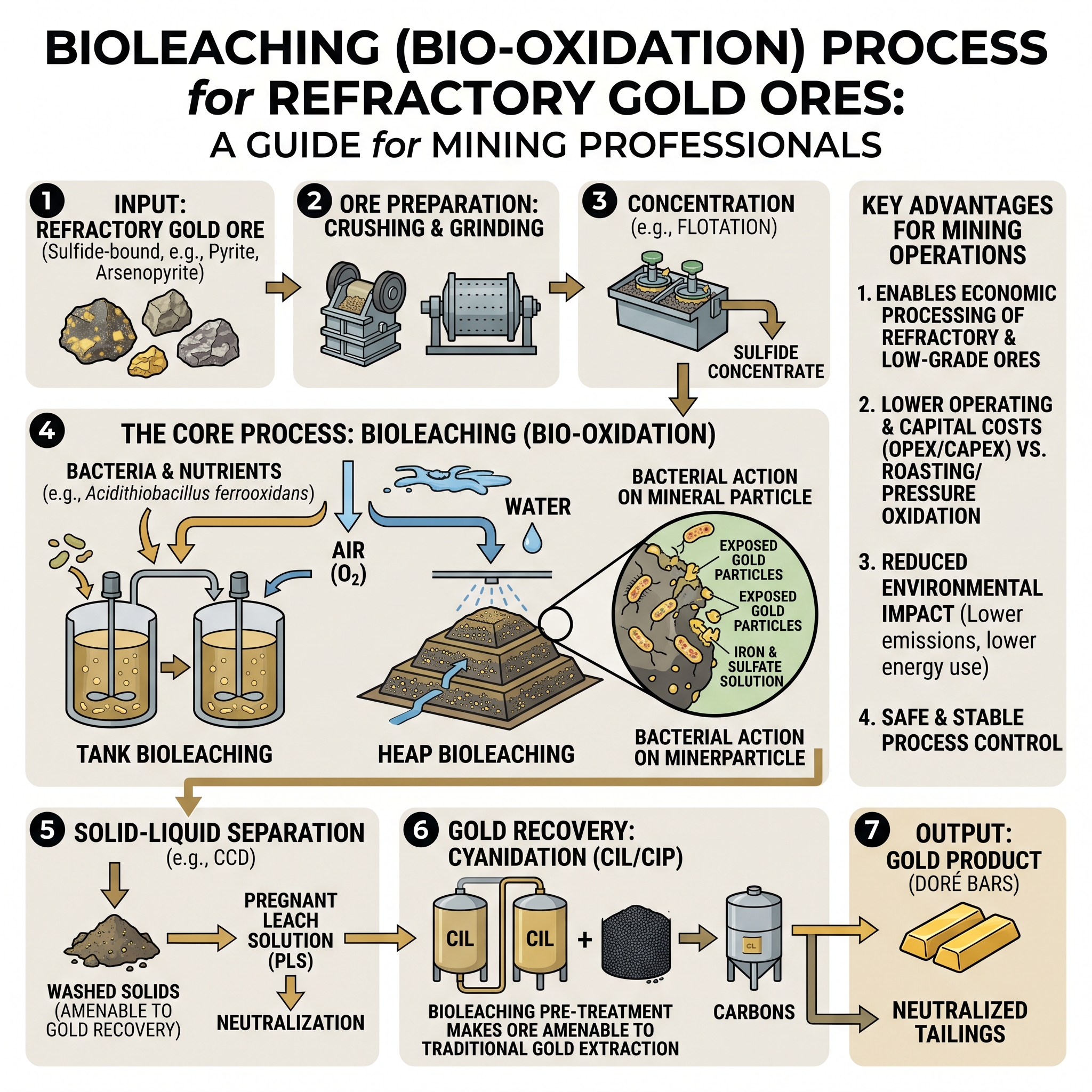
Biological oxidation for the extraction of gold in refractory sulfide ores is based on the breaking down of the matrices composed of pyrite and arsenopyrite. Biological processes reveal gold microparticles in a matrix of minerals not dissolving the precious metal in an acidic solution. Secondary techniques use safe lixiviants like thiosulfate and glycine rather than harmful cyanidation. Tailings dumps become profitable because of biological oxidation becoming an economic resource and cleaning up the environmental damage done in the past. Practical experience confirms that biooxidation keeps dangerous arsenic in the liquid form till its precipitation into stable minerals.
The application of bioleaching is expanding via heap leaching and reactors. Heap bioleaching is utilized by Chile and China to extend mines’ operation period and to exploit low-grade deposits. Studies with reactors reveal that moderately thermophilic communities adapt themselves successfully to copper concentrates up to ten percent of pulp density. Stirred reactors increase interaction between minerals and microorganisms as well as between gas and liquid phases leading to nearly complete copper extraction. Current attempts of wider application try to resolve the problem of capital costs and corporate fears.
Bioleaching, being sustainable, offers a very efficient process for the treatment of refractory copper ores, poor grade ores, and gold tailings. The utilization of silver and activated carbon as catalysts solves the old problem of kinetic limitations and thus facilitates high metal dissolution along with in situ arsenic stabilization. The use of stirred tank reactors and heap leaching shows that biological treatment processes can scale up to large-scale commercial production. The use of biohydrometallurgy processes is economically beneficial while reducing environmental impact. Bioleaching processes will certainly strengthen their position as a sustainable mining process.