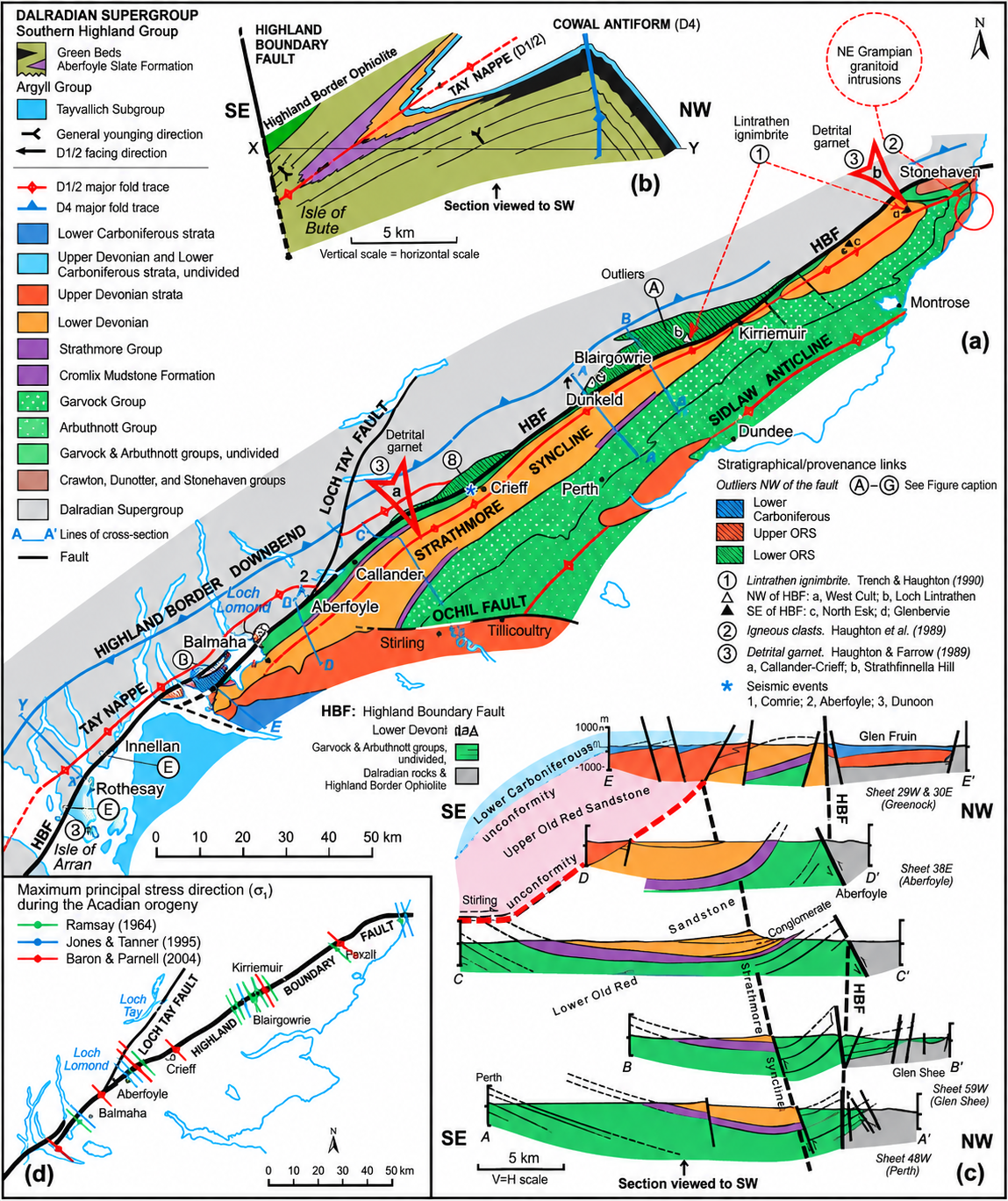
Fault-related displacements present major technical problems in mining geology. One single faulting event may break apart an otherwise contiguous body of highly valuable ore deposits over large distances (Peters, 2001). Mining prospectors usually fail to make accurate interpretations of the underground geology due to their reliance on simplified two-dimensional flat maps. Proper interpretation of faulted mineral deposits requires careful three-dimensional spatial analysis and structure validation. There are three main steps in which geologists make accurate subsurface cross-sections using faulting: (1) calculation of three-dimensional displacement vectors from linear piercing points, (2) kinematic section balancing by palinspastic restoration, and (3) strike-slip out-of-plane movement estimation.
Measurements obtained from only one planar bed or ore body surface cannot define the actual displacement along the fault. Two-dimensional offset measurements across a fault plane provide incomplete information since an infinite number of displacements may produce the observed offset distance (Dutch, 1999). Intersections between the structure contours and the fault plane show the current spatial positions of the features but not their original positions before deformation. To estimate displacement, it is necessary to find three-dimensional linear indicators called piercing points on both sides of the fault contact.
A piercing point is a unique intersection between two non-parallel geological surfaces and a fault plane, e.g., an ore body and an intrusive dike or fold axis (Dutch, 1999). By drawing the structure contours for both geological features on each side of the fault, one will get the unique positions of the points. The straight line connecting these two points gives the total net displacement that includes vertical throw, horizontal heave, dip-slip, and strike-slip displacements. Extended structure contours beyond current topography allow finding the eroded linear indicators.
Palinspastic restoration gives physical proof to constructed cross-sections. In inverse modeling, palinspastic restoration reverses the process of deformation step by step to obtain pre-deformation geometry of the geological profile (Wikipedia, 2026). A cross-section is said to be balanced when the undeformed profile produces a reasonable geometry without introducing false gaps, overlaps, or area changes. Choice of deformation models by geologists is based on the rheology of rocks and tectonic settings (Wikipedia, 2026).
Flexural slip models work on the principle of unfolding of fault-bounded blocks using bedding planes, preserving both line lengths and cross-sectional areas. Vertical or inclined simple shear models work on the principle of accommodating change in shape through parallel slip planes for extensional fault settings. Trishear models operate in triangular heterogeneous strain zones near fault tips.
Traditional two-dimensional restoration techniques are built on the principle of pure in-plane motion where there is zero transfer of mass through the profile. In practice, multi-phase deformation, oblique shear, and strike-slip faults negate this critical basic assumption (Peters, 2001; Wikipedia, 2026). The motion of material through the plane of section creates considerable geometric distortion for two-dimensional restorations. Modern techniques in geology use specific three-dimensional models for modeling non-planar trajectories. Geologists use regional structures in addition to three-dimensional block restoration techniques to determine the location of offset ore zones within complex fault systems.
A careful definition of the cross sections transforms speculations on the geology into powerful tools used in mining for prediction purposes. The use of 3-D linear piercings addresses the problem of misinterpretation that could be brought about by apparent displacements. Section balancing algorithm assesses structural feasibility, while the three-dimensional kinematic modeling ensures the inclusion of out-of-plane displacements. Direct use of structural geology is helpful when conducting drilling operations.
References
Dutch, S. (1999). Find the Offset of a Fault. Natural and Applied Sciences, University of Wisconsin – Green Bay.
Peters, S. G. (2001). Use of structural geology in exploration for and mining of sedimentary rock-hosted Au deposits (U.S. Geological Survey Open-File Report 01-151). U.S. Department of the Interior.
Wikipedia contributors. (2026). Section restoration. Wikipedia, The Free Encyclopedia.