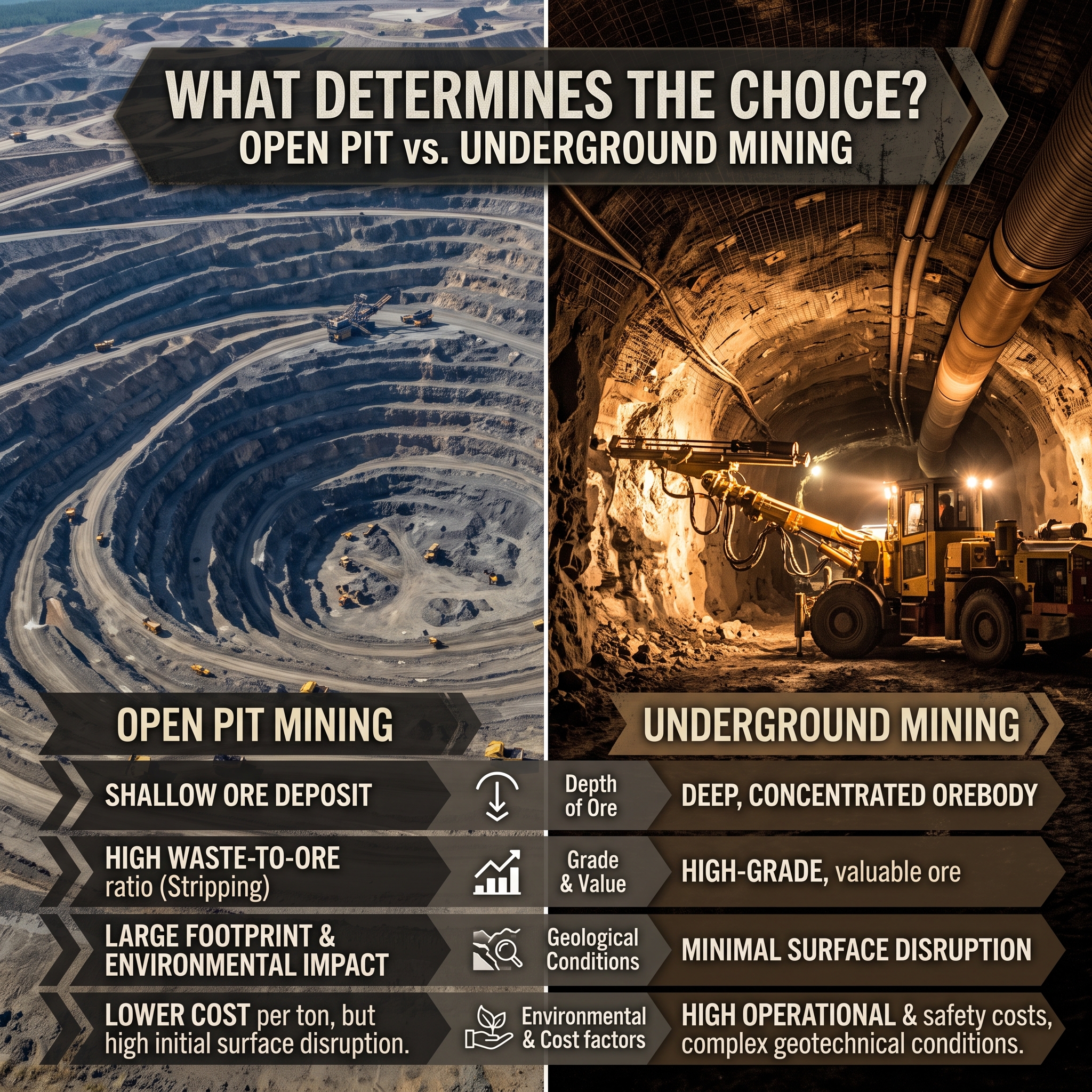


The choice between open pit and underground mining represents one of the most fundamental engineering decisions in mineral resource development. Early project evaluation requires a comprehensive analysis of deposit geometry, economic feasibility, safety parameters, and site-specific operational risks. Resource engineers must avoid reliance on single rules of thumb, as each ore deposit presents unique rock mass mechanics, spatial orientations, grade distributions, and depth profiles. Modern mine planning incorporates mathematical modeling and multi-criteria decision-making frameworks to evaluate competing extraction paths. This summary reviews the primary factors governing method selection across three core domains: spatial characteristics, economic risk management, and environmental transitions.
Deposit geometry serves as the primary physical filter during initial method evaluation. Shallow orebodies with wide lateral extent strongly favor surface open pit excavation due to ease of access and high stripping efficiency. Deeply buried, steep, or narrow-vein deposits necessitate subsurface extraction techniques such as sublevel stoping, cut-and-fill, or caving. Rock mass quality and structural stability dictate the required ground support, opening dimensions, and overall wall stability. High spatial variability in ore grade distribution further influences whether mass excavation or selective stoping is appropriate. Geotechnical conditions directly govern structural safety, ore dilution rates, recovery percentages, and overall mine layout feasibility.
Economic evaluation balances upfront capital expenditures against long-term operating costs per tonne. Open pit operations typically exhibit lower operational expenses per unit volume but require substantial early strip ratios and waste removal. Underground operations incur higher initial capital outlay for shafts, declines, underground crushing facilities, and specialized haulage infrastructure. Advanced financial modeling incorporates discounted cash flows, Net Present Value calculations, real options, and market price volatility. Quantitative frameworks like the Risk-based Evaluation Methodology account for technical scheduling uncertainties and operational flexibility, ensuring that target production levels match corporate risk tolerance while maximizing shareholder value under uncertain economic conditions.
Occupational health considerations present distinct trade-offs between surface exposure and subsurface hazards. Open pit surface operations expose personnel to slope instability and heavy machinery risks, while underground environments involve rock falls, ventilation constraints, and confined spaces. Surface operations create significant land disturbance and terrain degradation, whereas underground methods minimize surface footprints but require specialized tailings and backfill management. Many orebodies feature a critical transition depth where surface extraction becomes economically unviable. Hybrid or sequential mining strategies allow operators to extract shallow reserves via open pit before transitioning to subterranean methods.
Method selection between open pit and underground mining demands a rigorous balance of physical geology, financial return, occupational safety, and environmental stewardship. Project planners utilize multi-criteria decision-making tools and unsupervised clustering algorithms to mitigate individual evaluation bias and resolve conflicting methodological outcomes. Systematic risk analysis protects project value across market fluctuations, technical scheduling constraints, and operational delays. Comprehensive evaluation frameworks integrate financial models with geotechnical parameters to deliver robust recommendations. Strategic multi-phase planning ensures optimal resource recovery throughout the operational life of the mine, transforming complex geological data into a sustainable and profitable extraction sequence.