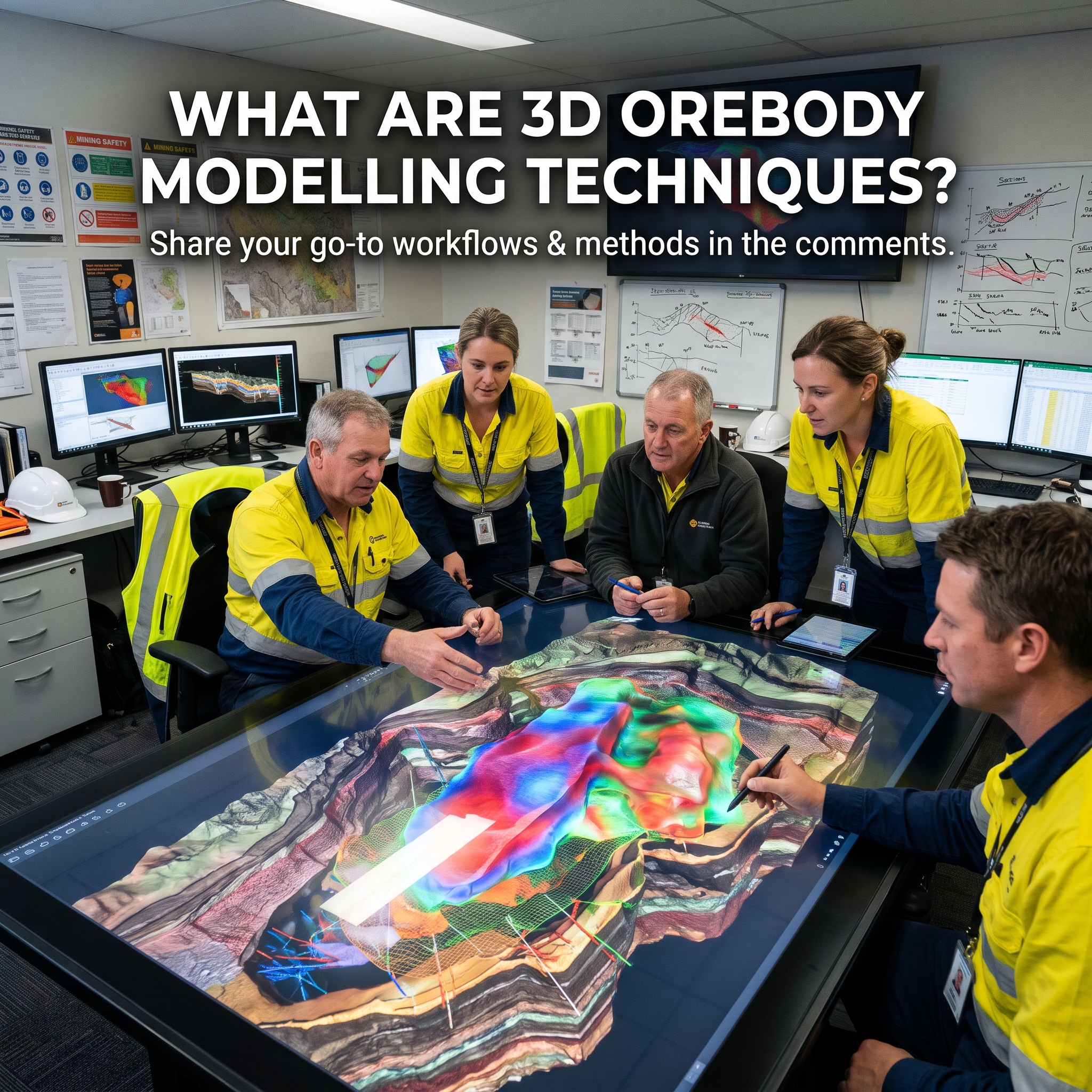


Subsurface mineral exploration presents a formidable operational and financial challenge, as mining ventures must commit extensive capital based on isolated diamond drill holes separated by tens of metres of unsampled rock. To resolve this vast void, geologists develop three-dimensional orebody models that synthesize spatial coordinates, structural mapping, and geochemical assay records into a continuous digital framework. These mathematical representations delineate lithological architectures, compute global tonnages, and evaluate local grade distributions prior to excavation. Modern subsurface characterisation rests upon three foundational methodologies: geological domain boundary construction, volumetric block model grade interpolation, and stochastic uncertainty quantification through spatial simulation.
Structural domain delineation represents the initial stage of spatial characterisation, establishing strict boundaries that prevent artificial grade smoothing across lithological contacts. Traditional explicit modelling relies on manual digitisation across cross-sections to construct triangulated wireframe solids, granting geologists precise control over structurally intricate fault networks and narrow vein systems. Conversely, implicit modelling derives continuous volumetric surfaces directly from borehole contacts through mathematical scalar fields and radial basis functions. This automated formulation updates dynamically as new drilling data arrives, accelerating iterative hypothesis testing. Contemporary workflows often combine both techniques, deploying rapid implicit algorithms for deposit exploration before enforcing explicit manual constraints on critical boundaries.
Volumetric discretisation divides domain envelopes into structured three-dimensional block models composed of regular cubic cells, sub-blocked boundaries, or stratigraphic seams. Spatial interpolation algorithms then populate these blocks with grades, bulk densities, and lithological classifications. Deterministic approaches, notably inverse distance weighting, assign grades through sample distances without assessing spatial correlation structures or estimation errors. Geostatistical kriging algorithms resolve this limitation, yielding the best linear unbiased estimates by weighting informing samples through semi-variogram models that quantify directional continuity and nugget variance. Engineers subsequently filter the resulting block model with economic cut-off grades to separate payable ore reserves from unviable waste rock.
Deterministic interpolation inevitably produces smoothed grade distributions that fail to reflect local geological heterogeneity and spatial risk. Conditional simulation overcomes this smoothing effect by generating multiple equiprobable numerical realisations that reproduce both the sample histogram and spatial variogram. Sequential Gaussian simulation adopts a maximum-entropy assumption suited for deposits with dispersed mineralization, whereas sequential indicator simulation applies threshold-specific variograms to preserve the connectivity of high-grade vein structures. Furthermore, geostatistical simulation of geological interfaces treats structural contacts as spatial random fields, establishing three-dimensional probability distributions of rock occurrences. These stochastic realisations generate grade-tonnage response curves, enabling engineers to optimise underground stope layouts and establish defensible economic dig-lines.
Reliable three-dimensional orebody characterisation demands a coherent progression from validated exploration databases to structural domaining, volumetric block discretisation, and stochastic uncertainty quantification. Rather than functioning as isolated tools, explicit boundaries, implicit scalar surfaces, kriging interpolations, and conditional simulations collectively establish an auditable subsurface digital twin. These geometric and mathematical models supply the vital inputs for open-pit shell optimisation, underground stope layout design, production scheduling, and regulatory reporting under frameworks such as JORC and NI 43-101. Ultimately, optimal technique selection depends on borehole spacing, deposit architecture, and mineralisation continuity, ensuring that mine development strategies remain technically viable and economically robust throughout the operational lifecycle.