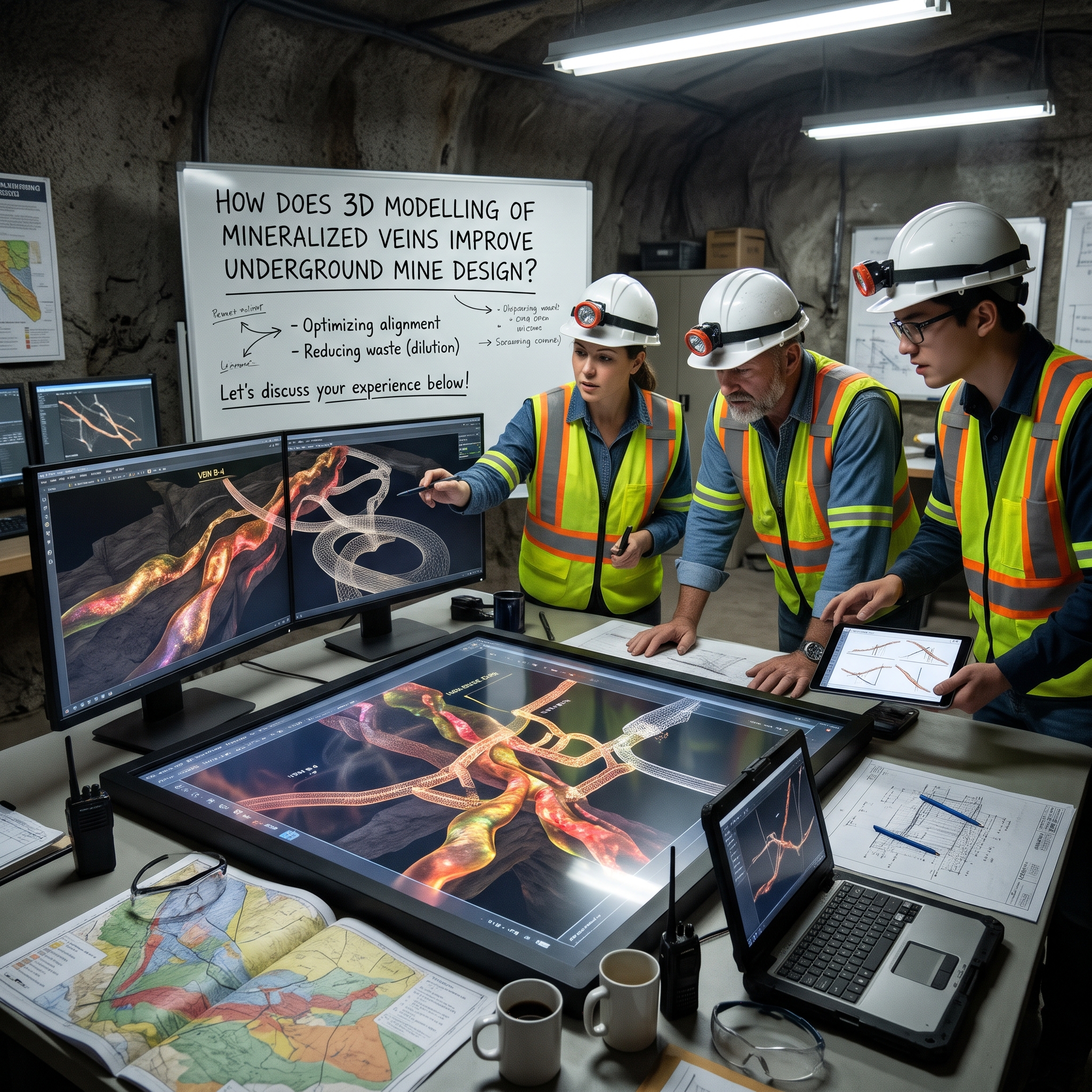


Narrow-vein mineral deposits present severe geometric and spatial challenges for underground excavation, characterized by abrupt structural shifts, pinching, and swelling along strike. Historical reliance on two-dimensional section interpretations frequently misrepresents these continuous, undulating geological bodies. Static cross-sections fail to resolve local volumetric variability, which causes excessive planned dilution or the unintended abandonment of high-grade ore. Modern three-dimensional geological and geotechnical modelling resolves these geometric ambiguities by converting complex borehole and sampling arrays into continuous volumetric representations. Consequently, spatial modelling establishes a robust foundation that transforms stope design, integrates comprehensive geomechanical assessments, and accelerates cross-disciplinary strategic planning across complex underground operations.
Precise delineation of hanging wall and footwall contacts through implicit three-dimensional algorithms enables mine planners to define realistic stope geometries. Digital block models capture local thickness fluctuations and grade variations, allowing engineers to calculate dilution directly against operational minimum mining widths. Automated shape optimisers translate these volumetric solids into buildable stope envelopes that maximise metal recovery while minimising uneconomic wall-rock sloughing. Furthermore, algorithmic workflows map development networks along economic mineralization rather than arbitrary geometric trajectories. Network algorithms rapidly compute optimal extraction paths across varying grade thresholds, establishing a direct link between spatial vein distribution and cut-off grade strategies that maximise net present value.
Geotechnical block modelling extends spatial analysis beyond grade estimation by mapping rock mass competency across the subsurface domain. Interpolation techniques such as ordinary kriging project rock mass quality ratings, fracture frequencies, and structural discontinuities into discrete blocks from borehole core logs. Planners overlay proposed access declines, ventilation raises, and haulage drifts directly onto these geomechanical domains to identify hazardous ground conditions prior to excavation. Spatial awareness of major faults and altered structural corridors informs support system design, excavation stand-up spans, and pillar dimensions. In addition, geomechanical models guide extraction sequences, preventing catastrophic ground unravelling and mitigating severe abutment stress concentrations.
Dynamic three-dimensional modelling establishes a responsive operational framework through continuous data integration. New underground channel samples, drift mapping, and infill drillhole intercepts automatically refresh implicit wireframes, preventing local models from becoming obsolete as production advances. Standardised naming conventions and block model structures facilitate seamless data transfers between resource geologists and mine design engineers. Parametric templates enable engineering teams to simulate dozens of alternative sublevel spacings, drawpoint configurations, and production rates within hours rather than weeks. Rapid multi-scenario evaluations eliminate traditional planning bottlenecks, allowing management to evaluate financial performance indicators and technical trade-offs with rigorous quantitative backing.
Modern three-dimensional vein modelling replaces empirical assumptions and static planar cross-sections with an agile, data-driven underground engineering methodology. Unified digital frameworks align complex structural contacts with automated mine design algorithms, substantially reducing planned dilution and enhancing long-term cash flow predictability. Simultaneous geomechanical block modelling ensures that critical infrastructure avoids severe ground instabilities and high-stress abutments. Operations achieve maximum resource recovery and enhanced safety when geology, geotechnical characterization, and mine scheduling operate as a continuous feedback loop. Mine technical departments must commit to dynamic model reconciliation, updating subsurface wireframes with every blast advance to maintain strategic mine plan fidelity.