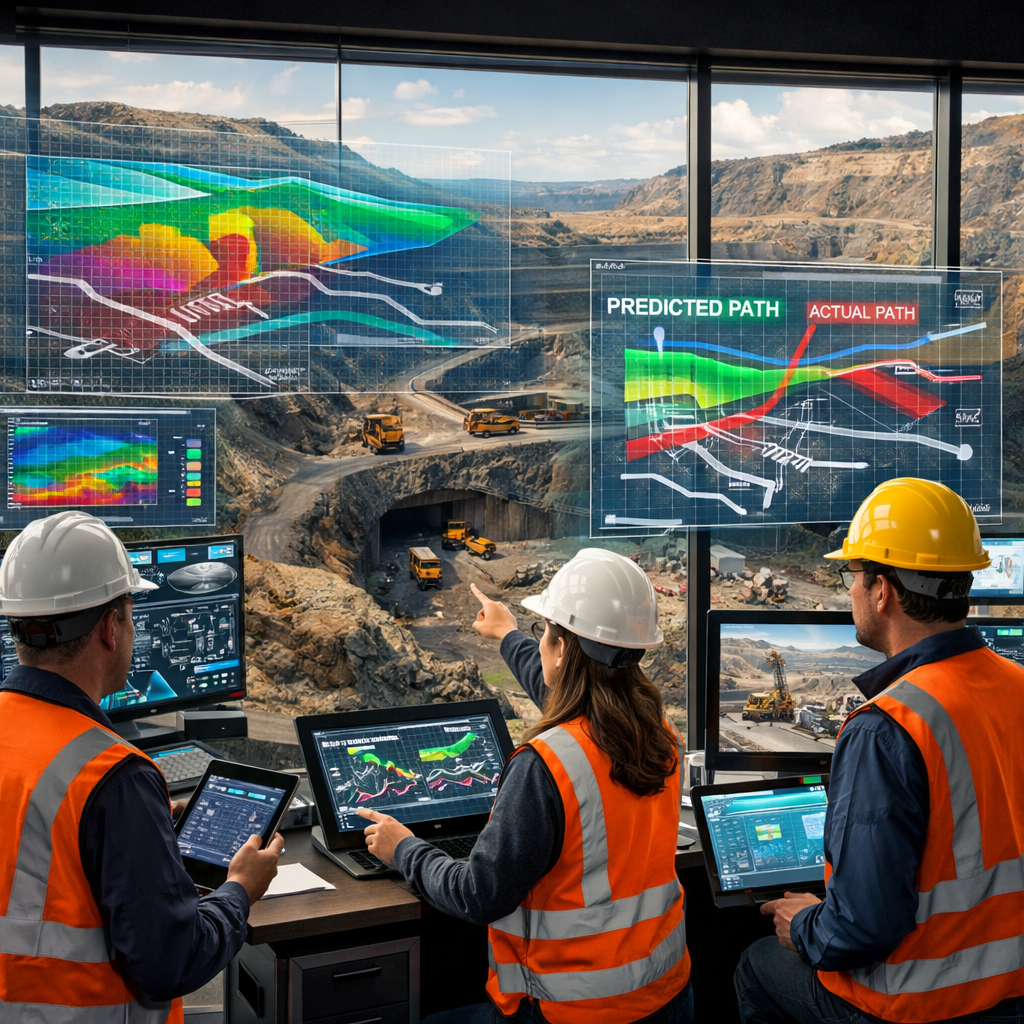
Modern mining faces the fundamental challenge of operating under uncertainty, from variable ore grades to complex geological structures. Advanced simulation technologies are transforming this landscape, making previously unpredictable operations manageable through data-driven predictive modelling.
Digital twin frameworks represent a significant leap forward in mine planning and control. Peña-Graf et al., (2022) demonstrated how discrete event simulation integrated with machine learning can create dynamic digital twins that respond to geological variation, enabling proactive production control and risk mitigation in gold processing operations. Similarly, Wilson et al., (2021) developed discrete event simulation models incorporating partial least squares regression to evaluate system-wide responses to geological uncertainty in oil sands extraction, providing a powerful tool for assessing operational risk factors.
Beyond operational control, simulation techniques are revolutionising resource estimation and mine design. None, (2023) applied Bayesian Evidential Learning to mineral resource modelling, using Monte Carlo realisations based on exploration data to reduce uncertainty in predicting orebody hardness and other critical properties. This approach allows for more confident domain delineation and resource classification. In underground mining, Penadillo et al., (2024) demonstrated that two-stage stochastic integer programming incorporating grade uncertainty simulations can increase net present value by approximately 20% compared to deterministic methods, highlighting the economic imperative of simulation-based planning.
The integration spans the entire value chain. Jones, (2022) showed how digital twin machine learning models connect hundreds of millions of tonnes of downstream performance data to add geometallurgical predictions directly into block models, optimising from mine to mill. Even slope stability, a critical safety concern, benefits from numerical simulation techniques that incorporate realistic lithological contrasts and rock property fluctuations to determine optimal design angles balancing geotechnical reliability and economic efficiency.
These advances collectively demonstrate that advanced simulations, by quantifying and managing uncertainty, are making mining operations increasingly predictable and optimisable across all time horizons.
References
Jones, P. C. S., Z. Pokrajcic, X. Hu, R. Embry, J. Carpenter, E. (2022, June 22). The application of digital twin machine learning models for Mine to Mill and Pit to Plant optimisation. OneMine. https://onemine.org/documents/the-application-of-digital-twin-machine-learning-models-for-mine-to-mill-and-pit-to-plant-optimisation
None, N. (2023). Bayesian Evidential Learning (BEL) Applied to Mineral Resource Modelling to Reduce Uncertainties. https://repository.tudelft.nl/record/uuid:c1921abf-0f68-4fac-9ba6-760dbda65f80
Penadillo, C., Dimitrakopoulos, R., & Kumral, M. (2024). Joint stochastic optimisation of stope layout, production scheduling and access network. Mining Technology, 133(2), 127–141. https://doi.org/10.1177/25726668241242230
Peña-Graf, F., Órdenes, J., Wilson, R., & Navarra, A. (2022). Discrete Event Simulation for Machine-Learning Enabled Mine Production Control with Application to Gold Processing. Metals, 12(2), 225. https://doi.org/10.3390/met12020225
Wilson, R., Mercier, P., Patarachao, B., & Navarra, A. (2021). Partial Least Squares Regression of Oil Sands Processing Variables within Discrete Event Simulation Digital Twin. Minerals, 11. https://doi.org/10.3390/min11070689