
Sign In


Forgot Password?

Don't have account, Sign Up Here

Forgot Password

Lost your password? Please enter your email address. You will receive a link and will create a new password via email.


Have an account? Sign In Now

Sorry, you do not have permission to Add a Post, You must login to Add a Post.


Forgot Password?

Need An Account, Sign Up Here

Sorry, you do not have permission to add Article.


Forgot Password?

Need An Account, Sign Up Here

Please briefly explain why you feel this Post should be reported.

Please briefly explain why you feel this Comment should be reported.

Please briefly explain why you feel this user should be reported.

Mining Doc Logo Mining Doc Logo Mining Doc Logo
Sign InSign Up

Mining Doc

Mining Doc Navigation

  • Home
    • About
    • Contact us
  • Mining articles
  • Online Courses
Search
Sign up

Mobile menu

Close
join for free
  • Home
  • Online courses
  • Case study
  • Mining Community
  • Solutions listing
    • Lase Solutions
    • O-PitBlast Solutions
    • Continuous Mining
    • Longwall mining
    • Geosight Scanners
    • LoopX AI
    • Terafil solutions
    • Blasting solutions
    • Geotechnical
    • Submersible Pumps
    • Mine rescue system
    • Ore sorting
    • Whittle Consulting Solutions
  • Add Blog
  • Feed
  • User Profile
  • Posts
    • New Posts
    • Trending Posts
    • Must read Posts
    • Hot Posts
  • Polls
  • Badges
  • Home
    • About
    • Contact us
  • Mining articles
  • Online Courses

Mining Doc Latest Posts

Akin Fadare
  • 0
  • 0
Akin Fadare
Added: July 3, 20262026-07-03T05:52:37-04:00 2026-07-03T05:52:37-04:00In: Mining Engineering

Beyond 200 Years: What Are We Really Designing for in Mine Closure?

  • 0
  • 0
While reading guidance on long-term mine closure planning, I came across a statement that immediately caught my attention:

The federal agency responsible for mine closure in Northern Canada is calling for a 200-year closure design period, while also evaluating how closure works may perform over 1,000 years.

At first glance, the distinction seems subtle. The more I thought about it, however, the more significant it became.
A 200-year design period is already well beyond the lifespan of most engineered infrastructure. Extending our thinking to 1,000 years changes the conversation entirely. It asks us to move beyond designing individual components and toward resilient systems capable of accommodating change over timescales that no engineer, company, or institution will directly witness.
That raises an interesting question:
If closure designs must perform for 200 years and remain credible over 1,000, what are we designing for: today’s conditions, or uncertainties we cannot yet define?

From Components to Systems

Engineering often focuses on designing individual components to satisfy specific performance criteria. In mine closure, however, long-term performance depends on how multiple systems interact over time.
 
Consider a tailings cover. Its long-term performance is not governed solely by the durability of the cover material. Instead, it depends on the interaction of numerous processes that evolve over decades and centuries, including:
  • changing climate conditions;
  • groundwater flow and hydrogeology;
  • vegetation succession;
  • erosion and landform evolution;
  • freeze-thaw cycles and permafrost dynamics in northern environments;
  • geochemical processes occurring within the underlying waste materials.
Each of these factors changes over time, and many interact in ways that cannot be predicted with complete confidence.
 
This highlights an important reality: closure systems are dynamic rather than static. Their long-term success depends not only on how they are built, but also on how they respond to changing environmental conditions throughout their service life.

Engineering Under Deep Uncertainty

Traditional engineering often relies on defining loads, establishing safety factors, and designing against reasonably foreseeable conditions.
Mine closure introduces a different challenge.
When the performance horizon extends across centuries, uncertainty itself becomes one of the principal design constraints.
 
Future climate conditions may differ substantially from those observed today. Hydrological regimes may shift. Vegetation communities may evolve. Regulatory expectations and societal values may also change over time.
None of these changes are entirely predictable.
 
As a result, designing for mine closure becomes less about predicting the future with certainty and more about making robust, risk-informed decisions under deep uncertainty.
 
That shift has important implications for how we think about design.
Rather than asking whether a closure system will perform exactly as intended for 1,000 years, perhaps a better question is whether it possesses sufficient resilience to continue performing acceptably as conditions inevitably evolve.

Confidence Versus Certainty

One aspect of the statement that particularly resonated with me is the distinction between a design period and a performance evaluation period.
The difference suggests that long-term closure may not be about guaranteeing performance over a millennium. Instead, it may be about demonstrating that the design remains technically defensible when viewed against a much longer horizon of uncertainty.
 
That changes how we think about engineering confidence.
Confidence may not come solely from stronger materials or larger factors of safety. It may increasingly depend on:
  • understanding system interactions;
  • identifying key uncertainties;
  • incorporating adaptive management where appropriate;
  • monitoring performance over time; and
  • making transparent, risk-informed decisions throughout the design process.
In other words, resilience may become as important as prediction.

A Question Worth Discussing

Mine closure is often described as one of the most complex engineering challenges because it requires us to design systems that must continue to function long after the mine has closed, the operating company has changed, and the engineers who developed the design are no longer around.
 
That reality makes me wonder:
 
How should we think about confidence in our designs when the performance horizon extends far beyond the life of the mine, the company, or even the engineer?
 
And equally important:
 
What role should risk-informed design, adaptive management, and systems thinking play when uncertainty itself becomes a primary design constraint?
 
I’d be interested to hear perspectives from mine planners, geotechnical engineers, hydrogeologists, environmental scientists, closure specialists, and regulators.
 
Long-term mine closure sits at the intersection of all these disciplines, and these conversations will help our understanding of resilient closure systems continue to evolve.
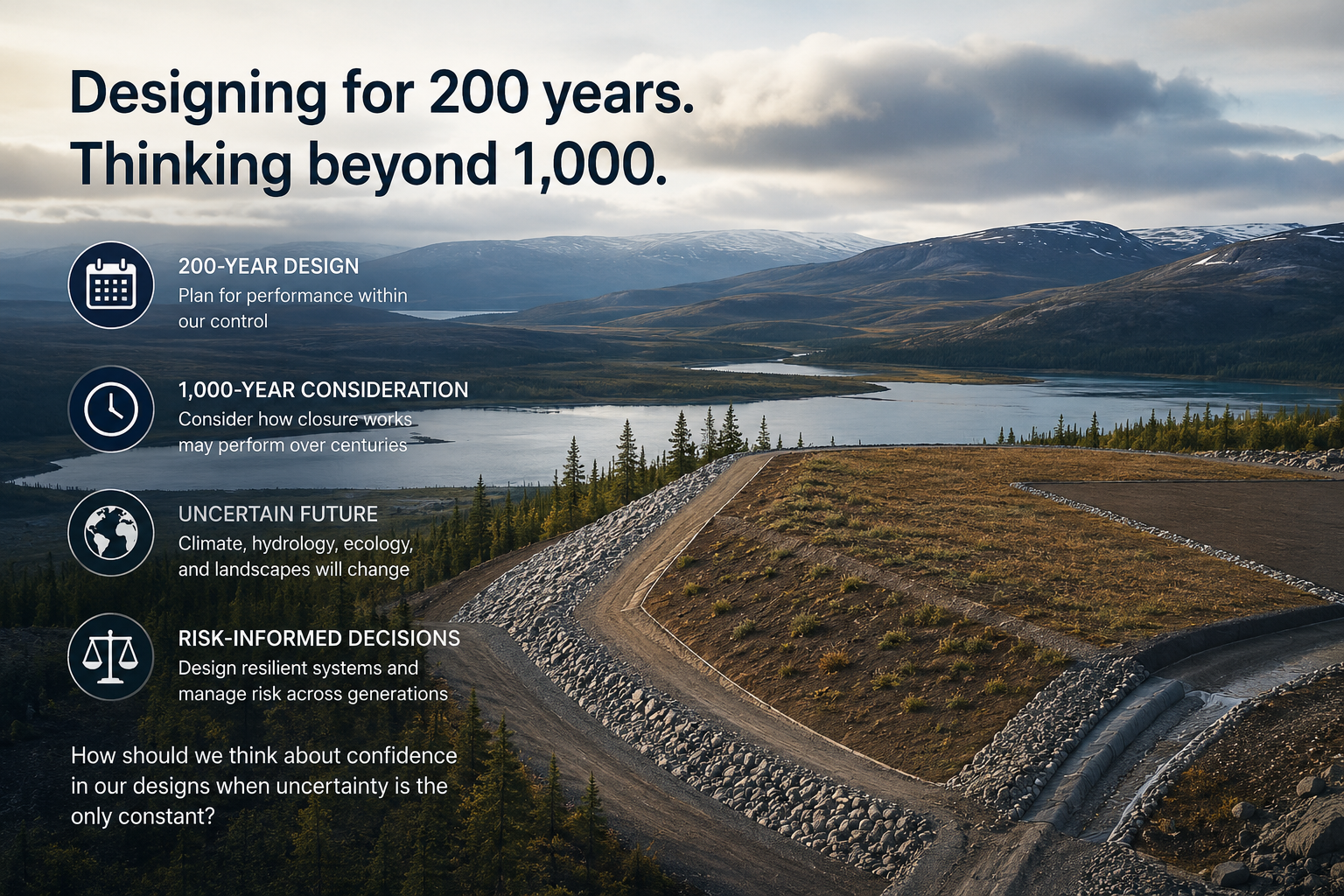
 
Reference: https://www.rcaanc-cirnac.gc.ca/eng/1646321588912/1646321643743
 
Beyond 200 Years: What Are We Really Designing for in Mine Closure?
0
  • 0 0 Comments
  • 14 Views
  • 11 Reactions
  • 0 Followers
  • 0
    • Report
  • Share
    Share
    • Share on Facebook
    • Share on Twitter
    • Share on LinkedIn
    • Share on WhatsApp

Related Posts

  • What are the technical requirements and limitations of remote and autonomous drilling systems for underground production drilling?
  • How to assess and manage water inflows in an underground mine intersecting a major aquifer or fault zone?
  • How to develop a mine production schedule that satisfies mill feed grade requirements, mining constraints, and project NPV objectives simultaneously?

You must login to add an Comment.


Forgot Password?

Need An Account, Sign Up Here
aalanaalan

Sidebar

  • Recent
  • Operational Guidelines and Efficiency Parameters for Modern Gravel Crushing
    • On: July 3, 2026

    Operational Guidelines and Efficiency Parameters for Modern Gravel Crushing

    • On: July 3, 2026

    From Demolition to Delivery: How Broken Concrete Crushing Plants Can ...

  • Sizing Track Crushers for Remote Mountain Infrastructure and Rocky Terrain
    • On: July 3, 2026

    Sizing Track Crushers for Remote Mountain Infrastructure and Rocky Terrain

  • Ready Mix Plants for Sale Used in Mining Camps and Industrial Plant Construction
    • On: July 1, 2026

    Ready Mix Plants for Sale Used in Mining Camps and ...

  • How Dual Power Track Crushers Reduce Fuel Costs in Heavy Duty Crushing Operations
    • On: July 1, 2026

    How Dual Power Track Crushers Reduce Fuel Costs in Heavy ...

  • Beyond ERP: Why Intelligent Finance Automation Is Reshaping Modern Mining
    • On: July 1, 2026

    Beyond ERP: Why Intelligent Finance Automation Is Reshaping Modern Mining

  • Finite Element Stress Analysis and Dynamic Load Dampening in Mining Logistics Infrastructure
    • On: July 1, 2026

    Finite Element Stress Analysis and Dynamic Load Dampening in Mining ...

Go to Home page to view more

Top Members

Olena Skyba

Olena Skyba

  • 150 Posts
  • 2 Comments
Pundit
Marcial

Marcial

  • 91 Posts
  • 0 Comments
Enlightened
Jean Marais (Sanodea Group)

Jean Marais (Sanodea Group)

  • 25 Posts
  • 0 Comments
Beginner
Trending on Mining Doc

Trending Communities

Fixed Plant General Information Geology Mining Case Studies Mining Doc Documentary Mining Engineering Mining Events Mining Finance and Economy Mining Human Resources Mining Industry Research Mining Operations Mining Software Solutions Mining Sustainability Mining Technology Solutions Mobile Plant Equipment

Explore

  • Home
  • Online courses
  • Case study
  • Mining Community
  • Solutions listing
    • Lase Solutions
    • O-PitBlast Solutions
    • Continuous Mining
    • Longwall mining
    • Geosight Scanners
    • LoopX AI
    • Terafil solutions
    • Blasting solutions
    • Geotechnical
    • Submersible Pumps
    • Mine rescue system
    • Ore sorting
    • Whittle Consulting Solutions
  • Add Blog
  • Feed
  • User Profile
  • Posts
    • New Posts
    • Trending Posts
    • Must read Posts
    • Hot Posts
  • Polls
  • Badges

Footer

Mining Doc

Join our community and connect with other people in the Mining industry for knowledge sharing.

Legal Stuff

  • Privacy Policy
  • Terms of Service

Help

  • Support
  • FAQs
  • How to add new content and how to promote a content
  • Compliance and guidelines
  • Subscribe to Mining Doc

Follow

© 2026 Mining Doc. All Rights Reserved


