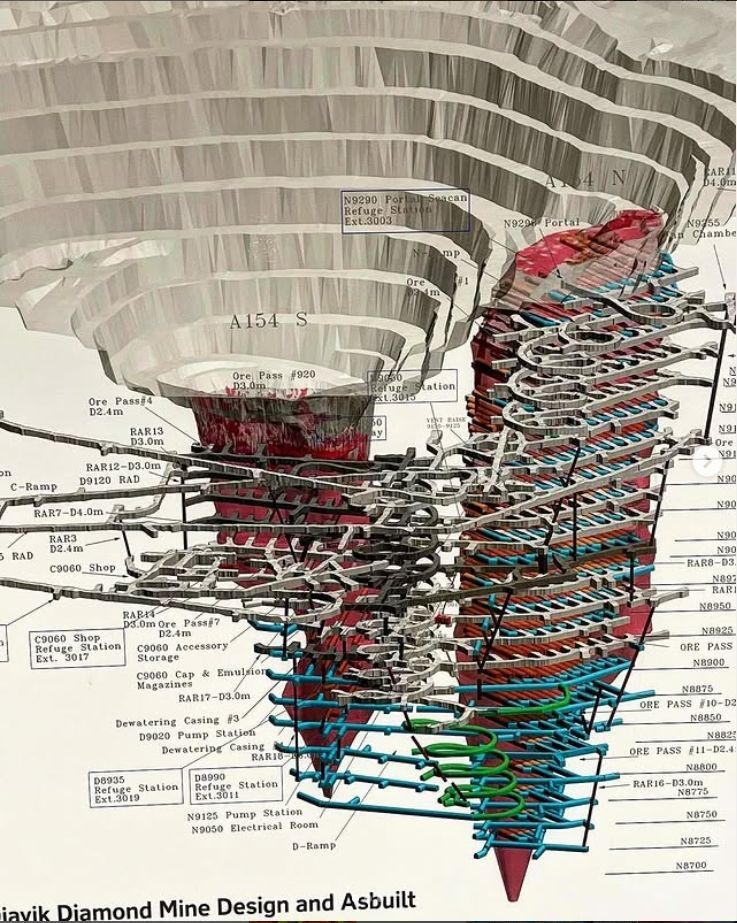
By considering both the ultimate open-pit limit and a potential underground operation located beneath this limit, it is possible to achieve a higher overall economic return. This is reflected in an improved Net Present Value (NPV) when the time value of money is incorporated into the economic evaluation.
The same calculation is subsequently applied to multiple development scenarios generated from nested pit shells and different underground column heights. Each intermediate pit shell is associated with a corresponding underground mining option, and an integrated production schedule is developed for both the open-pit and underground operations. This approach enables the estimation of the maximum project NPV within a combined open-pit–underground mining framework.
A joint analysis of the results makes it possible to determine the optimal transition point and timing between open-pit and underground mining. The analysis confirms that a combined mining strategy significantly increases the overall economic value of the project compared with a scenario relying solely on open-pit extraction.
Thus, based on the ultimate pit, the nested pit shells, and the economically mineable underground column heights, the total project NPV (open pit + underground) is calculated by integrating the extraction costs and associated economic revenues for each scenario. This methodology allows the identification of the optimal transition level, corresponding to the maximum NPV.
The economic benefit associated with each mining level is calculated using the following equation:
Profit = Revenue – Costs = (G × T × F) – (Cm + Cp) × T
Where:
G (%): ore grade
T: extraction level – tonnage mined (tonnes)
F: conversion factor – conversion to pounds per tonne (lb/t)
Cm: mining cost – extraction cost (USD/t)
Cp: processing cost – treatment cost (USD/t)