
Sign In


Forgot Password?

Don't have account, Sign Up Here

Forgot Password

Lost your password? Please enter your email address. You will receive a link and will create a new password via email.


Have an account? Sign In Now

Sorry, you do not have permission to Add a Post, You must login to Add a Post.


Forgot Password?

Need An Account, Sign Up Here

Sorry, you do not have permission to add Article.


Forgot Password?

Need An Account, Sign Up Here

Please briefly explain why you feel this Post should be reported.

Please briefly explain why you feel this Comment should be reported.

Please briefly explain why you feel this user should be reported.

Mining Doc Logo Mining Doc Logo Mining Doc Logo
Sign InSign Up

Mining Doc

Mining Doc Navigation

  • Home
    • About
    • Contact us
  • Mining articles
  • Online Courses
Search
Sign up

Mobile menu

Close
join for free
  • Home
  • Online courses
  • Case study
  • Mining Community
  • Solutions listing
    • Lase Solutions
    • O-PitBlast Solutions
    • Continuous Mining
    • Longwall mining
    • Geosight Scanners
    • LoopX AI
    • Terafil solutions
    • Blasting solutions
    • Geotechnical
    • Submersible Pumps
    • Mine rescue system
    • Ore sorting
    • Whittle Consulting Solutions
  • Add Blog
  • Feed
  • User Profile
  • Posts
    • New Posts
    • Trending Posts
    • Must read Posts
    • Hot Posts
  • Polls
  • Badges
  • Home
    • About
    • Contact us
  • Mining articles
  • Online Courses

Mining Doc Latest Posts

Mining Doc
  • 0
  • 0
Mining DocEnlightened
Added: October 14, 20262026-10-14T06:34:29-04:00 2026-10-14T06:34:29-04:00In: Mining Engineering

How can artificial intelligence optimize drilling parameters and predict blasting performance in mining operations?

  • 0
  • 0

Traditional drill-and-blast operations in surface and underground mining rely on empirical formulas like the Kuz–Ram fragmentation model and Maurer’s drilling equations. These classical models often fail to account for complex, heterogeneous subterranean geology. Recent advancements in Machine Learning (ML), Deep Learning (DL), and Internet of Things (IoT) sensors offer a powerful alternative. Operators can now replace static trial-and-error techniques with dynamic computational frameworks. This transformation enables precise real-time drilling adjustments, accurate rock fragmentation forecasts, and comprehensive multi-objective cost optimization across the entire mine value chain.

Rock drilling efficiency depends heavily on controllable operational variables such as Weight on Bit (WOB), Revolutions Per Minute (RPM), and mud flow rate (Q). Physical equations struggle to capture non-linear downhole interactions under varying Unconfined Compressive Strength (UCS). Advanced artificial intelligence models overcome these physical limitations. Top-tier algorithms, including Exponential Gaussian Process Regression (GPR) and hybrid Transformer–LSTM architectures with TS-Mixer, predict Rate of Penetration (ROP) with exceptional accuracy, reaching R² values as high as 0.9991. Embedded platforms like Hexagon Drill Assist automate rig control to boost productivity by over 30%. Furthermore, drill-shaft IoT sensors like DataCloud’s Rhino process real-time vibrations to quantify rock density, joint spacing, and strength directly at the drill face.

Accurate prediction of rock fragmentation after blasting is essential for downstream processing. Modern machine learning frameworks replace outdated empirical formulas with high-precision predictive engines. Hybrid models combining Backpropagation Neural Networks (BPNN) and Extreme Gradient Boosting (XGBoost) with metaheuristic optimizers like the Zebra Optimization Algorithm (ZOA) accurately forecast mean fragment size (P50). Explainable AI tools like SHAP consistently reveal that specific charge, powder factor, and burden distance account for over 80% of model predictive power. In addition to these algorithms, high-resolution drone mapping and 3D digital twin platforms provide centimeter-level terrain analytics. Mines utilizing these integrated spatial insights achieve significant performance gains, such as a 5.5% reduction in fragment size distribution when adopting electronic initiation.

Blast outcomes directly influence overall mine profitability and operational safety. Single-objective approaches fail because lowering drilling costs often increases crushing energy demands later. Modern AI frameworks solve this trade-off by pairing predictive engines with evolutionary multi-objective algorithms like NSGA-II. This combination generates a Pareto optimal front, allowing site engineers to select blast designs that balance explosive expenditure against target fragment size. Beyond immediate cost savings, uniform rock breakage reduces wear on loading shovels and lowers energy consumption in crushing circuits. Furthermore, precise AI blast modeling minimizes environmental hazards, effectively controlling ground vibration, flyrock, air overpressure, and backbreak to protect mine personnel and infrastructure.

Artificial intelligence represents a fundamental shift in subterranean engineering, replacing rigid empirical rules with dynamic data-driven insights. Machine learning models elevate drilling productivity while predicting rock fragmentation with unprecedented precision. Furthermore, multi-objective optimization aligns drill-and-blast parameters with whole-of-mine economic goals and safety standards. Explainable AI frameworks like SHAP and LIME provide necessary transparency, building user trust among site personnel. The adoption of these intelligent systems allows mining operations to minimize operational expenses, protect workers, and achieve long-term environmental sustainability.
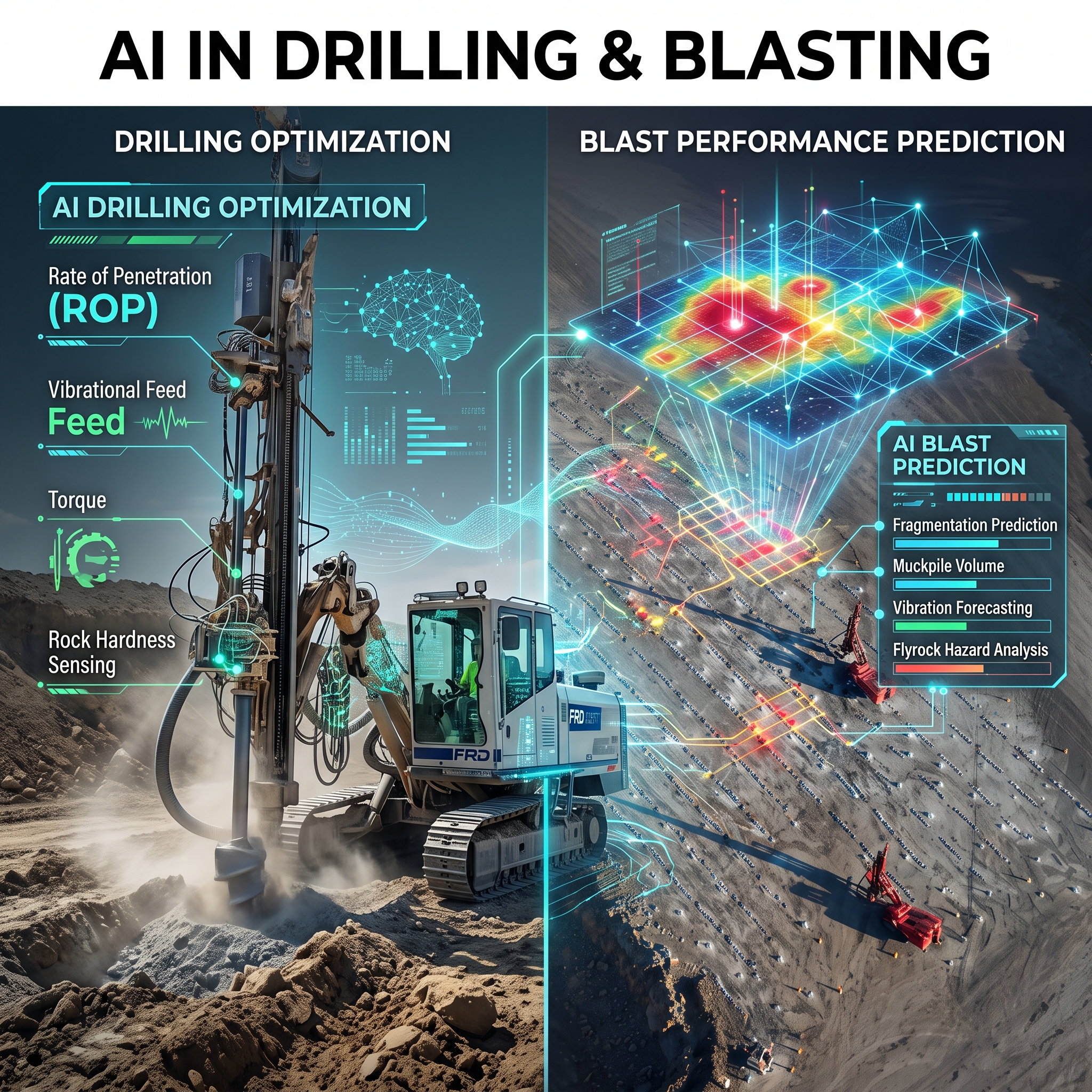

How can artificial intelligence optimize drilling parameters and predict blasting performance in mining operations?
0
  • 0 0 Comments
  • 34 Views
  • 34 Reactions
  • 0 Followers
  • 0
    • Report
  • Share
    Share
    • Share on Facebook
    • Share on Twitter
    • Share on LinkedIn
    • Share on WhatsApp

Related Posts

  • How can blast design optimization improve fragmentation and reduce downstream crushing costs?
  • How does blast-hole deviation affect fragmentation, ore dilution, and explosive consumption?
  • How to diagnose the cause of excessive dilution in a sublevel stoping operation?

You must login to add an Comment.


Forgot Password?

Need An Account, Sign Up Here
aalanaalanaalan

Sidebar

Sponsored Ads

aalan

Sponsored Ads

aalan

Sponsored Ads

aalan
Go to Home page to view more

Top Members

Olena Skyba

Olena Skyba

  • 150 Posts
  • 2 Comments
Pundit
Marcial

Marcial

  • 91 Posts
  • 0 Comments
Enlightened
Jean Marais (Sanodea Group)

Jean Marais (Sanodea Group)

  • 26 Posts
  • 0 Comments
Beginner
Trending on Mining Doc

Trending Communities

Fixed Plant General Information Geology Mining Case Studies Mining Doc Documentary Mining Engineering Mining Events Mining Finance and Economy Mining Human Resources Mining Industry Research Mining Operations Mining Software Solutions Mining Sustainability Mining Technology Solutions Mobile Plant Equipment

Explore

  • Home
  • Online courses
  • Case study
  • Mining Community
  • Solutions listing
    • Lase Solutions
    • O-PitBlast Solutions
    • Continuous Mining
    • Longwall mining
    • Geosight Scanners
    • LoopX AI
    • Terafil solutions
    • Blasting solutions
    • Geotechnical
    • Submersible Pumps
    • Mine rescue system
    • Ore sorting
    • Whittle Consulting Solutions
  • Add Blog
  • Feed
  • User Profile
  • Posts
    • New Posts
    • Trending Posts
    • Must read Posts
    • Hot Posts
  • Polls
  • Badges

Footer

Mining Doc

Join our community and connect with other people in the Mining industry for knowledge sharing.

Legal Stuff

  • Privacy Policy
  • Terms of Service

Help

  • Support
  • FAQs
  • How to add new content and how to promote a content
  • Compliance and guidelines
  • Subscribe to Mining Doc

Follow

© 2026 Mining Doc. All Rights Reserved

