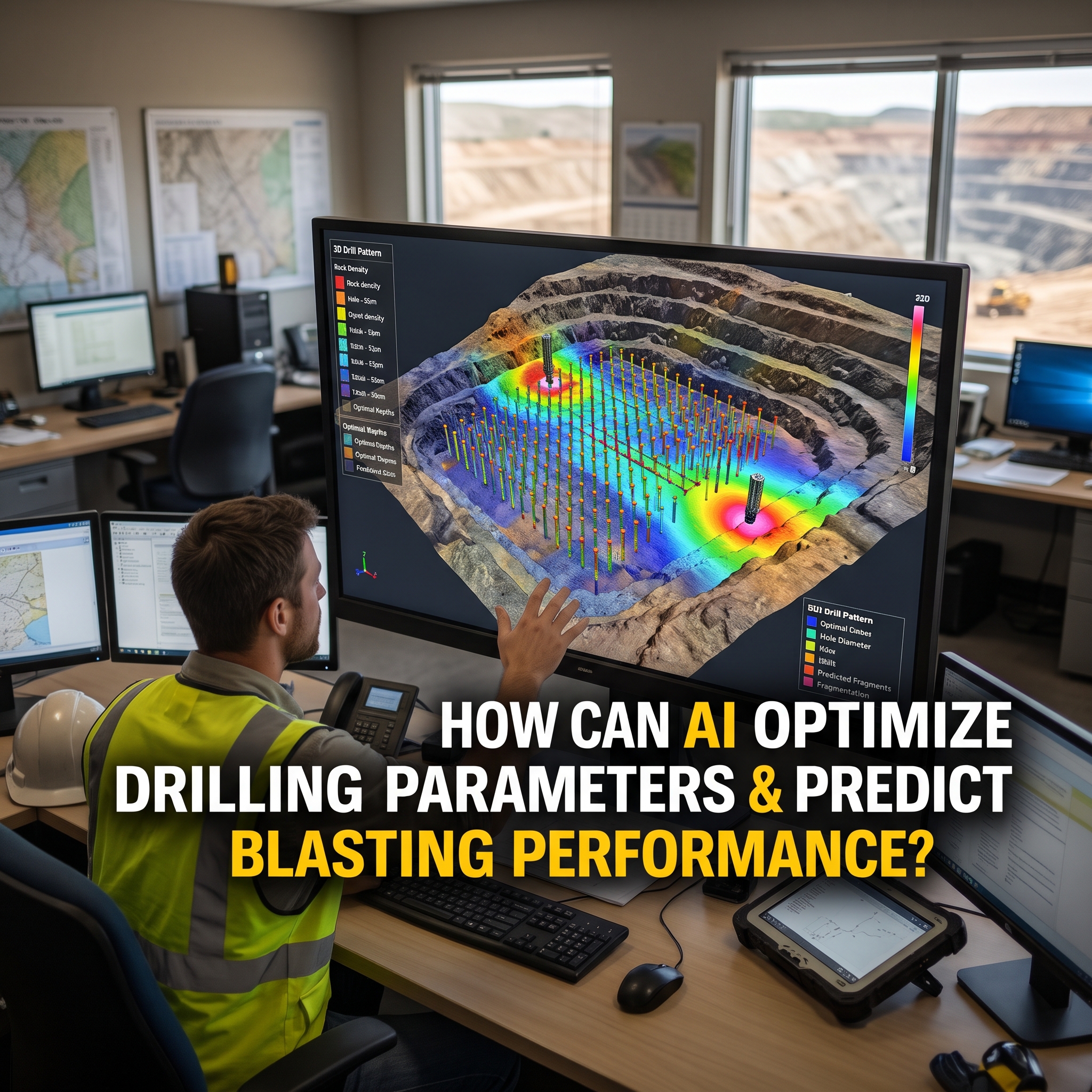


Conventional mineral extraction relies heavily on empirical formulas, visual inspections, and retrospective trial-and-error adjustments across primary rock-breakage stages. Primary rock excavation frequently represents up to thirty percent of total mine operating expenditure, which means that upstream inconsistencies inevitably amplify downstream comminution bottlenecks. Recent advances in computational intelligence offer a rigorous framework to replace isolated procedures with interconnected digital architectures. Sensor networks, digital twins, and machine learning models now coordinate the entire fragmentation lifecycle. This technological evolution reshapes surface mining across three distinct operational frontiers: automated drilling parameter optimisation, predictive rock fragmentation modelling, and dynamic environmental safety management.
Intelligent drill rigs equipped with Measure-While-Drilling telemetry transform routine blasthole excavation into an active geological exploration exercise. Downhole sensors register dynamic drilling resistance, torque fluctuations, and penetration rates to characterize rock mass properties instantaneously. These diagnostic systems delineate lithological boundaries, fracture intervals, and compressive strength variations without tedious laboratory delays. Autonomous rigs leverage precise satellite navigation to execute complex collar patterns, which prevents spatial deviations and significantly elevates fleet utilization. Furthermore, real-time logging feeds spatial data directly into blast design platforms. Site engineers can therefore tailor explosive distribution to the actual structural conditions of individual boreholes rather than outdated bench averages.
Predictive fragmentation modelling has progressed far beyond the static approximations of historical empirical formulas. Modern operations employ hybrid neural networks and support vector architectures optimized through metaheuristic algorithms, including particle swarm and bio-inspired search strategies. These intelligent frameworks capture intricate, non-linear relationships between rock strength, geometric spacing, and detonation timing, achieving coefficients of determination exceeding 0.96. Interpretability frameworks such as Shapley additive explanations verify that powder factor, charge length, and borehole burden serve as primary determinants of particle sizing. Virtual digital twin simulations evaluate competing design trade-offs prior to explosive loading, establishing uniform muckpile sizing that curbs ore loss and curtails downstream crushing energy.
Uncontrolled explosive energy generates hazardous air overpressure and ground vibrations that can compromise slope stability and provoke community conflicts. Deep learning architectures integrated with metaheuristic optimizers reliably forecast peak particle velocity and seismic frequencies across varying geological strata. Automated pre-blast protocols further elevate operational safety through digital verification dashboards. Specialized downhole sensors identify critical borehole anomalies such as cavity voids, wall collapse, and water intrusion, prompting corrective stabilization actions before initiation. Concurrently, drone surveillance enforces strict geofenced exclusion perimeters while electronic detonators perform continuous circuit health checks. Remote initiation systems remove personnel from hazardous highwalls, establishing rigorous control over dangerous blast environments.
The integration of artificial intelligence shifts drilling and blasting from an isolated craft into a closed-loop digital ecosystem. Continuous feedback loops calibrate subsequent design cycles through post-detonation photogrammetry, seismic monitoring, and crusher telemetry. This systemic optimization suppresses explosive overconsumption, mitigates severe environmental hazards, and produces uniform feed material that elevates mill recovery. Measurable gains in drill utilization, ore recovery, and energy efficiency confirm that automated intelligence drives substantial financial and operational resilience. As digital twin adoption expands across major producers, AI-enabled decision architectures will define standard engineering practice, fostering sustainable, cost-effective, and safe mineral extraction operations worldwide.