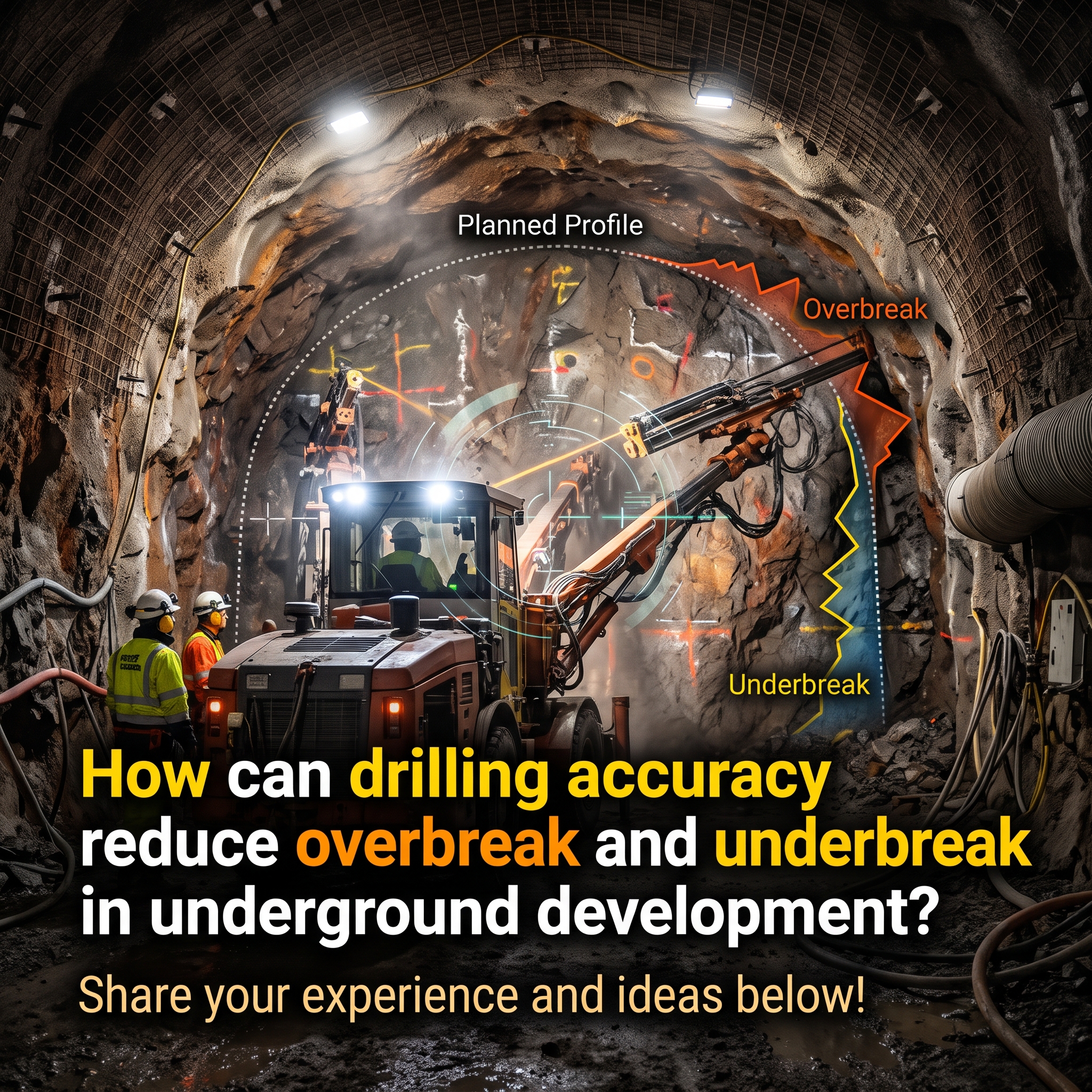


Excavation profiles in underground mining and tunnelling rarely match design perimeters by chance. Overbreak removes excess rock beyond the planned boundary, expanding void spans, generating loose slabs, and escalating ground support requirements. Conversely, underbreak leaves unexcavated rock within the profile, which chokes haulage clearances and necessitates dangerous manual trimming or secondary blasting. Site teams often assume that modified explosive recipes or heavier charges can fix uneven breaks, yet field trials repeatedly prove that blasting cannot compensate for poor drilling alignment. Precise blasthole placement serves as the true physical prerequisite for perimeter control, dictating whether detonation energy smoothly cleaves the boundary or shatters the host rock mass.
Drill alignment errors compound rapidly with depth. While operators collar perimeter holes with high visual precision at the face, the drill steel drifts as it advances into the rock mass. Collar spacings may cluster tightly around eight hundred millimetres, but angular wander frequently pushes hole toes beyond eleven hundred millimetres apart. This geometric divergence governs boundary failure. Excessive outward look-out angles force bottom charges deep into the host formation, producing severe overbreak, jagged rib profiles, and weakened brows. Insufficient look-out or excessive lateral wander chokes the crack path between holes, preventing fracture coalescence and leaving prominent rock cusps as underbreak. Quantitative three-dimensional laser scanning confirms this physical link: post-blast cavities directly mirror as-drilled hole trajectories rather than theoretical designs.
Traditional drifting relies on manual round marking and two-dimensional drafts, forcing miners to add redundant blastholes and elevate powder factors to counter human drilling wander. Modern computer-controlled drill jumbos eliminate this guesswork through automated spatial navigation. Recent engineering breakthroughs introduce double-face planning, which calculates coordinates across both the entrance face and the planned tunnel bottom. Inclined cut and relief holes alter burden vectors through three-dimensional space, creating severe burden asymmetry if planned solely on the collar plane. Recursive numerical algorithms now balance hole burdens across complex curved arches, cutting burden standard deviation by forty per cent. Field trials demonstrate that automated jumbo execution achieves blasthole pull factors above ninety per cent alongside half-barrel visibility factors reaching seventy per cent.
Engineered perimeter control requires strict coordination between the contour blastholes and the adjacent inner buffer row. Advanced design models establish that the practical damage radius of buffer charges should dictate the burden distance to the final contour. Buffer detonations shatter the primary rock volume, terminating their radial crack network along the intended profile and leaving only narrow rock cusps between damage circles. Outer perimeter blastholes sit exactly at these cusp locations, charged with decoupled explosives or detonating cord to trim the remaining cusps smoothly without shock damage. Tight drilling accuracy maintains this delicate physical balance. When buffer or contour holes drift off position, contour charges either fail to span the widened gap or punch radial fractures into the permanent wall.
Excavation quality in underground development depends directly on the geometric fidelity of the drilled round. Overbreak and underbreak are not inevitable mining hazards, but predictable outcomes of blasthole divergence, erratic burdens, and unguided buffer detonations. Mines achieve smooth, competent tunnel profiles by pairing computer-controlled drilling jumbos with double-face planning algorithms and decoupled buffer-perimeter architecture. High-precision hole placement ensures explosive energy performs intended rock breakage without shattering surrounding rock envelopes. Operations that commit to strict drilling control eliminate secondary scaling, reduce ground support cycles, and secure safer, more cost-effective underground openings.