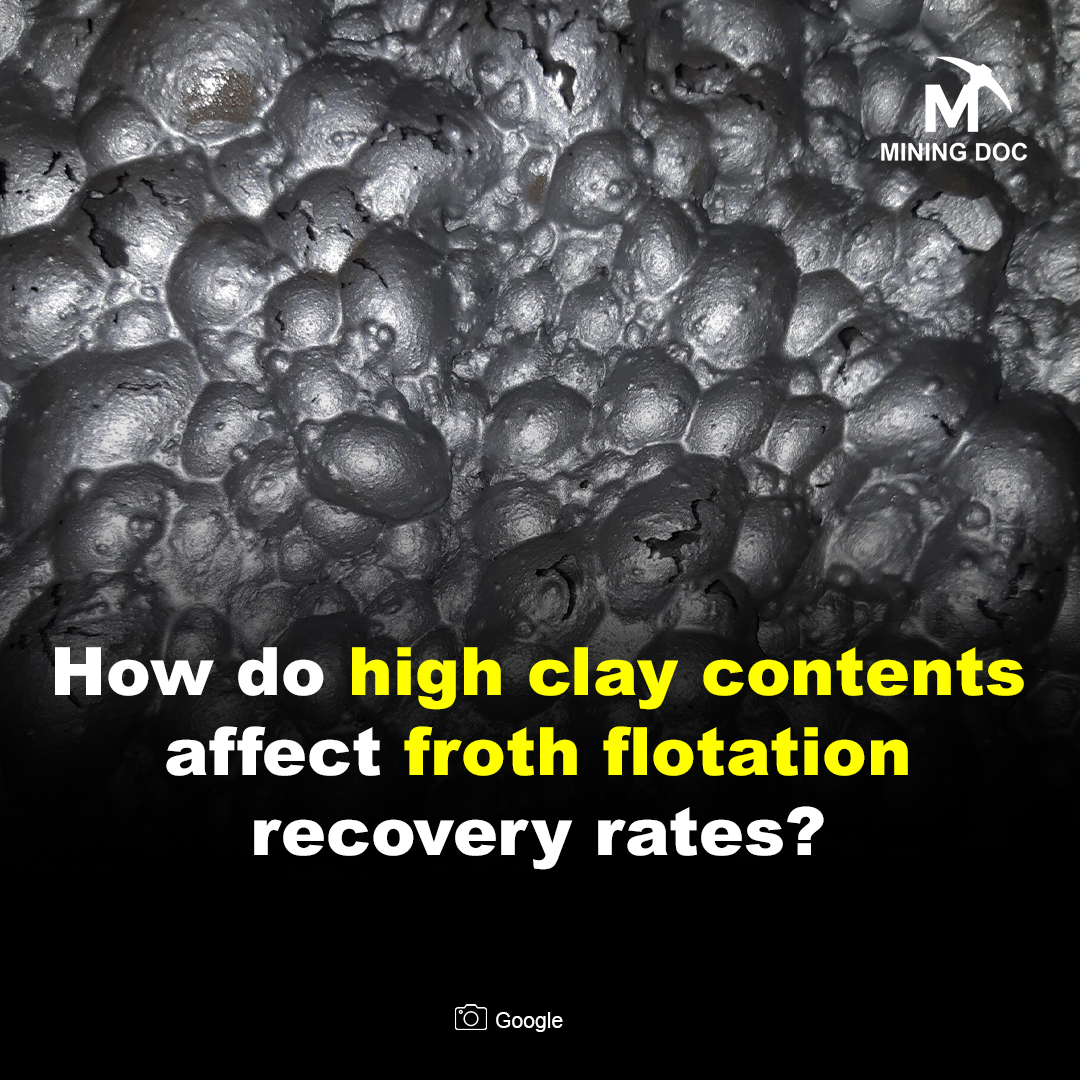
As ore grades decline, mines are digging deeper and wider and increasingly straight into clay-rich, weathered ore bodies. For flotation metallurgists, that’s not a minor inconvenience. It can be the difference between a viable project and a metallurgical nightmare. Clay gangue minerals kaolinite, smectite, illite are quietly one of the biggest recovery killers in modern processing plants.
Here’s the mechanics of why.
1️⃣ Slime Coating
Ultra-fine clay particles carry an electrostatic charge that attracts them to the surface of valuable sulfide minerals like a magnetic dust layer. Once coated, those sulfides can no longer contact collector reagents or air bubbles — effectively “hiding” valuable particles from the flotation process itself (Chen & Peng, 2018).
2️⃣ Increased Pulp Viscosity (Rheology)
Some clays smectite/bentonite in particular swell dramatically in water, creating enormous surface area relative to their mass. The result is a thick, muddy pulp that dampens bubble movement and turbulence, starving the system of the energetic particle-bubble collisions flotation depends on.
3️⃣ Entrapment & Entrainment in the Froth
Fine clay slimes don’t need to chemically attach to anything to hurt grade they can simply get physically carried along in the water film between bubbles, reporting straight into the concentrate and diluting it with unwanted gangue.
4️⃣ Reagent Robbing
Clays have a high cation exchange capacity (CEC) and enormous specific surface area meaning they greedily adsorb expensive collectors and depressants before those reagents ever reach the target mineral. It’s like paying for fertilizer that a weed patch soaks up before it reaches your crop.
Clay isn’t a single problem it’s four compounding ones, hitting chemistry, physics, and reagent economics simultaneously. The ore bodies of the future will demand flowsheets designed around clay management from day one, not bolted on as an afterthought.
In your plants, which clay-related issue has been hardest to solve: rheology, slime coating, entrainment, or reagent consumption?
References
Chen, X., & Peng, Y. (2018). Managing clay minerals in froth flotation — A critical review. Mineral Processing and Extractive Metallurgy Review, 39(5), 289–307. https://doi.org/10.1080/08827508.2018.1433175
Ndlovu, B., Farrokhpay, S., & Bradshaw, D. (2013). Behaviour of swelling clays versus non-swelling clays in flotation. Minerals Engineering, 55, 190–200. https://doi.org/10.1016/j.mineng.2013.09.004
Wills, B. A., & Finch, J. A. (2016). Wills’ mineral processing technology: An introduction to the practical aspects of ore treatment and mineral recovery (8th ed.). Butterworth-Heinemann.