
Sign In


Forgot Password?

Don't have account, Sign Up Here

Forgot Password

Lost your password? Please enter your email address. You will receive a link and will create a new password via email.


Have an account? Sign In Now

Sorry, you do not have permission to Add a Post, You must login to Add a Post.


Forgot Password?

Need An Account, Sign Up Here

Sorry, you do not have permission to add Article.


Forgot Password?

Need An Account, Sign Up Here

Please briefly explain why you feel this Post should be reported.

Please briefly explain why you feel this Comment should be reported.

Please briefly explain why you feel this user should be reported.

Mining Doc Logo Mining Doc Logo Mining Doc Logo
Sign InSign Up

Mining Doc

Mining Doc Navigation

  • Home
    • About
    • Contact us
  • Mining articles
  • Online Courses
Search
Sign up

Mobile menu

Close
join for free
  • Home
  • Online courses
  • Case study
  • Mining Community
  • Solutions listing
    • Lase Solutions
    • O-PitBlast Solutions
    • Continuous Mining
    • Longwall mining
    • Geosight Scanners
    • LoopX AI
    • Terafil solutions
    • Blasting solutions
    • Geotechnical
    • Submersible Pumps
    • Mine rescue system
    • Ore sorting
    • Whittle Consulting Solutions
  • Add Blog
  • Feed
  • User Profile
  • Posts
    • New Posts
    • Trending Posts
    • Must read Posts
    • Hot Posts
  • Polls
  • Badges
  • Home
    • About
    • Contact us
  • Mining articles
  • Online Courses

Mining Doc Latest Posts

Mining Doc
  • 0
  • 0
Mining DocEnlightened
Added: June 10, 20262026-06-10T06:15:43-04:00 2026-06-10T06:15:43-04:00In: Mining Engineering

How do you apply discrete element modelling (DEM) to evaluate caving potential and cave propagation in a block caving operation?

  • 0
  • 0

Block caving is a mining process that utilizes the self-collapse of an ore body through undercutting the ore body. The process needs to be assessed in terms of the “caving potential” and “cave propagation.” The first describes the capacity of the rock mass to break up, while the latter describes the process of cave extension upward. Both caveability and propagation need to be assessed with the use of the Discrete Element Modeling (DEM). It represents an algorithm of simulating the physical behavior of rock masses through assembling them from separate particles.

The process of predicting caveability is complicated by the inability of most empirical techniques to provide necessary accuracy in modern-day operations. The use of DEM allows creating computer models considering the presence of pre-existing faults within the rock mass (Suzuki Morales & Suorineni, 2017). Thus, it offers an effective alternative to physical modeling enabling planners to simulate the interactions of particles at the microscopic level.

In terms of assessing the cave potential of a rock formation using the DEM approach, one should consider the natural stresses of the formation under investigation, i.e., the initial conditions. In this context, after undercutting the ore body created using DEM, the stress distribution is assessed to understand how few conditions would result in self-sustained failure. If such conditions would not result in adequate fracturing, the model would assess whether the pre-conditioning step is required for creating favorable conditions for further caving, such as hydrofracturing (Elmo et al., 2022).

The process of caving having been proven through observations, the DEM technique is used to model the growth of caves over time. The software determines the sequential failure of the bonds between the discrete elements, showing the way tensile cracks originate from joint surfaces and propagate. This gives insight into failure processes, allowing for prediction of vertical cave development and rock stabilization.

Apart from predicting collapse, DEM is highly beneficial for simulating the gravity-induced movement of the broken ore after the process of collapse. DEM simulation on a large scale is useful for establishing proper spacing between the drawpoints as it can model the phenomena of secondary fragmentation and percolation of the particles in the draw column (Hancock et al., 2010). In addition, the application of DEM has been proven successful in assessing hazards in the form of lethal air blasts due to the rapid compression of air below the collapsing rock mass (Galindo-Torres et al., 2018).

In summary, the implementation of DEM to block caving offers a mechanical view of mass mining underground. The accurate simulation of caving tendency and cave propagation helps to reduce uncertainty, which cannot be determined only through empirical approaches.

References

Elmo, D., Rogers, S., Veltin, K., & Lett, J. (2022). An effective numerical method to understand different aspects of cave preconditioning. Caving 2022: Fifth International Conference on Block and Sublevel Caving, 1337–1350. https://doi.org/10.36487/acg_repo/2205_93

Galindo-Torres, S. A., Palma, S., Quintero, S., Scheuermann, A., Zhang, X., Krabbenhoft, K., Ruest, M., & Finn, D. (2018). An airblast hazard simulation engine for block caving sites. International Journal of Rock Mechanics and Mining Sciences, 107, 31–38. https://doi.org/10.1016/j.ijrmms.2018.04.034

Hancock, W., Weatherley, D., & Chitombo, G. (2010). Large-scale simulations of gravity flow in block caving. Proceedings of the Second International Symposium on Block and Sublevel Caving, 553–566. https://doi.org/10.36487/acg_rep/1002_38_hancock

Suzuki Morales, K., & Suorineni, F. (2017). Using numerical modelling to represent parameters affecting cave mining. Proceedings of the First International Conference on Underground Mining Technology, 295–307. https://doi.org/10.36487/acg_rep/1710_23_suzuki_morales
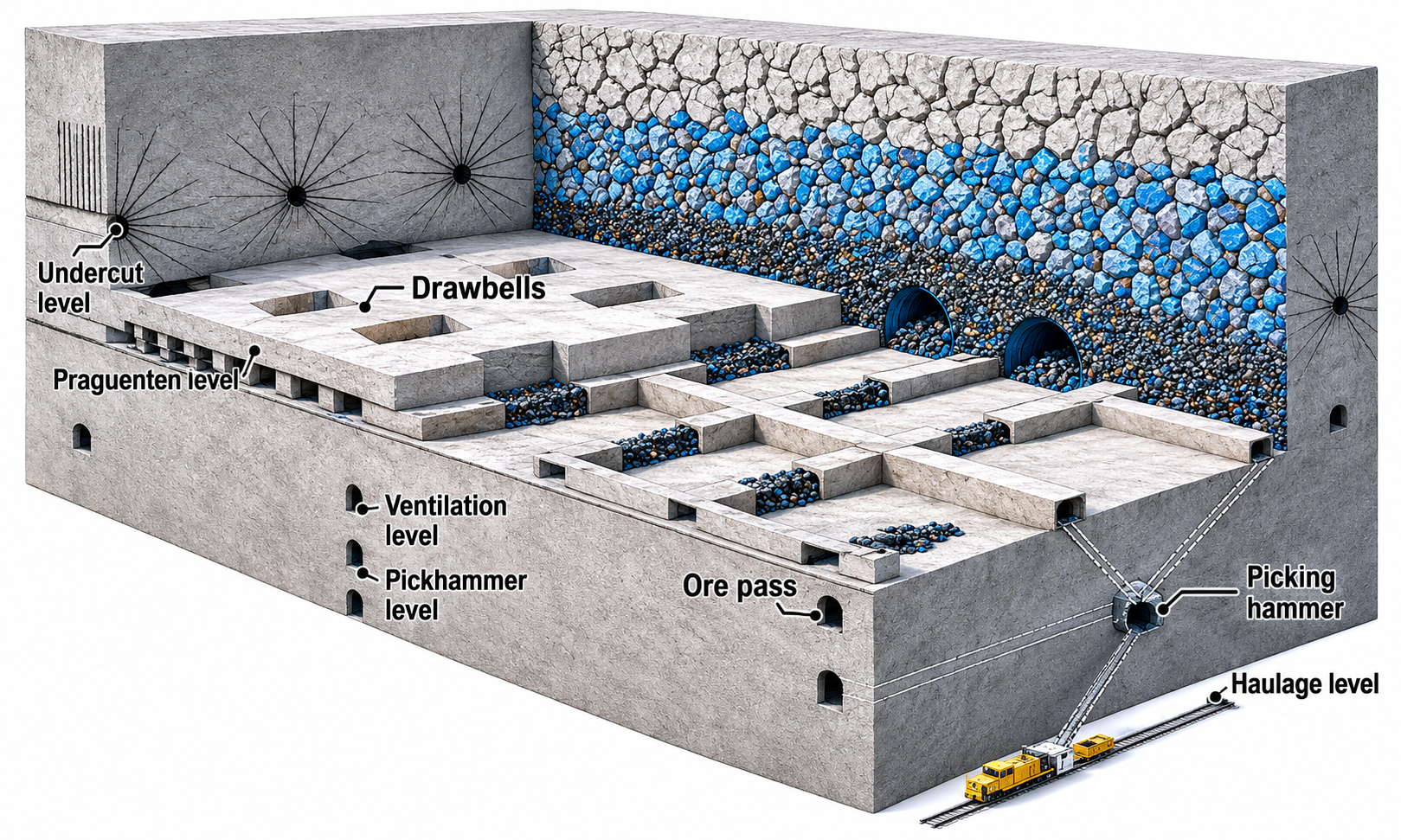

How do you apply discrete element modelling (DEM) to evaluate caving potential and cave propagation in a block caving operation?
0
  • 0 0 Comments
  • 653 Views
  • 653 Reactions
  • 0 Followers
  • 0
    • Report
  • Share
    Share
    • Share on Facebook
    • Share on Twitter
    • Share on LinkedIn
    • Share on WhatsApp

Related Posts

  • What's the correct approach to selecting explosive type (ANFO vs. emulsion vs. heavy ANFO) for wet blast holes?
  • What's the correct field procedure for diagnosing misfires before re-entering a blast area safely?
  • Does advanced process control significantly reduce operator variability in concentrators?

You must login to add an Comment.


Forgot Password?

Need An Account, Sign Up Here
aalan

Sidebar

Sponsored Ads

aalan
  • Recent
  • Mining ERP: Bridging the Gap Between Planned and Actual Costs
    • On: September 14, 2026

    Mining ERP: Bridging the Gap Between Planned and Actual Costs

  • Ore Crushing Plant for Mountain Mines: Managing Access, Transport, and Production
    • On: September 12, 2026

    Ore Crushing Plant for Mountain Mines: Managing Access, Transport, and ...

  • How Does the Crushing Chamber Design of Aggregate Crushing Equipment Affect Output and Finished Product Quality?
    • On: September 12, 2026

    How Does the Crushing Chamber Design of Aggregate Crushing Equipment ...

  • How Can Mine Construction Teams Reduce Rework During Fast-Track Projects?
    • On: September 8, 2026

    How Can Mine Construction Teams Reduce Rework During Fast-Track Projects?

  • The Mine in Your Pocket: Why Mobile ERP Is Reshaping Mining Operations
    • On: September 8, 2026

    The Mine in Your Pocket: Why Mobile ERP Is Reshaping ...

  • How Concrete Is Used in Crusher and Screening Plant Foundations at Guatemalan Mines
    • On: September 4, 2026

    How Concrete Is Used in Crusher and Screening Plant Foundations ...

  • Portable Crusher Plant for Hard Rock Mines: How to Design the Crushing Circuit Before Grinding
    • On: September 3, 2026

    Portable Crusher Plant for Hard Rock Mines: How to Design ...

Go to Home page to view more

Top Members

Olena Skyba

Olena Skyba

  • 150 Posts
  • 2 Comments
Pundit
Marcial

Marcial

  • 91 Posts
  • 0 Comments
Enlightened
Jean Marais (Sanodea Group)

Jean Marais (Sanodea Group)

  • 26 Posts
  • 0 Comments
Beginner
Trending on Mining Doc

Trending Communities

Fixed Plant General Information Geology Mining Case Studies Mining Doc Documentary Mining Engineering Mining Events Mining Finance and Economy Mining Human Resources Mining Industry Research Mining Operations Mining Software Solutions Mining Sustainability Mining Technology Solutions Mobile Plant Equipment

Explore

  • Home
  • Online courses
  • Case study
  • Mining Community
  • Solutions listing
    • Lase Solutions
    • O-PitBlast Solutions
    • Continuous Mining
    • Longwall mining
    • Geosight Scanners
    • LoopX AI
    • Terafil solutions
    • Blasting solutions
    • Geotechnical
    • Submersible Pumps
    • Mine rescue system
    • Ore sorting
    • Whittle Consulting Solutions
  • Add Blog
  • Feed
  • User Profile
  • Posts
    • New Posts
    • Trending Posts
    • Must read Posts
    • Hot Posts
  • Polls
  • Badges

Footer

Mining Doc

Join our community and connect with other people in the Mining industry for knowledge sharing.

Legal Stuff

  • Privacy Policy
  • Terms of Service

Help

  • Support
  • FAQs
  • How to add new content and how to promote a content
  • Compliance and guidelines
  • Subscribe to Mining Doc

Follow

© 2026 Mining Doc. All Rights Reserved