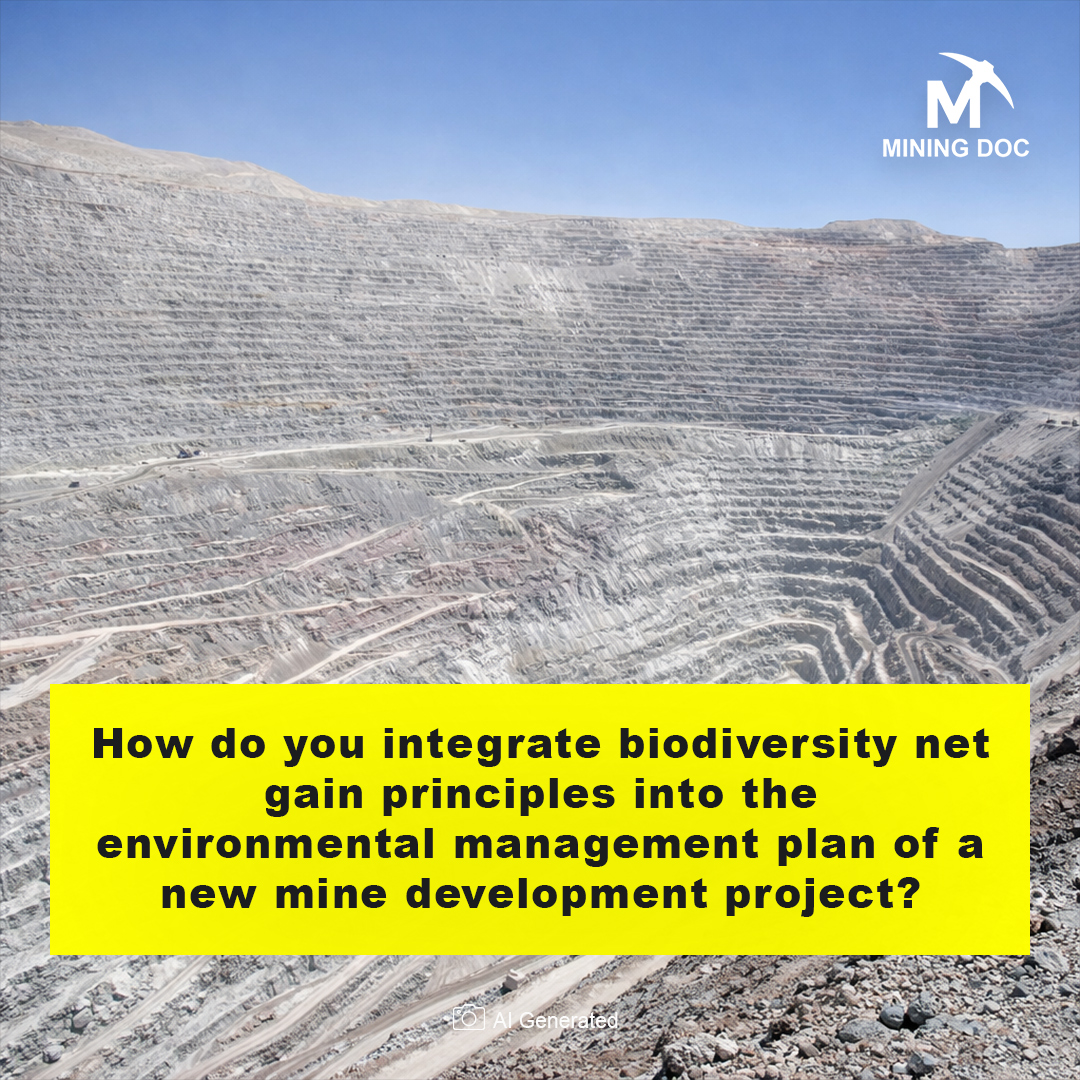
The integration of BNG in the environmental management plan (EMP) of a new mining operation represents a key development of sustainable development. Specifically, BNG can be defined as an environmental strategy which leaves the natural environment in a significantly better state than initially, in terms of habitat quality, ecosystem function, and species assemblage (Morrison-Saunders & Sánchez, 2024). On the contrary, EMP describes a specific project’s operational plan aimed at mitigating possible adverse impacts on the environment. Integration of the two mentioned concepts changes the approach from the reduction of harm in general to enhancement of the environment (Morrison-Saunders & Sánchez, 2024).
The key element for incorporation of the BNG into the EMP of a new mining facility is the proper application of the mitigation hierarchy. In other words, operators should make a preference of avoidance of impacts in the first place and then minimize possible adverse impact before thinking about compensation of them. Finally, the introduction of the ‘enhancement’ level of mitigation hierarchy can ensure that not BNG itself becomes a justification of destruction of rare environments (Morrison-Saunders & Sánchez, 2024).
A true net gain can only be achieved through an EMP that lays a scientifically sound foundation even before any groundwork takes place. The achievement of this objective requires embracing of standard metrics to assess biodiversity and ecosystem services. The assessors are tasked with carrying out the habitat mapping to calculate biodiversity units through the consideration of the size, distinctness, and condition of the habitat pre-mining (McVittie & Faccioli, 2020). It would then become possible for the EMP to predict with accuracy the biodiversity units to be generated to exceed the baseline.
After setting the base, there is the need for the formulation of effective strategies of either restoring the mined sites or undertaking offsetting at other sites not involved in mining activities. Mining firms usually end up meeting the goal of achieving BNG by upgrading the habitat to either more distinct or higher quality habitat during the process of reclaiming the mined lands (McVittie & Faccioli, 2020). A good example here would include replacing the damaged habitat with native biodiverse woodlands post extraction.
BNG cannot be achieved through mere quantification but through deep integration and collaborative participation. An effective EMP needs to acknowledge that biodiversity is inextricably linked to the people’s lives. Planning for BNG must involve forming relationships with local communities and Indigenous populations to make sure that there is an alignment between nature restoration and socioecological conditions (Scott et al., 2024). There should be careful balance of trade-offs so that the implementation of BNG will not result in the displacement of communities and will not overlook traditional knowledge concerning comprehensive land management (Scott et al., 2024).
To summarize, embedding the principles of BNG in the EMP of a mining venture is crucial to ensure sustainable exploitation of resources. The setting of clear goals, using of the mitigation hierarchy, appropriate evaluation techniques, and collaboration with local people enable the transition from ecological damage to positive ecological impact by mining ventures.
References
McVittie, A., & Faccioli, M. (2020). Biodiversity and ecosystem services net gain assessment: A comparison of metrics. Ecosystem Services, 44, 101145. https://doi.org/10.1016/j.ecoser.2020.101145
Morrison-Saunders, A., & Sánchez, L. (2024). Conceptualising project environmental impact assessment for enhancement: no net loss, net gain, offsetting and nature positive. Australasian Journal of Environmental Management, 31(4), 386–403. https://doi.org/10.1080/14486563.2024.2400899
Scott, M., Parker, G., Juntti, M., et al. (2024). The Biodiversity Crisis – Planning for Nature Recovery? Planning Theory & Practice, 25, 103–140. https://doi.org/10.1080/14649357.2024.2322879