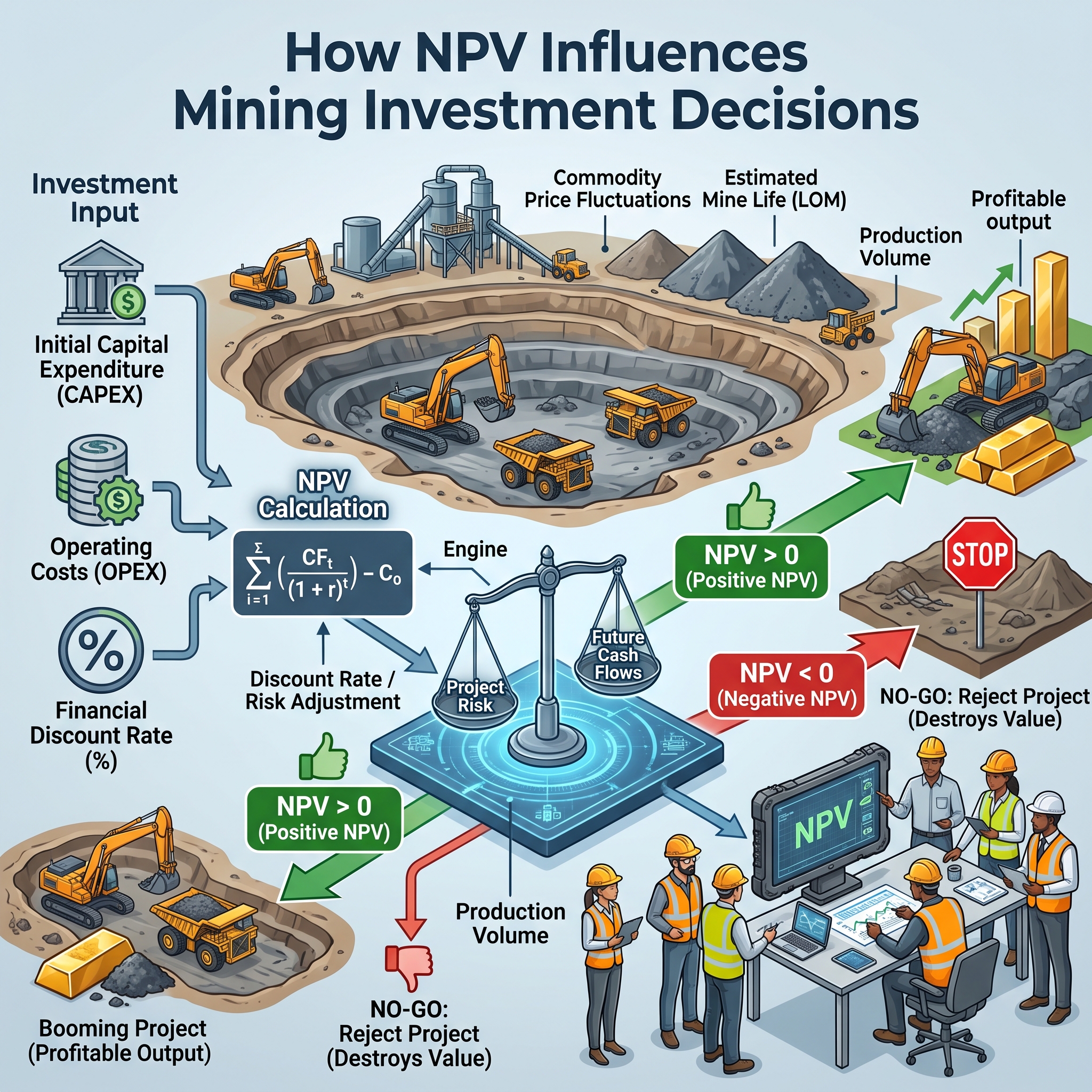
Capital allocation in the mining industry demands substantial upfront investment over long operating horizons under commodity price volatility and geological uncertainty. Net Present Value (NPV) serves as the primary discounted cash flow metric for evaluating project profitability by comparing future expected revenues against initial capital expenditure and operating expenses. Technical reports; such as Preliminary Economic Assessments, Pre-Feasibility Studies, and Feasibility Studies, rely heavily on NPV calculations to demonstrate commercial viability. Static NPV models often misinform investment decisions when used in isolation because traditional discounted cash flow formulas fail to account for operational flexibility and market fluctuations. This summary examines the role of NPV as a decision-making tool, its inherent limitations, and advanced methodologies like Real Options Valuation and stochastic scheduling.
Executive teams and institutional investors use NPV as an initial hurdle metric to determine whether an extraction venture meets the corporate cost of capital. A positive NPV indicates that projected cash inflows exceed expected capital outlays over the life of mine, whereas a negative value signals economic infeasibility. Asset managers rely on Net Present Value to rank competing exploration projects within corporate development portfolios and calculate comparative ratios like Price to Net Asset Value (P/NAV). Mine planners incorporate economic cut-off grades into production scheduling to maximize cumulative discounted cash flows. Higher metal prices reduce cut-off thresholds, allowing lower-grade rock to be processed as ore rather than discarded as waste. Consequently, NPV provides a standardized quantitative baseline that governs early project gating and long-term production sequences.
Traditional discounted cash flow models assume a deterministic future with fixed price assumptions, causing significant valuation discrepancies. Technical feasibility reports frequently present project NPVs that exceed actual corporate market capitalization by forty to sixty percent. Investors apply steep market discounts because feasibility studies implicitly assume that mine construction and production will proceed without operational delays or regulatory impediments. Standard NPV calculations apply a single risk-adjusted discount rate; such as the Weighted Average Cost of Capital, across both volatile revenues and manageable operating costs. This uniform discounting method penalizes upfront investments designed to lower long-term operating costs while heavily discounting late-stage liabilities like mine closure expenses. Furthermore, static models fail to incorporate non-systematic risks, including climate disruptions, geopolitical shifts, and changing regulatory frameworks.
Advanced valuation frameworks address the shortcomings of static NPV by integrating dynamic risk modeling and decision flexibility. Real Options Valuation (ROV) treats early-stage mining assets as financial call options, where project managers hold the right rather than the obligation to expand production, defer development, or temporarily halt operations. The combination of static NPV and Real Options Valuation yields an Enhanced NPV, which quantifies the financial worth of managerial adaptability during market downturns. Stochastic Production Programming replaces single-point price estimates with mean-reverting price distributions. Open-pit mine schedules optimized under stochastic frameworks adjust cut-off grades dynamically in response to market fluctuations, delivering higher practical NPVs and lower stripping ratios compared to deterministic schedules.
Net Present Value remains an indispensable baseline metric for evaluating the financial feasibility of mining assets and establishing initial capital allocation priorities. Sole reliance on static discounted cash flow models exposes decision-makers to severe valuation errors, unpriced market volatility, and underestimated closure liabilities. Corporate leaders achieve superior investment accuracy by supplementing traditional NPV with Real Options Valuation and stochastic production scheduling. Modern mine valuation requires viewing project economics as a dynamic range rather than a static figure, ensuring long-term profitability and operational resilience in an uncertain market.