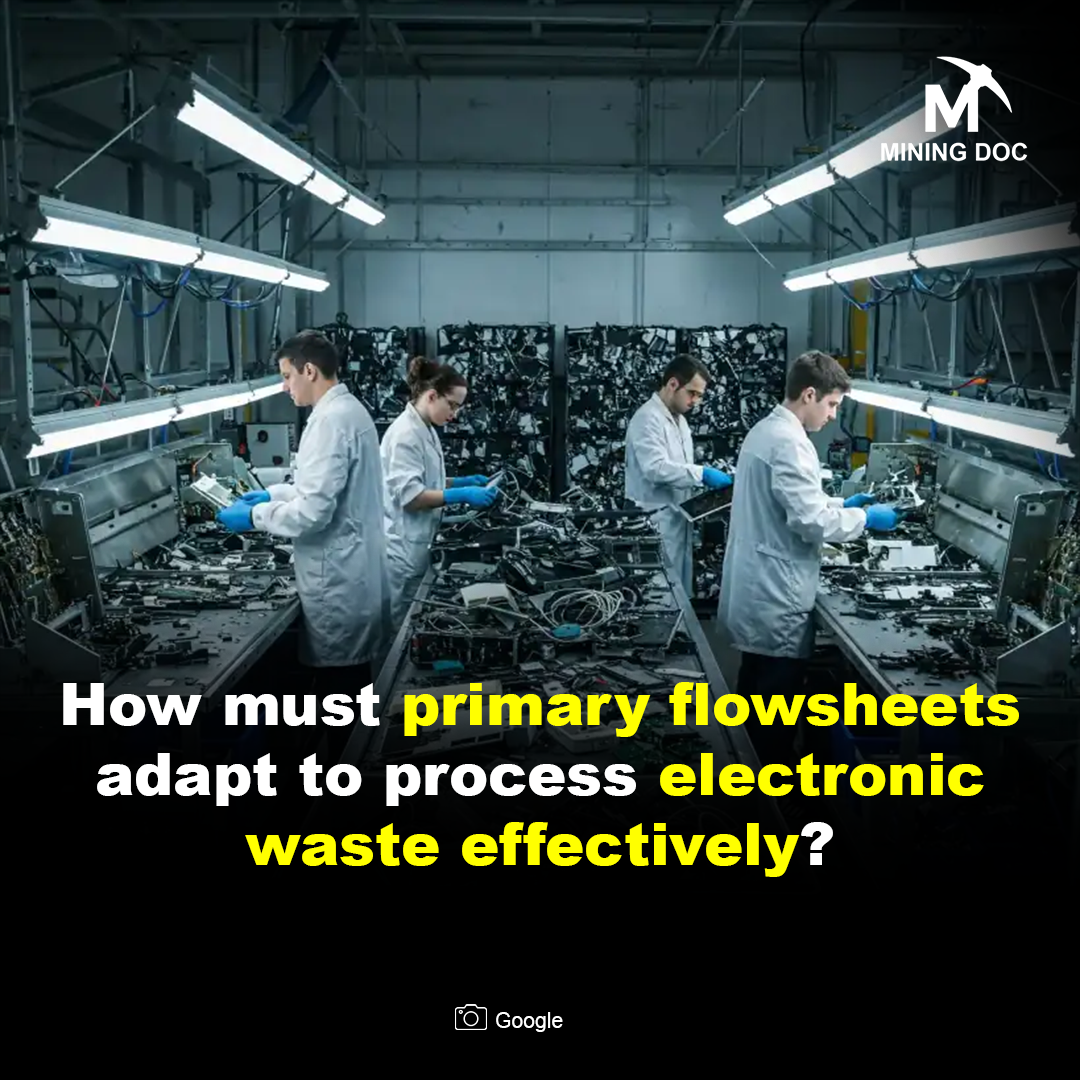
Traditional primary crushing, flotation, and smelting circuits rely on geological consistency, but e-waste presents a completely unpredictable composition. Instead of brittle rock, electronics contain light organics, halogenated flame retardants, and complex metal alloys that clog grinding equipment and foul reagent systems. Attempting to run e-waste through unmodified mining circuits results in severe metal losses, poor liberation, and dangerous environmental non-compliance.
Adapting these flowsheets requires replacing jaw crushers with specialized shredders, air classifiers, and optical sorters to liberate metals from plastics before furnace treatment. In pyrometallurgical circuits, smelters are reconfigured to utilize plastic content as fuel while relying on advanced off-gas scrubbing to capture toxic dioxins and halogens. Hydrometallurgical systems must shift to dissolve zero-valent metals, retuning solvent extraction circuits to process complex multi-metal solutions.
Managing slag chemistry and capturing hazardous elements like lead and cadmium ensures environmental safety while turning former waste into secondary resource streams. As critical mineral security and ESG pressures intensify, urban mining is rapidly transforming from a side process into a core extractive metallurgy discipline. Metallurgists who master the integration of both primary and secondary flowsheet designs will ultimately lead the future of global resource recovery.
References:
-
Reuter, M. A., Hudson, C., van Schaik, A., Heiskanen, K., Meskers, C., & Hagelüken, C. (2013). Metal recycling: Opportunities, limits, infrastructure (UNEP International Resource Panel Report). United Nations Environment Programme.
-
Hagelüken, C., & Meskers, C. E. M. (2010). Complex life cycles of precious and special metals. In T. E. Graedel & E. van der Voet (Eds.), Linkages of sustainability (pp. 163–197). MIT Press.
-
Cui, J., & Zhang, L. (2008). Metallurgical recovery of metals from electronic waste: A review. Journal of Hazardous Materials, 158 (2–3), 228–256. https://doi.org/10.1016/j.jhazmat.2008.02.001