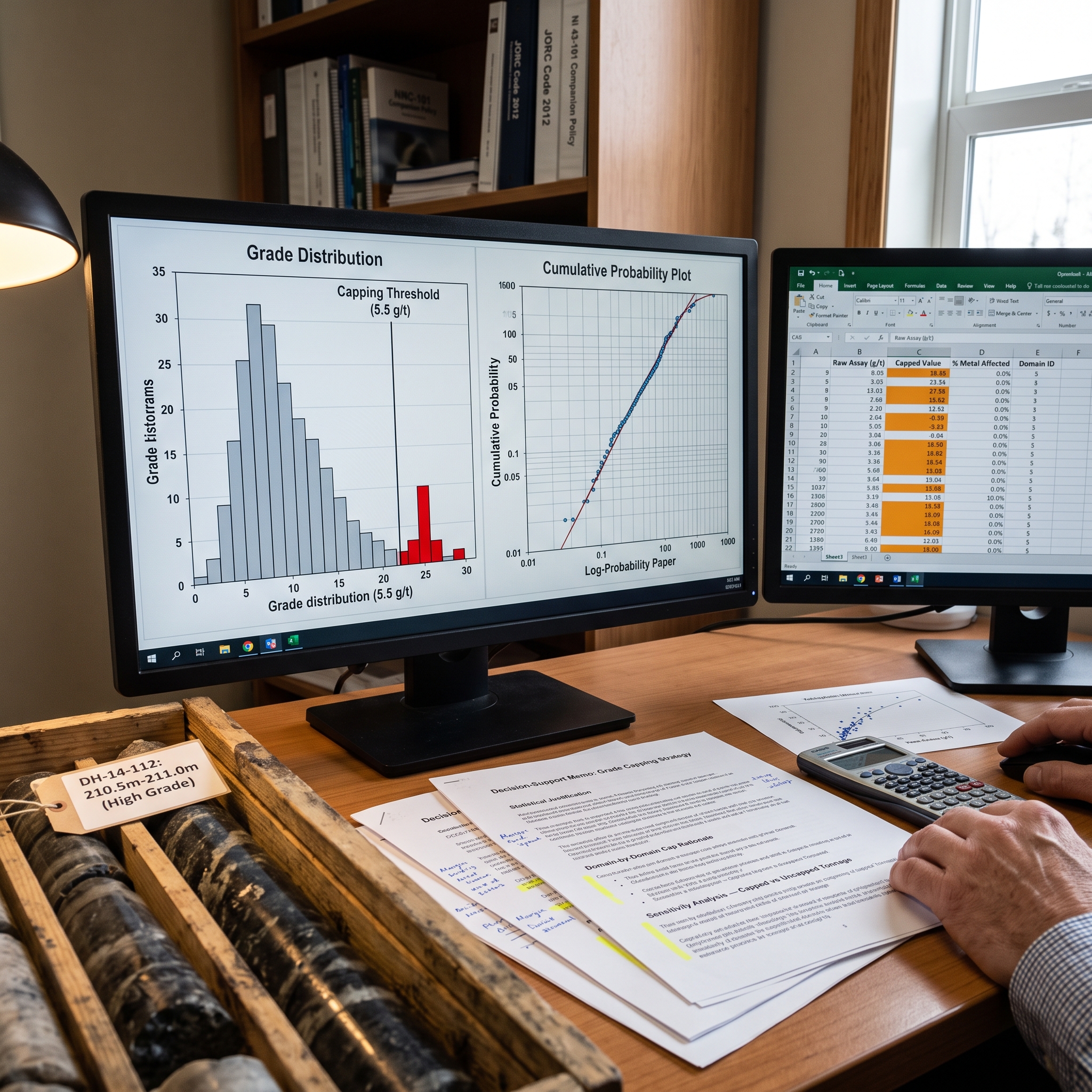
Top-cuts, also referred to as grade capping, in mineral resource estimation refers to the reduction of very high or anomalous grades before performing the interpolation. Top-cuts are used to prevent any false smearing of the high grades to the low grade blocks in the vicinity. Under international guidelines, the reporting of resources involves detailed analysis and resource estimates need to be justified. Qualified Person (QP) should prove that the top cuts chosen are scientifically and statistically valid. The proper estimation of a vein system requires that very high grades do not affect the results (Mutobvu et al., 2024).
The key factor which calls for capping is the natural skewness of mineral deposit distributions, including precious metals, where a relatively low number of very high-grade bonanza samples can represent an overly large portion of the overall metal concentration. Without taking any measures, the process of interpolation will disperse such extreme grades to excessively large amounts, resulting in the serious overestimations of local block grades and, as a consequence, making mining operations economically unviable. Thus, a certain compromise must be sought, where capping will not allow for overestimation but will not prevent from utilizing the economic potential of the deposit.
The basis for any justified capping is the application of sound statistical analysis, instead of using random guidelines. The commonly used strategies consist of finding the points of breaks in the log-normal cumulative distribution graph, checking histograms, or establishing hard borders like two standard deviations above the mean. Such strategies can be quite subjective in nature, but modern techniques assess the effectiveness of capping through the establishment of the thresholds which ensure minimum possible loss of data and, at the same time, limit overestimation. One of such advanced methods is the three-dimensional hot-spot analysis of the borehole data (Kim et al., 2018).
The defensibility of top-cuts in relation to JORC and NI 43-101 criteria further depends on geological and spatial considerations. The mineralisation is fully controlled by structural factors, so the proper method is geological domaining of the high-grade shoots instead of blind capping of a full global dataset. The usual interpolation techniques produce the smooth surfaces that do not represent the real variation of grades in situ (Cherchenevski et al., 2019); thus, the use of moderate top-cuts along with spatial limitation of the search ellipsoid is typical among QPs. In other words, the non-capped sample will impact the blocks inside the limited spatial range, while capped grade will be applied outside that range.
When Qualified Persons (QPs) carry out an independent audit on whether NI 43-101 or JORC codes have been complied with, the top-cut methodology comes under strict scrutiny. In this respect, it is necessary for the auditor to determine the “metal at risk”, which is the ratio of total metal that has been stripped off from the model through the capping technique. In cases where too much metal has been stripped off by a top-cut method from the deposit, it becomes mandatory for the QP to offer complete information regarding reconciliation of the model. Due to the subjective aspect of outlier identification, it is necessary to reveal all facts about the statistics used and geological implications.
In summary, the use of defensible top-cuts under JORC and NI 43-101 protocols involves an iterative process that combines sound statistics with geological knowledge. Selecting a random percentile value or simply cutting off assay results at random high values is legally and scientifically inadequate. With the use of sound statistical techniques and strict geological domaining as well as making the metal tonnage implications clear, QPs come up with estimation models that can be relied upon. In essence, the defensible top-cut procedure helps in protecting investors against overestimation and provides an accurate picture of mineral resource economic viability.
References
Cherchenevski, P. K., Costa, J. F. C. L., & Rubio, R. H. (2019). Grade uncertainty embedded in long term scheduling: stochastic mine planning. REM – International Engineering Journal, 72, 275-284. https://doi.org/10.1590/0370-44672018720119
Kim, S.-M., Choi, Y., & Park, H.-D. (2018). New Outlier Top-Cut Method for Mineral Resource Estimation via 3D Hot Spot Analysis of Borehole Data. Minerals, 8(8), 348. https://doi.org/10.3390/min8080348
Mutobvu, T., Pretorius, H., Muller, C. J., & Mabala, M. I. (2024). Probabilistic Modelling of Geologically Complex Veins of the Barberton Greenstone Complex at Fairview Mine, South Africa. Minerals, 14(4), 343. https://doi.org/10.3390/min14040343