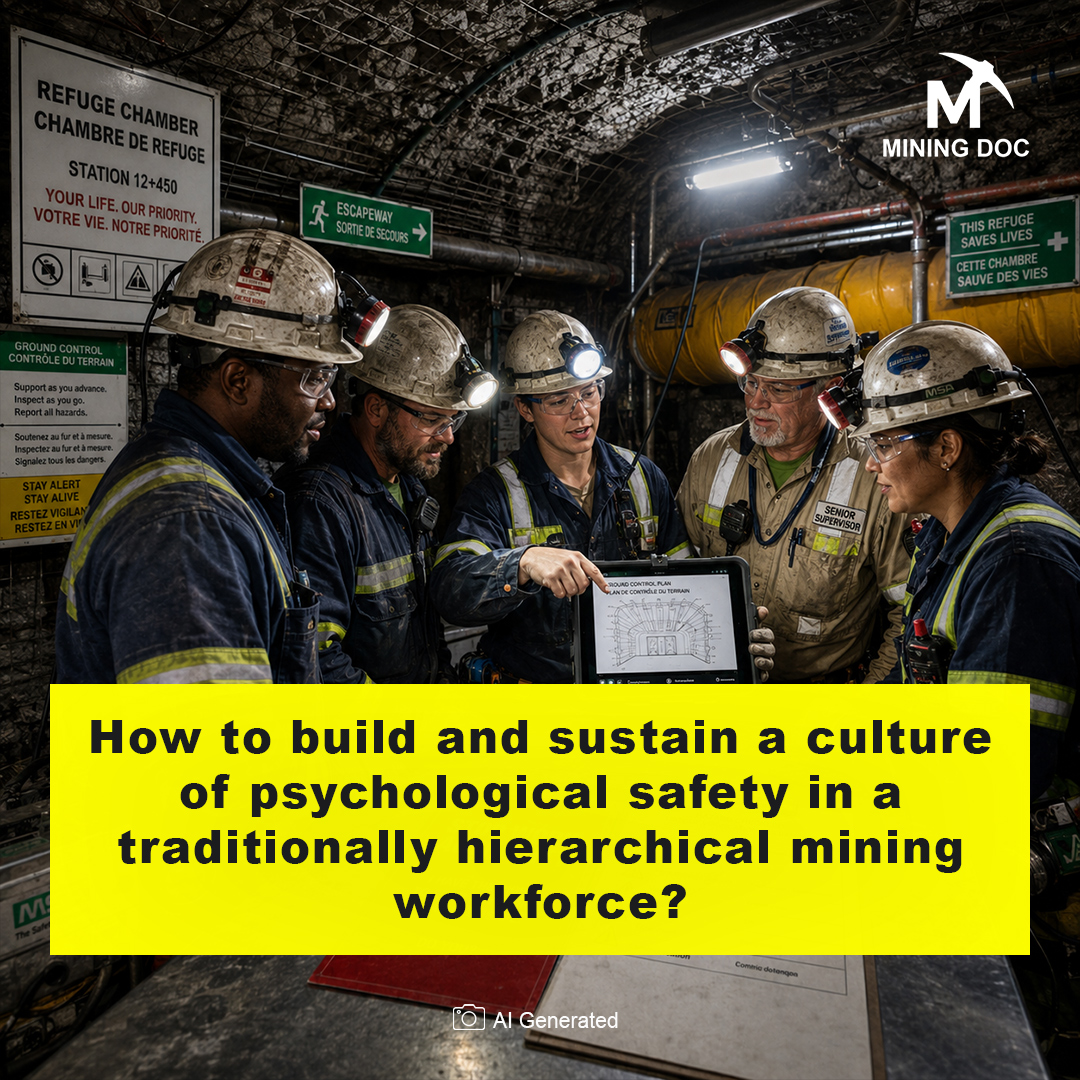
The establishment of a safety culture in hazardous sectors of the economy depends on the knowledge of two fundamental notions. The psychological safety can be described as a collectively held notion that the workplace is safe enough for interpersonal risks when people are able to express their worries without being subject to adverse outcomes (Newman et al., 2017). On the contrary, a hierarchical structure of the mining sector includes rigid top-down management.
However, the inherent difficulties associated with the hierarchical form can inhibit psychological safety. For instance, traditionally the mining industry has adopted a directive style of leadership geared towards achieving maximum efficiency in production. Within such a setup, the miners could be intimidated by their supervisors, and thus communication of any near misses will be inhibited. This means that the absence of communication will lead to the occurrence of serious accidents.
The main motivator for the creation of psychological safety is leadership safety commitment. Leaders who prioritize the well-being of their employees over productivity quotas eliminate the fear linked to the conventional hierarchical approach. Leadership safety commitment has a substantial positive influence on the safety participation behavior of miners, creating a psychological foundation of trust (Niu & Liu, 2022). In such a way, by enabling a free conversation without consequences, leaders make safety a joint endeavor.
Nevertheless, apart from leadership, the creation of psychological empowerment of miners is essential to maintaining a safety culture. Psychological empowerment can be defined as the perception of autonomy and meaning in one’s activities. Studies have shown that psychological empowerment plays a key role as a mediator between the values of an individual worker and his/her safety behaviors (Chen et al., 2022). Thus, empowering people implies transferring the decisions regarding safety to them.
The process of creating sustained psychological safety involves building a positive peer and supervisory environment. The aggregate attitude of colleagues functions as a moderator which can help strengthen the leadership efforts. The positive safety attitude among one’s peers and supervisors increases the effect of upper management commitment on psychological safety of miners (Niu & Liu, 2022). Such safety climate promotes the formation of safe behavior into habit (Chen et al., 2022).
To summarize, the issue of maintaining psychological safety in an organization with hierarchical workforce requires a holistic approach. It is necessary to prove the commitment of leadership to safety, encourage psychological empowerment, and build a positive peer climate. Thus, it becomes possible to overcome the gap between hierarchical structure and communication and ensure not only the health but also organizational resilience.
References
Chen, T., Hu, W., Liu, J., & Li, H. (2022). Effect of Work Values on Miners’ Safety Behavior: The Mediating Role of Psychological Empowerment and the Moderating Role of Safety Climate. Sustainability, 14, 9553. https://doi.org/10.3390/su14159553
Newman, A., Donohue, R., & Eva, N. (2017). Psychological safety: A systematic review of the literature. Human Resource Management Review, 27, 521-535. https://doi.org/10.1016/j.hrmr.2017.01.001
Niu, L., & Liu, Y. (2022). The Relationship Between Leadership Safety Commitment and Resilience Safety Participation Behavior. Psychology Research and Behavior Management, Volume 15, 517-531. https://doi.org/10.2147/prbm.s349712