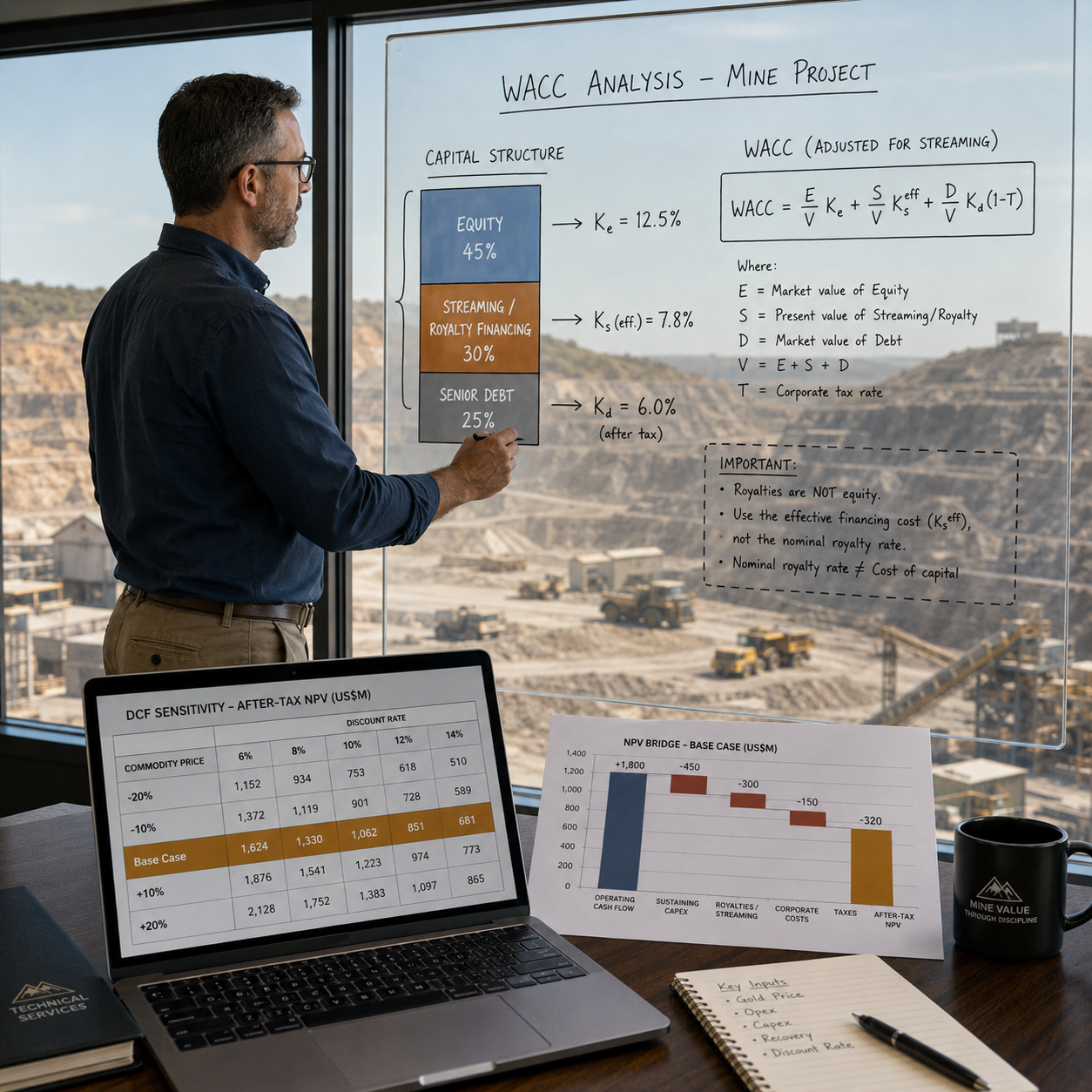
A proper evaluation of a project entails knowledge of some financial basics. The Weighted Average Cost of Capital (WACC) is the composite cost at which an organization acquires resources to fund assets. This cost reflects the weighted cost of debt and equity. The other sources of funds are referred to as streaming and royalty financing. They entail investing money to receive a certain proportion of production or revenues in future. Valuation using WACC becomes complicated in cases where a certain project uses both sources of finance.
The biggest challenge that comes up is determining whether such a project can fit into a conventional WACC analysis. The standard procedure involves the use of two elements in the computation. The challenge here is that one is supposed to analyze the costs of production factors taking into consideration the cost of capital when alternative instruments are used (Trench et al., 2024). Streaming agreement cannot be considered a form of debt because there are no repayments of interest and principal whereas it cannot be termed as equity either.
When it comes to the application of WACC, two methodology choices could be considered as the right choice. It should either take cash flows adjustment or discount rate adjustment approach. In the first case, the obligation of making royalty payment could be treated as a purely operational expense. Then the valuation of a particular project will require that annual cash flows be adjusted to the present value using WACC as a discount rate but only after royalty payments will be subtracted (Abramowski et al., 2021). This way, when free cash flows are diminished before discounting takes place, WACC stays unchanged and shows the rate that is needed for the traditional capital providers.
Alternatively, the WACC formula could be altered in a way that it will cover three sources of capital in a single entity: the cost of equity, debt, and the royalty. In this situation, the alternative capital cost could be calculated as the IRR of deliveries against capital inflows at the time of transactions. However, as the calculation of discount rates involves quantification of the degree of uncertainty, evaluating the actual cost of these unique financial tools may demand project-specific risk premium inclusion (Ponomarenko et al., 2022).
The weights of the factors that are taken into account in the implementation of WACC are extremely significant. To get the weight of royalty factor, it is necessary to establish how much of the funding is upfront and how much it is compared to the whole capital structure of the project. Moreover, it should be kept in mind that, due to the nature of streaming arrangement, market risks are shifted from the shoulders of the project owner to the financier, which makes risk nature of the rest part of the equation necessary to take into account as well.
In summary, in projects involving equity financing in addition to stream and royalties financing, financial alignment becomes crucial. There is need to choose the option of reducing other financing liabilities from FCF or incorporating the other factors within a multiple-tranche formula for WACC. Both the approaches mentioned are technically feasible, but the option selected has to be applied uniformly for avoiding any mistakes.
References
Abramowski, T., Urbanek, M., & Baláž, P. (2021). Structural economic assessment of polymetallic nodules mining project with updates to present market conditions. Minerals, 11(3), 311. https://doi.org/10.3390/min11030311
Huang, C. Y., & Dzeng, R. J. (2019). Evaluating ancillary business scale for PPP-BOT projects: A social housing BOT case in Taiwan. Sustainability, 11(5), 1415. https://doi.org/10.3390/su11051415
Ponomarenko, T., Marin, E., & Galevskiy, S. (2022). Economic evaluation of oil and gas projects: Justification of engineering solutions in the implementation of field development projects. Energies, 15(9), 3103. https://doi.org/10.3390/en15093103
Trench, A., Baur, D., Ulrich, S., & Sykes, J. P. (2024). Gold production and the global energy transition—A perspective. Sustainability, 16(14), 5951. https://doi.org/10.3390/su16145951