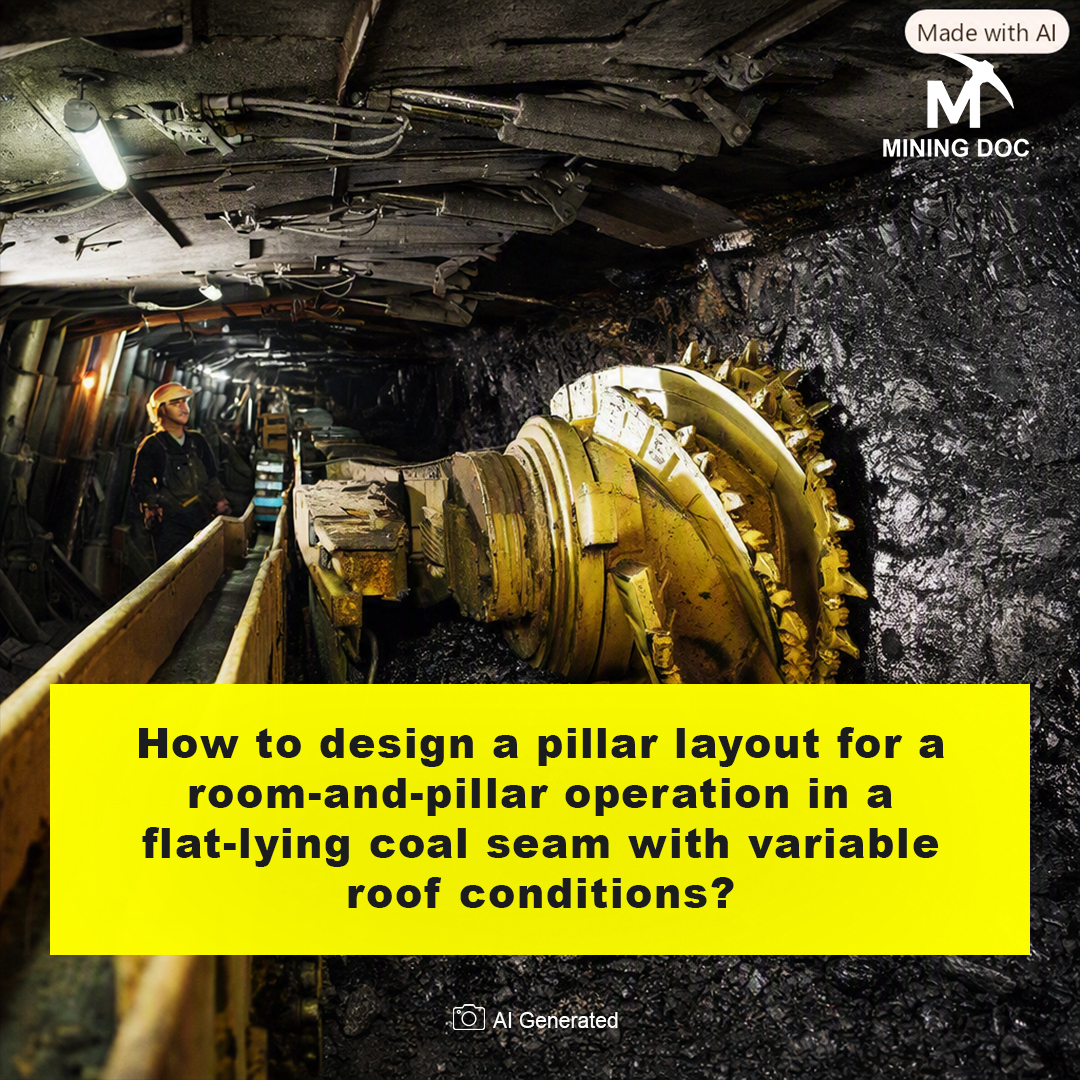
Room-and-pillar mining is one of the most widely used underground mining techniques which are intended for flat lying coal seams. According to this technique, intersecting tunnels (rooms) are created within the seam and un-mined blocks of coal (pillars) remain to support the overlying strata. Flat lying seam suggests the horizontal nature of the seam which allows creating a systematic design. Nevertheless, variable roofs (inconsistent lithology and varying height) complicate the process of mining. The optimal design of layout in this case should ensure the maximum production capacity and geotechnical stability of the mine at the same time.
The central element of pillar design is the load carried from the roof to the floor. The roof-pillar-floor system concentrates and redistributes elastic energy during excavation process. In case when local mine stiffness decreases or roof acts like an elastic beam on the moving ground, multi-pillar instability will cause the domino effect (Dong et al., 2024). Engineers should calculate the load of tributary area considering the fact that variable roof strata may cause non-uniform stress distribution within the pillars.
Stress concentration is one of the important considerations in estimating the dimension of the pillars in room and pillar method of mining. In case rooms are enlarged, then the stress concentration will be at the pillars leading to yielding at the corners and splitting along the plane (Mehra & Budi, 2024). Based on the response mechanisms for room and pillar design and considering high-stress area which induces large deformation, hence it becomes very important to use 3D parametric modeling to maximize the width-to-height ratio of the pillar.
In view of variable roof, the interaction of the coal pillar with the immediate roof becomes quite complex. If there is an alternation in the overburden or presence of hard rocks in overburden, this causes roof that is overhung and applies tremendous pressure on the adjacent pillars (Chen et al., 2024). It becomes imperative in such cases to alter the design of the pillar in terms of enlarging it in weak geological condition areas. This is because the placement of the large barrier pillar helps segregating the entire mine in panels.
The evaluation of the possible roof falls during the mining process becomes an integral part of the pillar design process. Different geological bodies may demonstrate different behavior: thus, overhangs formed by rocks serving as cantilevers can become unstable, causing great stress concentration in the underlying pillar areas (Prusek et al., 2016). Thus, accurate geological mapping should always be conducted. When a weak shale roof is present, it is necessary to make smaller rooms and wider pillars to diminish the span of exposed roof. On the contrary, a strong sandstone roof allows widening rooms and narrowing pillars.
In summary, the design of a room-and-pillar layout for flat lying coal seam under varying roof conditions becomes a complicated process that requires going from empirical tributary calculations to complex numerical modeling and constant evaluation of risks. As a result of load transfer study, stress distribution management, and adjustment of excavation spans depending on immediate roof competency, it is possible to design a layout that guarantees safe working conditions for miners and effective coal recovery.
References
Chen, D., Wang, X., Bai, J., & Zhang, F. (2024). Deformation mechanism and control technology of gob-side roadway with continuous mining and continuous backfilling: a case study. Geomatics, Natural Hazards and Risk, 15. https://doi.org/10.1080/19475705.2024.2350480
Dong, H., Guan, K., Liu, H., Hu, Q., Li, H., & Zhou, Y. (2024). Numerical and theoretical analysis of multi-pillar instability under elastic beams. Geomatics, Natural Hazards and Risk, 15. https://doi.org/10.1080/19475705.2024.2353135
Mehra, A., & Budi, G. (2024). 3D Modelling approach to identify parametric configurations for pillar stability in underground metal mine: a case study. Geomatics, Natural Hazards and Risk, 15. https://doi.org/10.1080/19475705.2024.2367630
Prusek, S., Rajwa, S., Wrana, A., & Krzemień, A. (2016). Assessment of roof fall risk in longwall coal mines. International Journal of Mining, Reclamation and Environment, 31, 558–574. https://doi.org/10.1080/17480930.2016.1200897