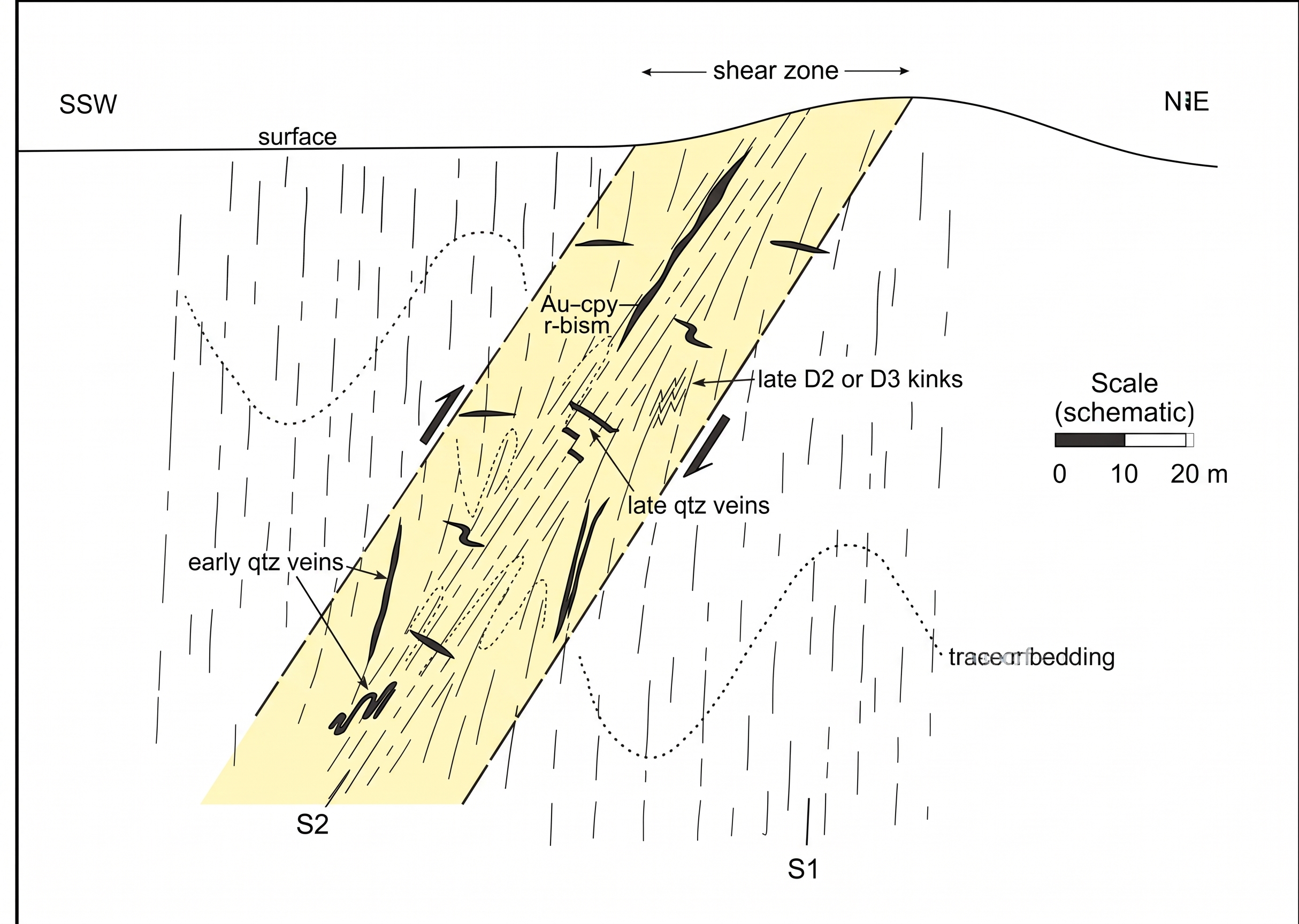
Shear-hosted gold deposits form a substantial portion of all global gold resources and usually occur in subduction-related tectonic environments (Groves et al., 2018). While characterizing such deposits, it is critical to determine primary versus remobilized structural controls. The primary controls correspond to the original geological geometries (e.g., crustal-scale faults and shear zones) serving as the conduits and traps for mineralizing fluids during the primary orogenic event. The remobilized controls are the products of subsequent tectonic or pressure-temperature perturbation events, which redistribute the primary gold into new structural positions (Velásquez et al., 2018).
The primary controls are defined by the progressive deformation of the active orogen. World-class gold deposits tend to be located in second-order structures near crustal-scale shear zones, which are the primary fluid conduits (Groves et al., 2018). In the course of field mapping, gold is found trapped in certain structural positions, including district-scale jogs, anticlinal fold hinges, or lithological contacts. Those structures are syn-kinematic with the main penetrative deformation episode, i.e., the mineralized quartz veins and alteration halos are parallel to the regional foliation and shear sense.
Remobilization results in the superposition of new structural geometries on top of the primary mineralization. Remobilization is associated with the reactivation of local structures and pressure changes, which lead to fluid boiling and drive the mechanical or chemical relocation of the ore from primary to secondary sites (Velásquez et al., 2018). In remobilized cases, the structural mapping will demonstrate the presence of gold-bearing structures, which appeared after the primary deformation. Usually, those secondary sites are the late brittle faults, tension gashes, or pressure shadows of the competent porphyroblasts cutting through the initial ductile fabric.
The accurate determination of the type of controls requires careful analysis of the cross-cutting relationships and kinematic indicators in the field. Primary gold-bearing structures tend to have the orientation of early stages of continuous regional deformation (Williams et al., 1989). For instance, the extensive early shear zones may include the main primary mineralization, but the further deformation will transfer the ore into the newly formed later-generation structures. If the mapping shows the presence of a significant number of highly localized late brittle structures offsetting the main foliation, then it is a clear indication of remobilization.
Microstructural analysis allows validating the field observations in case of ambiguous macroscopic differences. On the microscopic level, primary mineralization includes the co-precipitation textures of the early alteration minerals and undeformed sulfides. At the same time, remobilized gold tends to occur as a filling of the late micro-fractures inside the deformed sulfides or as new precipitation at the sub-grain boundaries during the secondary deformation (Velásquez et al., 2018). Using advanced techniques, it becomes possible to show how the deformation-induced misorientation of the minerals leads to the migration of invisible primary gold into visible clusters along new microscopic structural paths.
To sum up, the distinction between primary and remobilized controls is vital for accurate exploration modeling of shear-hosted gold deposits. The primary controls correspond to the original plumbing systems, which appear during the main orogenic event. At the same time, the remobilized controls reflect the local tectonic overprinting, leading to the fundamental change in the spatial geometry of the ore body. With the integration of the field mapping of cross-cutting relations with microstructural analysis, geologists will be able to reconstruct the complicated tectonic history of the deposit.
References
Groves, D. I., Santosh, M., Goldfarb, R. J., & Zhang, L. (2018). Structural geometry of orogenic gold deposits: Implications for exploration of world-class and giant deposits. Geoscience Frontiers, 9, 1163-1177. https://doi.org/10.1016/j.gsf.2018.01.006
Velásquez, G., Salvi, S., Siebenaller, L., Béziat, D., & Carrizo, D. (2018). Control of Shear-Zone-Induced Pressure Fluctuations on Gold Endowment: The Giant El Callao District, Guiana Shield, Venezuela. Minerals, 8, 430. https://doi.org/10.3390/min8100430
Williams, P. R., Nisbet, B. W., & Etheridge, M. A. (1989). Shear zones, gold mineralization and structural history in the Leonora district, Eastern Goldfields Province, Western Australia. Australian Journal of Earth Sciences, 36, 383-403. https://doi.org/10.1080/08120098908729496