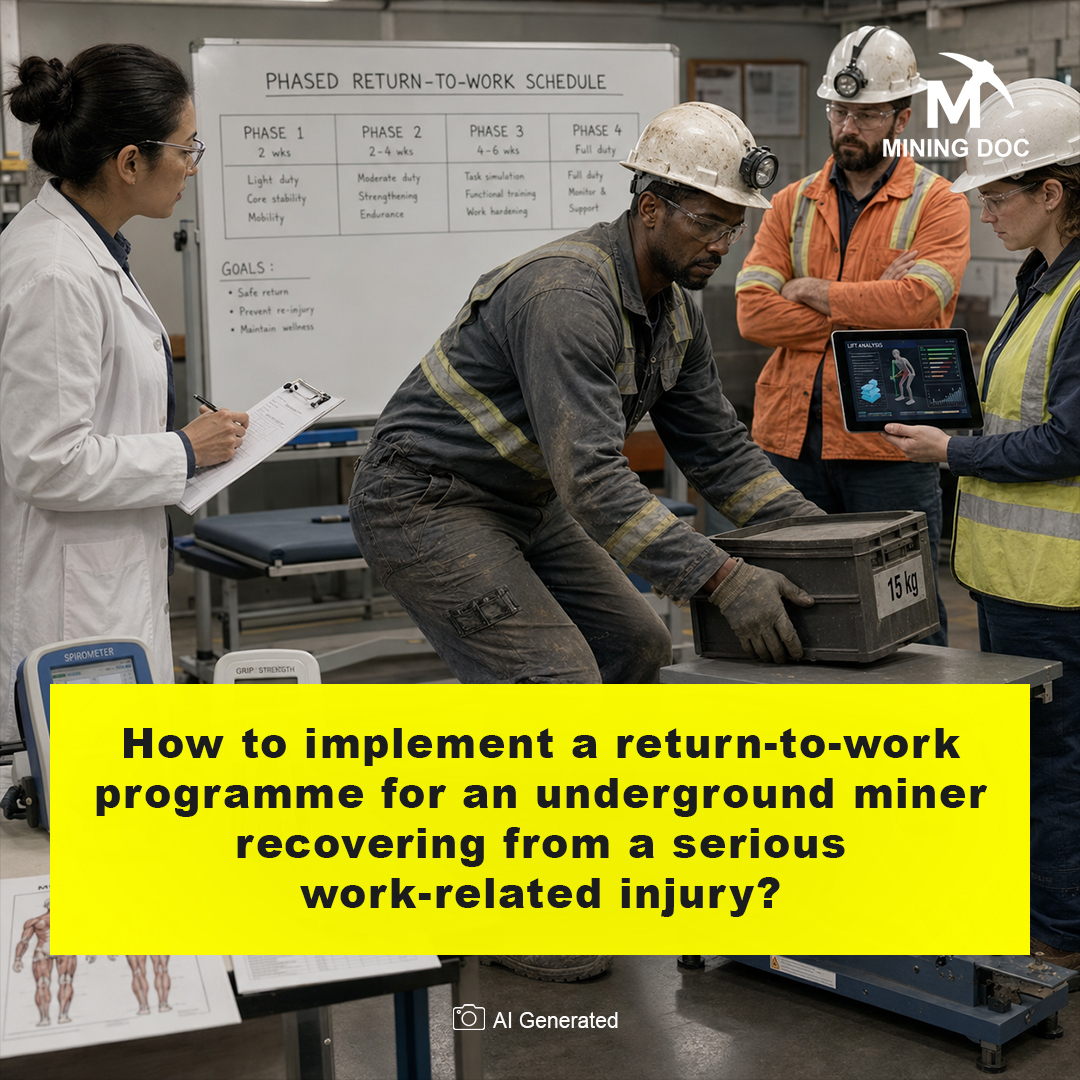
A “return to work” (RTW) program refers to an organized process that involves collaboration between stakeholders in order to help employees who are injured get back into their place of work. In terms of an underground mine setting, a ‘work-related serious injury’ refers to severe musculoskeletal injuries such as ruptured anterior cruciate ligament (ACL) injuries or crushing injuries caused by heavy machinery (Tiftikci et al., 2015). Implementation of a successful RTW program in such an environment calls for a systematic, staged process. The overall aim of the program is to help the miner recover without sustaining any further injury.
The key to a successful RTW program includes having a multidisciplinary team comprising occupational physicians, physiotherapists, mine safety managers and the injured worker. Prior to the reintegration process, a thorough evaluation of the physical and functional condition of the individual needs to be done. This includes checking whether the injured area has healed properly, like stability of joints post-surgery, and the overall conditioning necessary to cope with the strenuous activities of underground mining (Tiftikci et al., 2015).
Besides the issue of physical readiness, there needs to be consideration for psychosocial and occupational barriers. Absence from work due to illness might negatively affect a person’s routines, self-perception, and willpower. Employing tools like the Model of Human Occupation can help identify the precise barriers – lack of confidence, the fear of being injured again, and anxiety (Strømstad et al., 2024). In the mining sector, psychological readiness is just as important as the physical one. Counseling and open communication are crucial for building up a person’s self-confidence.
In the event of the issuance of medical clearance with restrictions, the employee must not be assigned the same underground tasks he was working on prior to the injury. A RTW plan is designed in which particular types of activities are assigned based on one’s physical and psychological condition (Strømstad et al., 2024). As for the miner, he will have to begin with surface activities, like equipment inspection or control room activities. The physical load will slowly increase.
A more developed phase of the RTW program utilizes work hardening and job simulation. Mining in a subterranean environment demands certain movements, such as crawling in tight spaces or moving across uneven surfaces. The OT designs exercises to recreate the above-mentioned tasks in a safe environment to ensure that the patient’s body can cope with certain biomechanical stresses (Tiftikci et al., 2015). In cases where injury renders it impossible for the miner to resume his duties in the original capacity, the RTW program should make efforts to find alternative solutions or retrain the worker.
Lastly, constant monitoring and evaluation are crucial for the RTW program to be successful. Monitoring the miner during the process of transition back into work will help to track the progress of the recovery. With the help of constant monitoring, the RTW program will be able to detect potential flare-ups of the miner’s pain or fatigue and regulate his workload accordingly. Therefore, the RTW program creates a system of safety and support not only for the injured miner but also for the company as a whole.
References
Strømstad, K., Skarpaas, L. S., Haslerud, S. I., et al. (2024). Exploring return to work barriers through the lens of model of human occupation. The NOW WHAT project. Scandinavian Journal of Occupational Therapy, 31. https://doi.org/10.1080/11038128.2023.2297732
Tiftikci, U., Serbest, S., Kilinc, C. Y., Karabicak, G. Ö., & Vergili, Ö. (2015). Return to work in miners following anterior cruciate ligament reconstruction. Pan African Medical Journal, 22. https://doi.org/10.11604/pamj.2015.22.173.7979