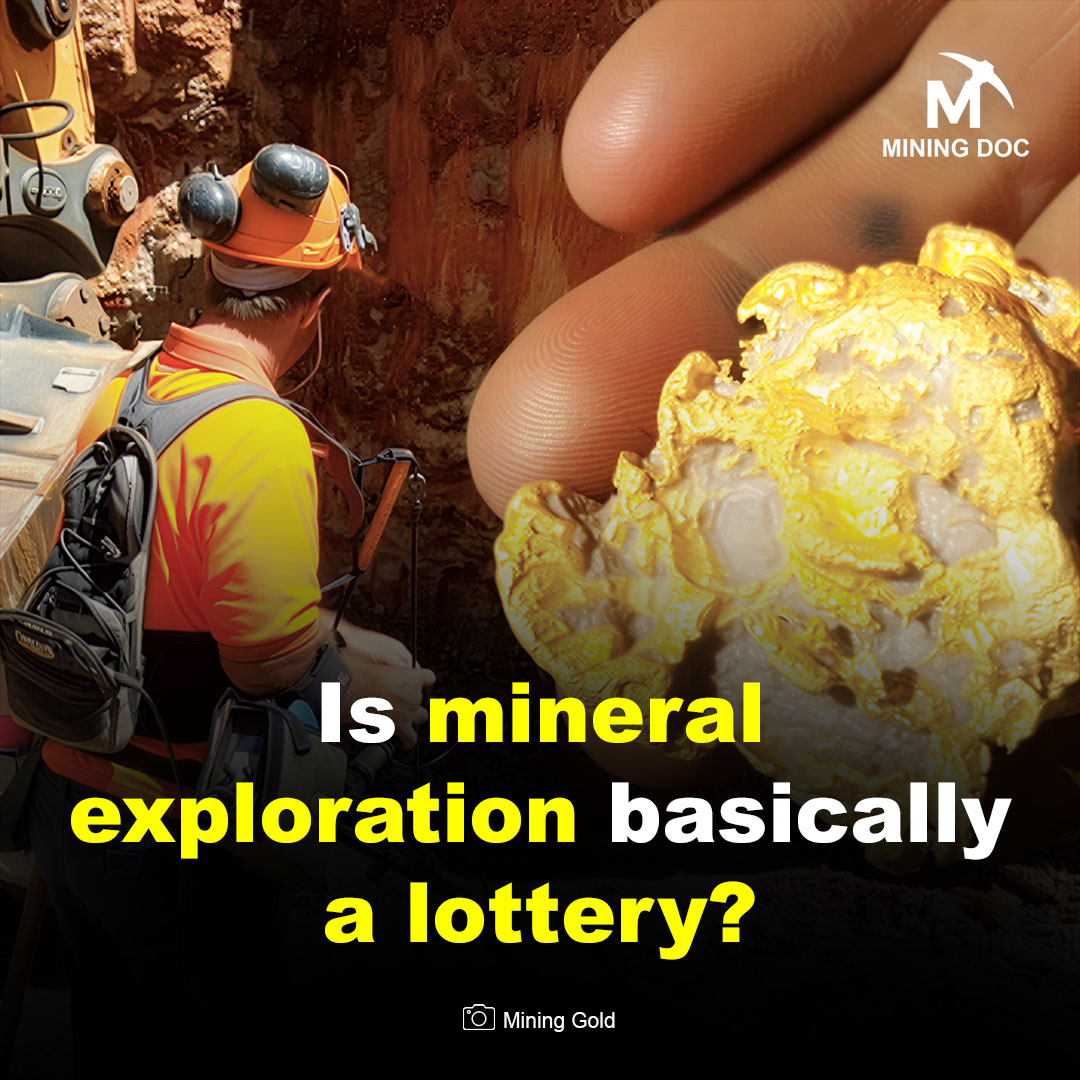
In the popular imagination, mineral exploration is often depicted as a romanticized “gold rush”—a chaotic dash where luck is the only currency. However, contemporary scientific literature paints a far more nuanced picture. While the element of chance is undeniable, modern exploration has evolved into a sophisticated exercise in risk management, leveraging advanced geochemistry, geophysics, and machine learning to tilt the odds in favour of the explorer.
The “lottery” argument: statistical realities
From a purely statistical perspective, the comparison to a lottery is not entirely unfounded. Recent economic modeling highlights a “deterioration in exploration efficiency,” where the probability of discovery for commodities like gold and copper has become increasingly detached from the massive capital investments poured into them (Castillo et al., 2025). The odds of an early-stage “greenfield” prospect becoming a Tier 1 mine—defined as a company-making asset with over 20 years of life—are estimated to be lower than 1 in 1,000 (Discovery Alert, 2025).
This inherent uncertainty has led some economists to model exploration as a “game of chance” where an agent pays for information to reduce uncertainty about an asset with a random initial value (Bell, 2015; Castillo & Roa, 2021). In this framework, no amount of exploration can entirely eliminate the risk, and the “gambler’s ruin” remains a constant threat for junior mining companies with limited capital.
Beyond luck: the role of scientific reduction
Despite these daunting odds, the industry is not merely “gambling.” The transition from blind luck to informed probability is driven by what researchers call “scientific reduction” (Lyell Collection, 2025). Unlike a lottery, where every ticket has the same chance of winning regardless of the player’s skill, mineral exploration success is heavily weighted by the application of geological expertise.
Key strategies used to move from random chance to calculated risk include:
- Geochemical process discovery: utilizing multivariate statistical analysis to identify mineral stoichiometry and “signatures” that distinguish ore-forming processes from background noise (Lyell Collection, 2025).
- Machine learning (ML) integration: the use of ML for large-scale mineral prospectivity mapping has seen a surge from 2016 to 2025, allowing geologists to process vast datasets to predict deposit locations with higher accuracy than traditional manual methods (MDPI, 2025).
- Bayesian learning: explorers use Bayes’ formula to update the probability of a deposit’s existence as they move through successive stages of drilling and testing, effectively “learning” from the ground to decide whether to continue or abandon a project (USGS, 2025).
The paradox of geological maturity
A critical factor that distinguishes exploration from a simple lottery is the concept of “geological maturity.” As a region is explored, the “information spillovers” from previous discoveries help new explorers understand the local geology better. However, this is balanced by the “depletion effect,” where the easiest-to-find deposits are discovered first, leaving only the deeper, more complex, or “blind” deposits for future generations (Castillo & Roa, 2021). This makes the “game” harder over time, requiring even more advanced technology—such as UAV-based magnetic surveys and deep-learning-based drill core scans—to remain competitive (Semantic Scholar, 2022; IEEE, 2025).
Conclusion: a calculated gamble
In summary, while the probability of failure in mineral exploration is high enough to mirror a lottery, the methodology is grounded in rigorous empirical science. Success is less about finding a “winning ticket” and more about the systematic elimination of “losing” ground. As operational complexity increases and ore grades decline, the industry’s reliance on digital innovation and system-level thinking will be the only way to navigate the “defining decade” of mineral scarcity (Minetek, 2025).
References
Castillo, E., & Roa, C. (2021). Defining geological maturity: The effect of discoveries on early-stage mineral exploration. Resources Policy, 74.
Castillo, E., Diaz, S., Nadia, M., Charango, M., R. (2025). Analyzing mineral exploration efficiency: Too little for too much? Evidence from project valuations and implied discovery probabilities. ResearchGate.
Discovery Alert. (2025). Mining deposit tier classification: Key insights for 2025. https://discoveryalert.com.au/mining-deposit-tier-classification-2025-strategies/
Lyell Collection. (2025). State-of-the-art analysis of geochemical data for mineral exploration.
MDPI. (2025). The evolution of machine learning in large-scale mineral prospectivity prediction: A decade of innovation (2016–2025). Minerals, 15(10).
Minetek. (2025). Navigating the top 10 mining risks in 2026. https://minetek.com/en-us/resource-hub/news/top-10-2026-mining-risks/
Okada, K. (2022). Breakthrough technologies for mineral exploration. Mineral Economics.
USGS. (2025). Examining risk in mineral exploration. Natural Resources Research.