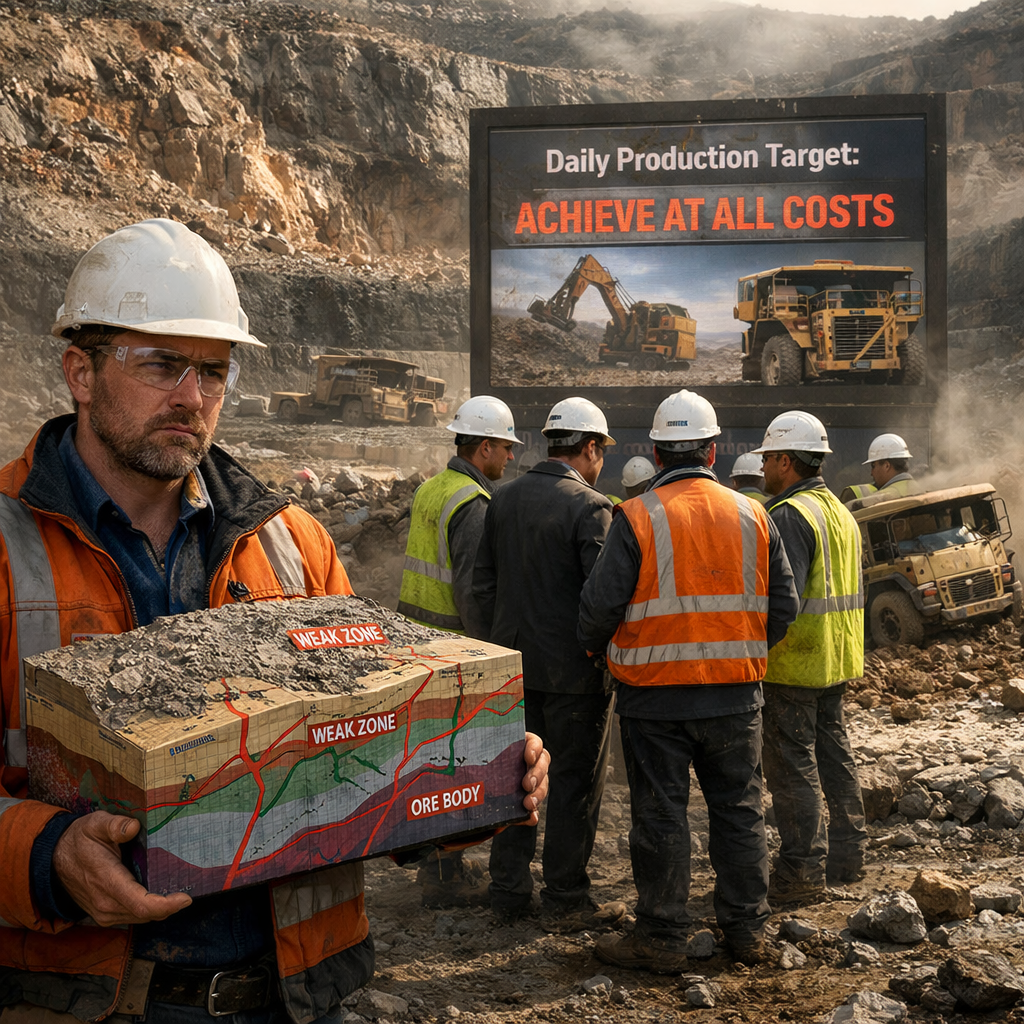
The mining industry remains a cornerstone of global economic development, yet it is characterized by a high rate of project failure. While economic volatility and logistical hurdles are often blamed, recent scientific literature suggests that the marginalization of geological expertise is a primary driver of these failures. From inadequate feasibility studies to catastrophic slope failures, the disconnect between management decisions and geological realities often leads to insurmountable technical and financial risks.
The myth of predictability in mining
One of the most significant reasons for mine failure is the overestimation of technical certainty during the early stages of project development. Research indicates that only a tiny fraction of large-scale mining projects are considered fully successful when evaluated against their initial scope and budget (Duan et al., 2024). A major contributor to this is the neglect of geological and geotechnical complexities during the Front-End Engineering Design (FEED) stage. When geologists are ignored, projects frequently suffer from impractical schedules and inaccurate cost estimations that do not account for the inherent variability of the earth (Duan et al., 2024).
Geological hazards and operational disruptions
Ignoring the geological environment leads to direct physical failures that can halt production or lead to permanent closure. For instance, in deep mining operations, the failure to integrate geological forecasting into safety protocols can result in “sudden, complex, and nonlinear” disasters, such as rock bursts and gas outbursts (Wang et al., 2022). These events are not merely “accidents” but are often the predictable result of high ground stress and engineering disturbances that geologists are trained to identify.
Furthermore, slope stability in open-pit mines is a critical area where geological warnings are frequently secondary to production targets. A back-analysis of failures in iron mines demonstrates that landslides often occur because of a failure to adhere to geological exploitation norms, particularly regarding sensitive marl layers and shear strain (Mishra et al., 2023). When management prioritizes short-term extraction over the geotechnical models provided by geologists, the resulting instability leads to property damage and significant financial loss (Mishra et al., 2023).
The financial cost of inadequate modeling
The financial ramifications of ignoring geologists are staggering. Globally, mining projects experience average cost overruns of 25% to 60%, largely because the geological aspects of the ore body were poorly understood or modeled (Duan et al., 2024). In many cases, “desk studies” that determine the location of old shafts or the extent of unstable ground are treated as administrative hurdles rather than essential risk-reduction tools. However, incorporating comprehensive geological investigations early in the project life cycle has been shown to substantially reduce both technical and financial liabilities (Spyridis, 2021).
Sustainability and unscheduled closures
The impact of ignoring geologists extends beyond the active life of a mine. Many mines fail to reach their planned operational lifespan, closing prematurely due to unforeseen environmental or social impacts that stem from poor geological planning (Mpanza et al., 2021). Sudden closures often leave behind environmental legacies, such as soil and water contamination, which could have been mitigated through integrated closure plans that rely heavily on geological and hydrogeological data (Mpanza et al., 2021).
Conclusion
The evidence from 2020–2026 scientific research underscores that the “human factor”—specifically the managerial decision to override or ignore geological data—is a leading cause of mine failure. To improve the success rate of mining ventures, the industry must shift from a production-first mentality to a geology-integrated approach. Only by placing the geologist at the center of the decision-making process can the mining industry manage the complex, nonlinear risks inherent in extracting the earth’s resources.
References
Duan, W., Tan, P. J., & Paik, J. K. (2024). Enhancing safety and resilience of ageing land-based LNG Tank structures through digital healthcare engineering: A feasibility assessment in seismic environments. Ships and Offshore Structures, 1–17. https://doi.org/10.1080/17445302.2024.2428229
Mishra, P. C., Panigrahi, R. R., & Shrivastava, A. K. (2023). Geo-environmental factors’ influence on mining operation: An indirect effect of managerial factors. Environment, Development and Sustainability, 26, 14639–14663. https://doi.org/10.1007/s10668-023-03211-2
Mpanza, M., Adam, E., & Moolla, R. (2021). A critical review of the impact of South Africa’s mine closure policy and the winding-up process of mining companies. The Journal for Transdisciplinary Research in Southern Africa, 17(1). https://doi.org/10.4102/td.v17i1.985
Spyridis, P. (2021). Revised comparison of tunnel collapse frequencies and tunnel failure probabilities. ASCE-ASME Journal of Risk and Uncertainty in Engineering Systems, Part A: Civil Engineering, 7(1). https://doi.org/10.1061/ajrua6.0001107
Wang, S., Liu, H., Li, L., & Zhang, C. (2022). Editorial: Geological disasters and its prevention in deep mining. Frontiers in Earth Science, 10. https://doi.org/10.3389/feart.2022.1071841