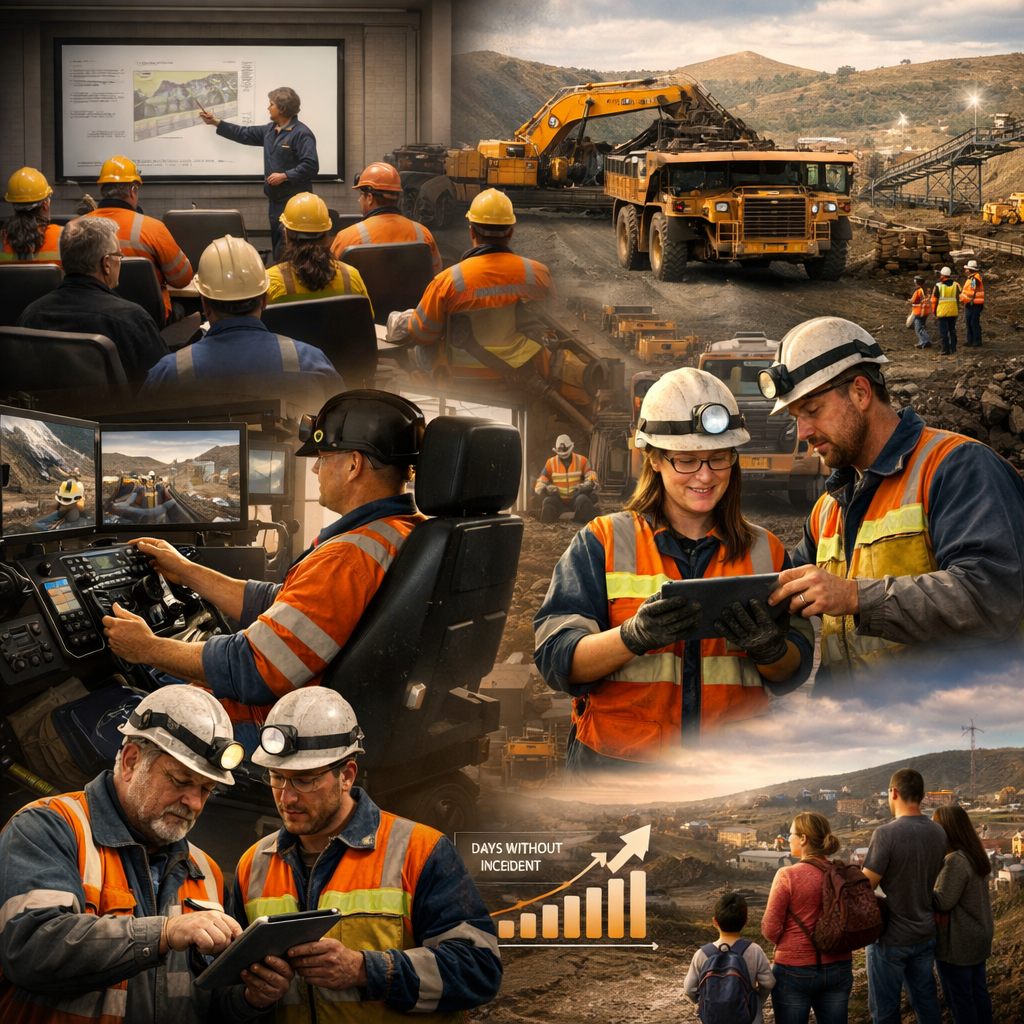
The global mining sector is currently undergoing a dual transformation: the transition toward “Green Mining” to meet climate targets and the rapid adoption of Industry 4.0 technologies, such as autonomous haulage and geospatial monitoring. This evolution necessitates a shift from manual-heavy labor to a high-skill workforce. Research increasingly demonstrates that upskilling miners—defined as the process of teaching workers new, advanced skills—is not merely a corporate necessity but a strategic investment that generates significant dividends for employees, mining firms, and local communities alike.
Enhancing operational resilience and economic value
From a corporate perspective, upskilling is a cornerstone of the Resource-Based View (RBV) of the firm, which posits that a skilled and adaptable workforce is a “rare and inimitable” resource that provides a sustained competitive advantage (MDPI, 2025). As mining operations move into deeper or more remote deposits, the complexity of extraction increases. Workers trained in digital literacy and automated systems are essential for managing these environments efficiently.
Upskilling directly influences the bottom line by reducing operational costs. For instance, the implementation of autonomous technologies, which requires supervisors to transition from traditional manual oversight to digital system management, has been shown to reduce operating costs by approximately 13% while outperforming manual fleets by 14% in productivity (Kolapo et al., 2025). Furthermore, continuous learning fosters “dynamic capabilities,” allowing mining companies to pivot their business models quickly in response to market volatility or technological disruptions (MDPI, 2025).
Safety and health: the human dividend
The most immediate “payoff” of upskilling is the drastic improvement in occupational health and safety. Traditional mining is inherently hazardous, involving exposure to toxic gases, extreme temperatures, and structural risks. By training miners to operate and supervise smart, autonomous technologies, companies can move human operators away from high-risk “active zones” to safe, remote control centers (Kolapo et al., 2025).
Modernizing training through immersive, digital platforms also addresses deep-seated cultural barriers. Research indicates that upskilling programs focusing on “supervisory leadership” help transition the industry from an autocratic, “militaristic” safety culture to one where workers are empowered to voice concerns and use data-driven insights to mitigate risks (De Klerk & Swart, 2023; SAIMM, 2025). This human-centric approach to modernization ensures that technological gains do not come at the expense of worker well-being.
Social sustainability and community longevity
Beyond the mine site, upskilling serves as a vital tool for Corporate Social Responsibility (CSR) and regional economic stability. Historically, mine closures or mechanization have led to devastating “economic worries” and unemployment in local regions (Baron & Bartl, 2024). However, when companies prioritize the reskilling of the local workforce, they mitigate these risks.
- Technology transfer: upskilling introduces advanced technical skills (e.g., geospatial analysis, electronic maintenance) into the local labor pool, which are transferable to other sectors like construction or telecommunications (Wilson, 2022).
- Economic multipliers: skilled workers typically command higher wages, which increases disposable income within the community, supporting local businesses and infrastructure (Gumede, 2018).
- Future-proofing livelihoods: in the context of the “green economy,” upskilling prepares workers for mid-to-high-skill occupations that will remain in demand even as the industry shifts away from high-carbon methods (Jackson, 2020).
Conclusion
Upskilling is the bridge between the mining industry’s past and its sustainable future. By investing in the intellectual capital of their workforce, mining companies achieve higher productivity, safer environments, and stronger “social licenses” to operate. For the workers, it offers a path to safer, more stable, and higher-paying careers. Ultimately, a more skilled mining workforce creates a more resilient global economy.
References
Baron, D., & Bartl, W. (2024). The coal phase-out in Germany and its regional impact on economic worries. Social Sciences, 13(7), 339. https://doi.org/10.3390/socsci13070339
De Klerk, J., & Swart, B. (2023). Paradoxes and dilemmas of responsible leadership in the mining industries of emerging economies – it is complex. Emerald Open Research, 1. https://doi.org/10.1108/eor-11-2023-0001
Kolapo, P., Ogunsola, N. O., Komolafe, K., & Omole, D. D. (2025). Envisioning human–machine relationship towards mining of the future: An overview. Mining, 5(1), 5. https://doi.org/10.3390/mining5010005
MDPI. (2025). How environmental turbulence shapes the path from resilience to sustainability: Useful insights gathered from small and medium enterprises (SMEs). Sustainability, 17(15). https://www.mdpi.com/2071-1050/17/15/6938
SAIMM. (2025). Towards mine modernisation: Digitisation of foundational supervisory leadership development training. The Journal of the Southern African Institute of Mining and Metallurgy, 125(6), 339-340.
Wilson, S. A. (2022). Measuring the effectiveness of corporate social responsibility initiatives in diamond mining areas of Sierra Leone. Resources Policy, 77, 102651. https://doi.org/10.1016/j.resourpol.2022.102651