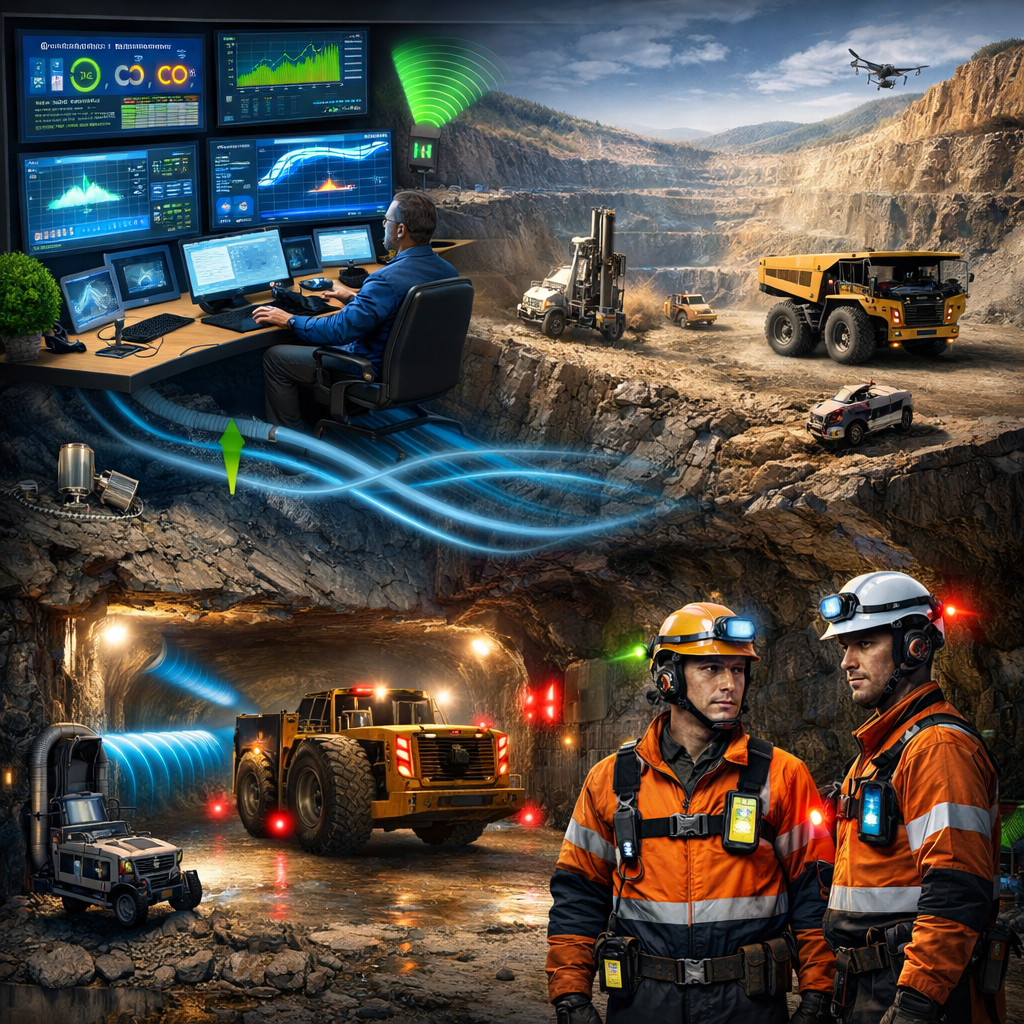
Mining has historically been one of the world’s most hazardous professions, defined by the constant struggle against geological instability and environmental hazards. However, the industry is currently undergoing a “Digital Revolution” that is fundamentally shifting the safety paradigm. Modern mines are no longer just excavations; they are sophisticated, data-driven environments where technology acts as a proactive shield for workers.
Autonomous and remote-controlled machinery
Perhaps the most significant leap in safety is the removal of personnel from high-risk zones. Autonomous Haulage Systems (AHS) and remote-controlled loaders allow operators to manage heavy machinery from the safety of a surface-level control room. By automating the movement of massive trucks, companies eliminate the risk of operator fatigue and collisions in narrow tunnels [1]. In underground mining, tele-remote drilling allows for the extraction of minerals in areas with unstable ground conditions without putting a human life at risk.
Real-time proximity detection and collision avoidance
Surface and underground mines are crowded with heavy equipment and pedestrians. Modern Proximity Detection Systems (PDS) use a combination of GPS, radar, and LiDAR to create a “safety bubble” around vehicles [2]. These systems go beyond simple alerts. If a person or another vehicle enters a machine’s “danger zone” and the operator doesn’t react, the collision avoidance system can automatically intervene to slow or stop the vehicle [3]. The V2X Communication (Vehicle-to-Everything) technology allows machines to talk to each other, predicting potential intersection accidents before they occur [4].
Wearable tech and biometric monitoring
Safety has moved from the toolbox to the worker’s clothing. Modern miners often wear “smart” PPE (Personal Protective Equipment) equipped with various sensors [5]. Smart caps or glasses can track eye movements and brainwave patterns to detect signs of micro-sleep or exhaustion in operators [6]. Wearables can now monitor heart rates, body temperature, and exposure to toxic gases like Carbon Monoxide (CO) or Nitrogen Dioxide (NO2) in real-time, sending an immediate alert to a central dispatcher if thresholds are exceeded.
Digital twins and predictive ground control
Geological instability, specifically “rock bursts” or roof collapses, remains a top concern. Engineers now use Digital Twin technology to create a 3D virtual replica of the mine. Sensors embedded in the rock detect tiny vibrations that precede a collapse. This data is fed into AI models that predict which areas of the mine are becoming unstable. Modern roof bolts can be equipped with strain gauges to provide real-time data on the pressure the supports are under, allowing for evacuation long before a physical failure occurs.
Smart ventilation and atmospheric control
Underground air quality is life or death. Ventilation on Demand (VoD) systems use sensors to detect where people and machines are located, directing fresh air only where it’s needed. This doesn’t just save energy; it ensures that if a fire breaks out, the system can automatically reroute air to prevent the spread of smoke into designated “safe havens” or escape routes.
The integration of these technologies has led to a marked decrease in “Lost Time Injuries” (LTI) across the global mining sector. As 5G networks become standard in underground operations, the latency of these safety systems will drop even further, making the concept of a “Zero Harm” workplace a reachable goal rather than a corporate slogan.
References
[1] “Minding the mine: Autonomous mobile equipment improves safety.” Accessed: Jan. 27, 2026. [Online]. Available: https://action.deloitte.com/insight/4057/minding-the-mine-autonomous-mobile-equipment-improves-safety
[2] “4 Proximity and Intrusion Sensor Solutions for Work Zone Safety – Neuroject.” Accessed: Jan. 27, 2026. [Online]. Available: https://neuroject.com/proximity-and-intrusion-sensor/
[3] “Underground mining equipment proximity detection systems continuous mining machines,” OEM Off-Highway. Accessed: Jan. 27, 2026. [Online]. Available: https://www.oemoffhighway.com/electronics/sensors/proximity-detection-safety-systems/article/10166326/underground-mining-equipment-proximity-detection-systems-continuous-mining-machines
[4] “V2X | Cellular Vehicle-to-Everything | Qualcomm.” Accessed: Jan. 27, 2026. [Online]. Available: https://www.qualcomm.com/automotive/solutions/v2x
[5] P. Bęś, P. Strzałkowski, J. Górniak-Zimroz, M. Szóstak, and M. Janiszewski, “Innovative Technologies to Improve Occupational Safety in Mining and Construction Industries—Part II,” Sensors (Basel), vol. 25, no. 18, p. 5717, Sep. 2025, doi: 10.3390/s25185717.
[6] “SmartCap.” Accessed: Jan. 27, 2026. [Online]. Available: https://www.hitachicm.com/ae/en/solutions/smartcap/