The treatment of processing plant wastes is an important issue that should be addressed by engineering in the operation life-cycle of modern mines. Traditional slurry tailings dams had been the standard in the global mining industry for many decades because of their easy-to-use upstream processing and simple dam construction techniques. Unfortunately, increasing numbers of catastrophic failures have led to a paradigm shift towards modern dewatering technologies (Burden & Wilson, 2023).
The comparison of traditional tailings dams with high-density pastes from the engineering perspective requires a thorough examination. This review considers factors that include geotechnical stability, rheological complexities, environmental risks, and economics of the life cycle of these structures. Analyzing the process of physical change from a suspension to non-segregating paste, this paper discusses the engineering aspects of designing paste TSF in comparison with its counterpart slurry one.
It is important to set clear definitions of the terminologies related to mine waste management before proceeding with this comparative engineering study. Slurry tailings refer to unthickened mineral slurries consisting of 25 to 45 percent by weight of solids and act as Newtonian fluid in the movement. On the contrary, paste tailings refer to highly dewatered material with solid concentration levels going above 70 percent forming non-segregated paste material showing non-Newtonian flow characteristics (Burden & Wilson, 2023).
Tailings Storage Facility (TSF) refers to the engineered structures (embankment and deposition zones and decant systems) built for impounding the tailings. Rheology, more precisely yield stress, determines the process of densified waste movement which involves the minimum shear stress necessary for flow initiation beyond cohesive force resistance. Lastly, dewatering entails mechanically removing the process water within the mineral matrix resulting in transformation from liquid into paste state.
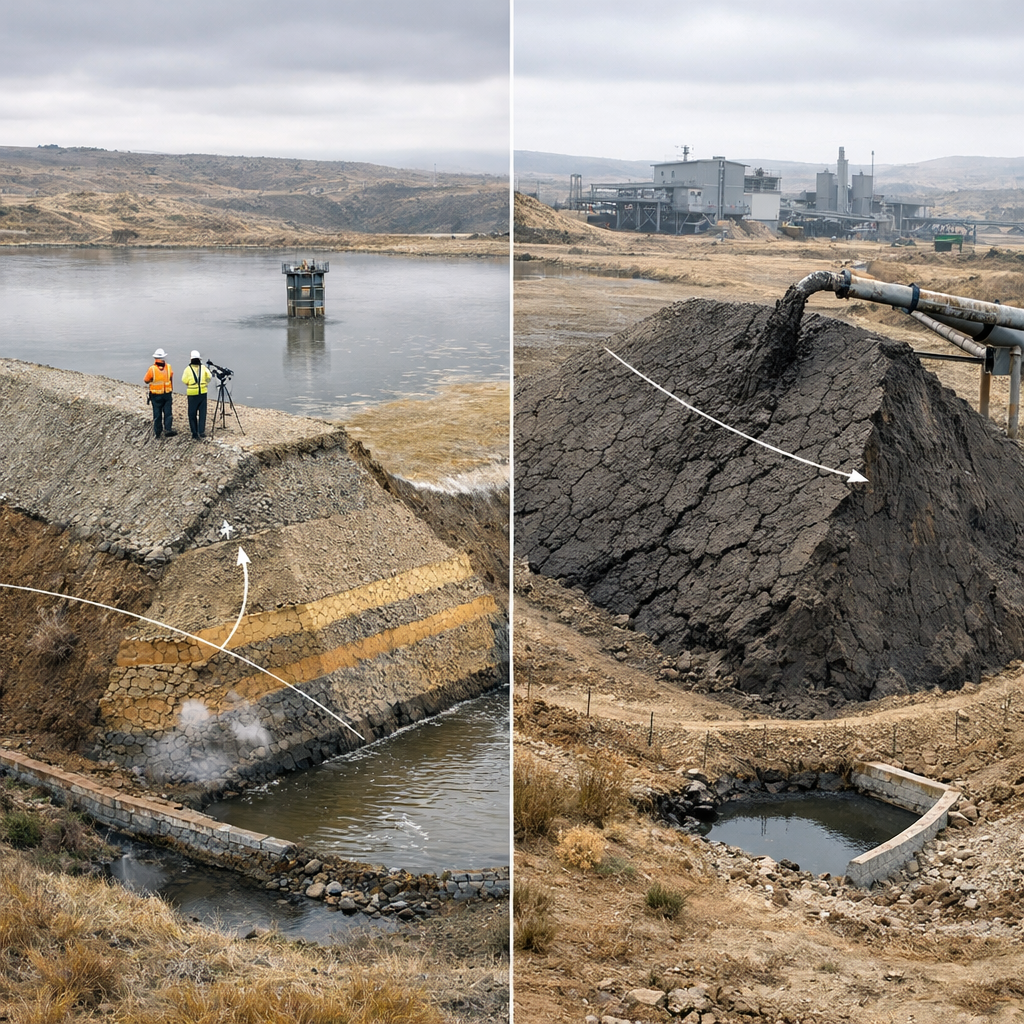
The transformation of physical state from dilute slurry to densified paste determines the geotechnical characteristics used for designing the facility. Slurry tailings are added to the tailing pond with zero yield stress and depend on the stability of peripheral embankments for confinement due to the long period of sedimentation that takes decades.
On the other hand, paste tailings exhibit rheological properties of Bingham plastic fluids, which have high yield stress and plastic viscosity and thus make it possible to deposit the material at mild slopes right away after discharge (Lee et al., 2017). The rheological properties are strongly dependent on the particle size distribution of the material, whereby larger amounts of fine particles lead to an exponential growth of yield stress due to enhanced micro-interlocking of the particles (Li et al., 2020). The alteration of particle size distribution directly affects the flow characteristics and the shear strength of the deposited material (Zhang et al., 2023). Thus, paste tailings compact quickly and reach near-maximum dry density very soon after deposition.
The physical properties of the different materials lead to different geometric designs of the infrastructure. Slurry dam construction involves creating huge embankments that can withstand hydrostatic forces from several million cubic meters of solid and free water. Paste tailings have enough yield strength to build a gently sloping self-supporting pile, and hence, the size of containment embankments that need to be created is extremely reduced.
Discharge methods used are dependent on the physical properties of each material; slurry discharge is through spigots located at the top of the embankments to create a beach while paste discharge takes place centrally using towers to create a radial pile. As such, a paste tailings storage facility occupies less geographical space than slurry storage facility to store an equal amount of tailings. Moreover, the water management infrastructure is significantly reduced; there is no need for the construction of decant towers and huge spillways to handle storm surges in slurry tailings facilities due to no existence of free-water pond (Burden & Wilson, 2023).
Risk mitigation is the key technical driver behind the transition from slurry to paste TSF designs. The slurry tailings impoundment will always sustain relatively high pore-water pressures inside the tailings mass, making the tailings vulnerable to flow liquefaction, internal piping, and overtopping caused by earthquake activity (Li et al., 2016).
Once the slurry dam breaks, the tailings material flows down as high-speed flow that may inundate the terrain below the dam. The paste tailings design, on the other hand, eliminates such risk by inherent nature; removal of the supernatant pond and creation of an unsaturated state of tailings reduce the risk of flow liquefaction dramatically (Li et al., 2016).
Apart from increased stability, the advanced upstream dewatering allows recovery and reuse of the process water back in the metallurgical facility right away; such a step is crucial in dry climates. Finally, paste tailings allow gradual capping and simultaneous restoration while the mine is still operating; slurry dams remain untrafficable for decades after closing.
The shift to paste technology brings about economic and operational considerations that make up the basis of the feasibility of the project. Traditionally, the low capital outlay associated with slurries together with the low unit operation costs, which utilize ordinary centrifugal pumps for conveying the relatively low viscosity fluid, makes the system more favorable. In contrast, the capital cost in setting up a paste process is high and involves the installation of special equipment for handling the material, such as deep-cone thickeners, positive displacement pumps, and pressure piping designed to tolerate high friction losses (Burden & Wilson, 2023).
Consequently, the operating cost for the process is relatively high due to the energy costs required to move the high yield stress material. On the other hand, the total cost of ownership should balance the upstream dewatering costs with the capital cost saved downstream. Paste TSFs require minimal earthwork for constructing dams, minimize land acquisition cost because of the smaller surface area and reduced financial assurance bonds necessary for mine closure.
The decision of whether to use a traditional slurry dam or a paste tailings system involves a clear difference of opinion regarding the handling of mine wastes based on trade-offs between operational convenience and long-term stability. The traditional slurry impoundments have been historically cheap to construct; however, the inherent risks of such an impoundment have been high because of their dependence on structures that are vulnerable to breaches.
The application of paste technology helps overcome such challenges by removing the water from the slurry using mechanical means and creating a material that is guaranteed stability, is minimally disruptive geographically, and inhibits flow liquefaction. In light of the increasingly strict environmental laws being enacted around the world, it can be argued that the trend within geotechnical engineering will continue in favor of densification. Future TSF design should consider plant costs in relation to rheology, water recovery, and risk of closure liabilities.
References
Burden, R., & Wilson, G. W. (2023). Commingling of waste rock and tailings to improve “dry stack” performance: Design and evaluation of mixtures. Minerals, 13, 295. https://doi.org/10.3390/min13020295
Lee, J. K., Ko, J., & Kim, Y. S. (2017). Rheology of fly ash mixed tailings slurries and applicability of prediction models. Minerals, 7, 165. https://doi.org/10.3390/min7090165
Li, J., Yilmaz, E., & Cao, S. (2020). Influence of solid content, cement/tailings ratio, and curing time on rheology and strength of cemented tailings backfill. Minerals, 10, 922. https://doi.org/10.3390/min10100922
Li, S., Chen, Q., & Wang, X. (2016). Superiority of filtered tailings storage facility to conventional tailings impoundment in southern rainy regions of China. Sustainability, 8, 1130. https://doi.org/10.3390/su8111130
Zhang, X., Wang, H., & Wu, A. (2023). Study on correlations between tailings particle size distribution and rheological properties of filling slurries. Minerals, 13, 1134. https://doi.org/10.3390/min13091134