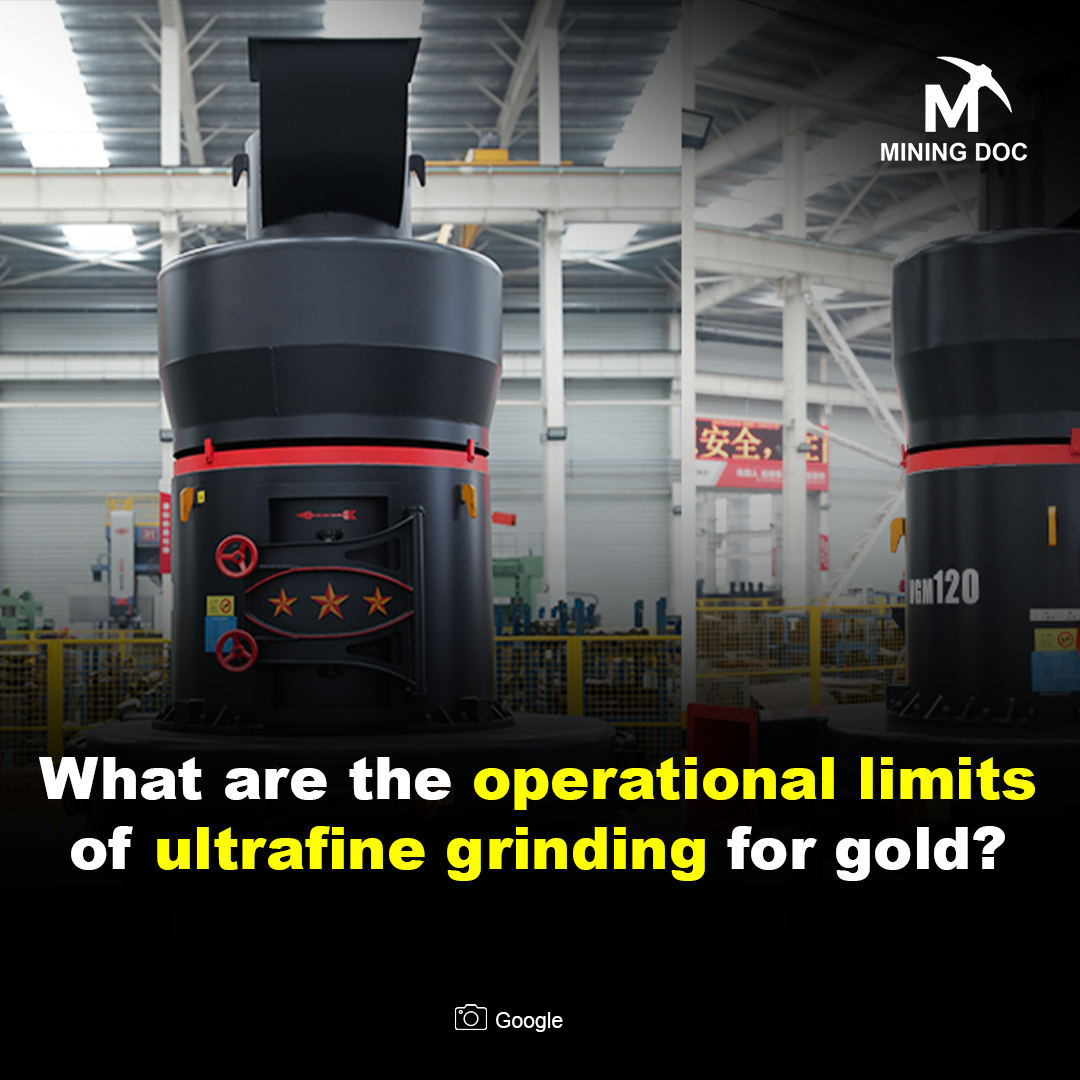
As easy, oxidized, near-surface gold deposits deplete, more of the world’s remaining reserves are refractory: gold locked inside sulfide matrices like pyrite and arsenopyrite, invisible to conventional cyanidation. To free it, some ore bodies now require grinding down to 10–15 microns — roughly a tenth the width of a human hair. That’s the promise of Ultrafine Grinding (UFG).
Here are the real operational limits engineers run into once they push particle size that low:
1️⃣ Energy Consumption Thresholds
Grinding energy doesn’t scale linearly — it rises exponentially as target size drops below ~10 microns. Each additional micron of fineness costs disproportionately more power, meaning the last few microns of grind are often the most expensive by far (De Bakker, 2014).
2️⃣ Slurry Rheology & Viscosity
Finer particles mean dramatically more surface area per tonne. Past a certain point, pulp behaves less like a fluid and more like a paste — yield stress rises, pumping and mixing get harder, and slime coating can blanket coarser particles, choking downstream flotation and leach kinetics.
3️⃣ Media Wear & Separation
Ultrafine target sizes demand ultrafine grinding media (often <2mm ceramic or steel beads). That creates two headaches: media retention screens prone to blinding/plugging, and steady media consumption costs that scale up fast at this scale of attrition.
4️⃣ Downstream Process Conflicts
Push particles too fine and you invite over-grinding side effects — elevated cyanide consumption from newly exposed reactive surfaces, oxygen mass-transfer limitations during leaching, and tougher solid–liquid separation and filtration on the back end.
UFG isn’t a limitless liberation tool — it’s a balance of energy cost, rheology, wear economics, and downstream chemistry. The mines succeeding with it aren’t just grinding finer; they’re engineering the whole circuit around the physics of very small particles.
Where have you seen UFG economics break down first on real projects — energy cost, media wear, or downstream reagent consumption?
References
De Bakker, J. (2014). Energy use of fine grinding in mineral processing. Metallurgical and Materials Transactions E, 1(1), 8–19. https://doi.org/10.1007/s40553-013-0001-6
Pease, J. D., Young, M. F., & Curry, D. C. (2005). Fine grinding as enabling technology – The IsaMill. In Crushing and Grinding Conference, Perth, Australia.
Wills, B. A., & Finch, J. A. (2016). Wills’ mineral processing technology: An introduction to the practical aspects of ore treatment and mineral recovery (8th ed.). Butterworth-Heinemann.