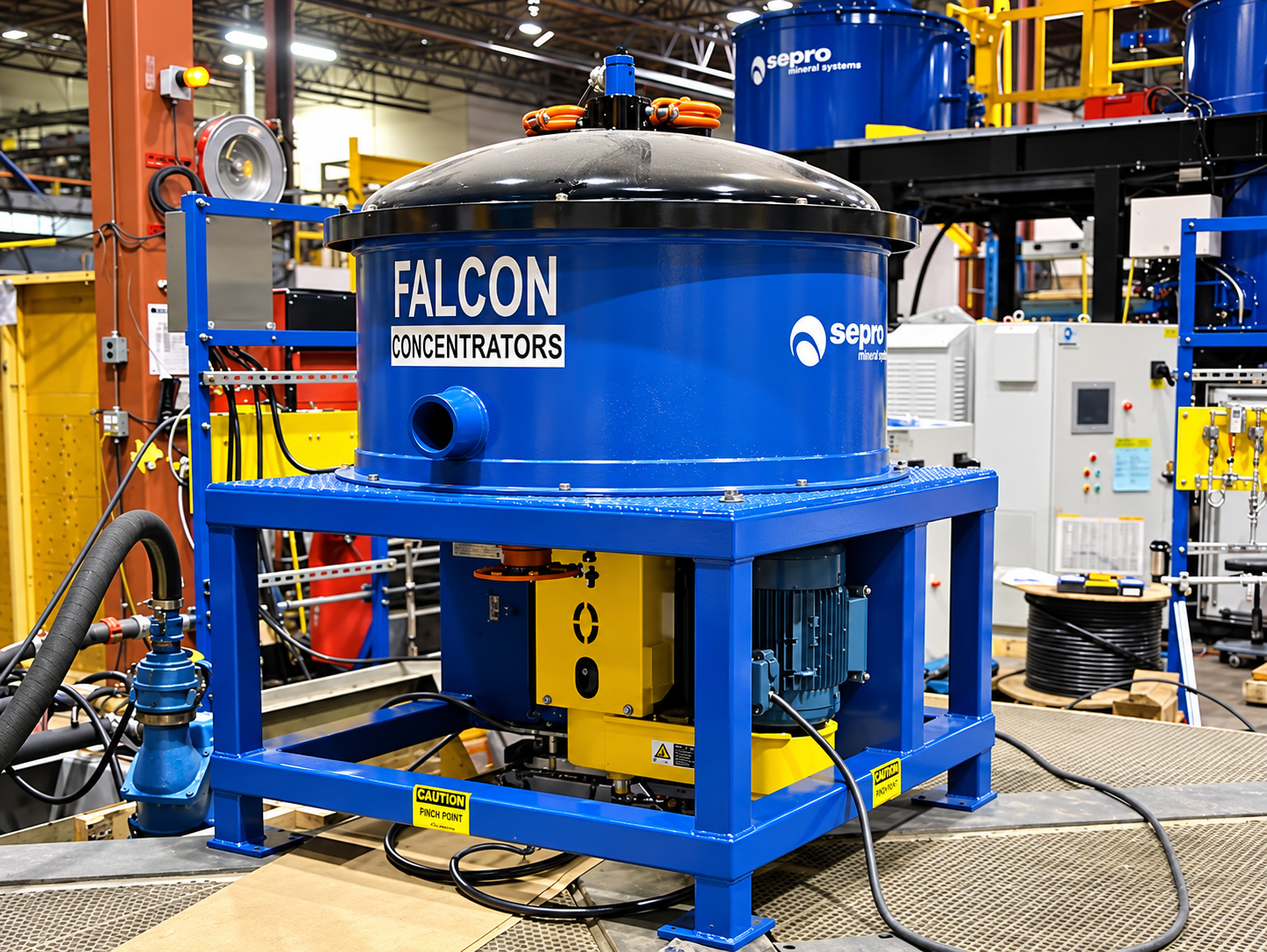
Centrifugal gravity separators, including Knelson and Falcon concentrators, take advantage of stronger gravitational field (60G – 200G) to collect heavy mineral target elements (such as gold). Even though their lives significantly differ at various mining operations (from 3 months to 36 months), premature bowls breakage is caused not by material-related factors, but rather by mechanical ones. Control of feed particles parameters, quality of water for fluidization, and proper zoned components maintenance is crucial for extending the life of bowls.
The presence of oversized particles (>6 mm) in the slurry or tramp iron will put undue wear cones, polyurethane rings, and ceramics into high-velocity impact and heavy gouging. Also, high pulp density in the feed will cause intense particle-to-particle interaction and local scouring, which will remove any boundary layer on the bowl walls. In order to increase wear life, the system must be run with hard pre-screening, where the maximum particle size is 6 mm (1.7 mm in grinding circuit), and the slurry pulp density is between 30% and 60%.
Unfiltered fluidization water or scaling fluidization water presents major operational risks through plugging of fluidization ports and precipitation of minerals (for example, calcium or gypsum) on the water cavity surface. Plugged holes prevent even distribution of water, resulting in packing of concentrate beds and creation of extremely high friction zones and operational pressures greater than 207 kPa (30 psi), as well as rotor imbalance. Prevention entails pretreatment of the water for maintaining solids content below 20 ppm (<5 µm), monitoring of 50-mesh filter differential pressure from 28 to 56 kPa (4 to 8 psi), and cleaning of plugged holes only using specialized hole-cleaning tools.
The primary wear of concentrator bowl liners occurs mainly at the point where there is high-speed slurry impact, hence making it financially unfeasible to replace a whole bowl liner since there will be some regions that are still usable. The use of modular parts which have high impact capacity, for example, molded rubber Lower Strike Point (LSP) inserts ring, helps in dissipating impact energy and doubling the life of bowl liner without having to remove the entire liner. Furthermore, the practice of inspection on a weekly or monthly schedule through cone-wear indicators ensures that replacement of liners is done before structural polyurethane failure.
Premature wearing of Knelson and Falcon concentrate bowls represents a controllable operation problem rather than an inevitable cost that operators have to incur. With the implementation of strict pre-screening of the feed with top size below 6 mm, stringent control of water quality for fluidization (solids below 20 ppm), as well as zonal protection techniques including rubber LSP inserts, the mineral processing plants will be able to control premature wearing and balance problems.